
Oracle Database Migration and Modernization for Enterprise CIOs
Enterprise CIOs are under increasing pressure to modernize large Oracle database estates without disrupting critical business operations. Many Oracle environments support core systems across banking, insurance, healthcare, manufacturing, retail, logistics, and enterprise resource planning. These systems are deeply connected to applications, batch jobs, reporting workflows, integration layers, and compliance processes.
The challenge is significant. Enterprises need to reduce dependency on legacy Oracle platforms, control licensing and infrastructure costs, and move toward more flexible cloud-native databases. At the same time, they must avoid downtime, data integrity issues, application failures, compliance gaps, and failed production cutovers.
For CIOs, Oracle database migration and modernization is no longer only a technology initiative. It is a strategic transformation program that affects cost structure, operational resilience, business agility, and long-term innovation.
Modern migration approaches, supported by intelligent automation platforms such as Newt Global’s DMAP, are changing what enterprises can achieve. Organizations can now assess complex Oracle estates, automate schema and code conversion, validate data quality, and coordinate large-scale migrations faster and with greater confidence.
For companies migrating databases of 17 TB or more, this shift from manual migration to automation-led modernization can significantly reduce risk and improve predictability.
Why Oracle Database Modernization Is a Strategic Priority for Enterprise CIOs
Oracle databases have powered enterprise workloads for decades. They are mature, reliable, and deeply embedded in business operations. However, many organizations now face a growing mismatch between legacy database architecture and modern business needs.
CIOs are expected to deliver faster innovation, better cost efficiency, greater scalability, stronger governance, and improved resilience. Legacy Oracle estates can make these goals harder to achieve when they are expensive to operate, difficult to scale, and dependent on specialized skills.
Oracle database modernization helps enterprises move toward a more flexible data foundation. It enables organizations to adopt cloud-native platforms, open-source database technologies, managed database services, and automated operations.
For executive technology leaders, modernization creates opportunities to reduce long-term database operating costs, improve application agility, strengthen disaster recovery, reduce dependency on legacy infrastructure, improve cloud readiness, support analytics and AI initiatives, and simplify governance across database estates.
The business value is clear. However, execution must be disciplined. A poorly planned Oracle migration can create production risk, business disruption, and budget overruns. This is why enterprise CIOs need a structured modernization approach supported by automation, governance, and expert execution.
The Business Case for Oracle Migration: Reducing Licensing Costs and Legacy Database Risk
One of the strongest drivers for Oracle migration is cost optimization. Oracle licensing and support costs can represent a substantial portion of enterprise IT budgets. As databases grow, workloads expand, and infrastructure ages, the total cost of ownership often increases.
These costs typically include database licensing, annual support, hardware, storage, backup infrastructure, disaster recovery, DBA resources, compliance, and application maintenance tied to legacy database logic.
In many large enterprises, Oracle estates have grown over many years through acquisitions, application expansion, departmental deployments, and one-off projects. As a result, CIOs often inherit environments that include redundant, underutilized, or poorly documented databases.
A well-planned Oracle database modernization program helps CIOs identify which workloads should be retired, consolidated, rehosted, replatformed, or fully modernized. This segmentation is essential. Not every Oracle database requires the same migration path.
Some databases may move to a managed Oracle service. Others may be converted to PostgreSQL-compatible platforms. Some may be retired entirely. High-value systems may require deeper application modernization.
The goal is not migration for its own sake. The goal is to create a more efficient, scalable, and future-ready enterprise data architecture.
Why Large Oracle Database Migrations Fail Without Automation
A single Oracle database migration can be complex. A large enterprise migration involving dozens or hundreds of databases can quickly become difficult to manage without automation. The complexity increases further when databases are 17 TB or larger, support mission-critical workloads, or include extensive PL/SQL logic.
Large Oracle database migrations often fail or slow down because of incomplete discovery, underestimated PL/SQL conversion effort, hidden application dependencies, complex batch jobs, embedded SQL, manual schema conversion errors, limited testing, poor rollback planning, and fragmented governance.
Traditional migration approaches often rely on point tools, spreadsheets, manual scripts, and disconnected testing processes. These methods may work for small migrations, but they do not scale well across enterprise database estates.
Enterprises need more than a schema conversion tool or a data movement utility. They need a migration operating model that connects assessment, conversion, remediation, migration, validation, testing, governance, and cutover readiness.
This is where database migration automation becomes critical. Automation helps teams identify complexity earlier, standardize repeatable tasks, reduce manual errors, accelerate conversion, and improve validation. More importantly, it gives CIOs better visibility into migration readiness before production cutover.
Oracle to PostgreSQL Migration: A Leading Path for Enterprise Database Modernization
For many enterprises, Oracle to PostgreSQL migration has become a preferred modernization path. PostgreSQL offers strong relational database capabilities, broad ecosystem support, open-source flexibility, and compatibility with several managed cloud database services.
Moving from Oracle to PostgreSQL can help organizations reduce licensing exposure, modernize application architecture, and adopt cloud-native database operations.
However, Oracle to PostgreSQL migration is not a simple export-and-import exercise. It requires careful planning because Oracle and PostgreSQL differ in schema design, data types, stored procedures, package structures, trigger behavior, sequences, indexing, query optimization, and transaction handling.
The most difficult part is often not data movement. It is the conversion of database logic and application dependencies. Many Oracle environments contain years of embedded business logic inside packages, procedures, functions, and triggers. This logic must be analyzed, converted, tested, and validated.
Automation platforms such as Newt Global’s DMAP help by supporting assessment, conversion intelligence, code analysis, and validation workflows. This allows migration teams to identify high-effort objects, prioritize remediation, and reduce repetitive manual work.
For CIOs, PostgreSQL migration offers significant long-term value. But it must be supported by the right assessment, automation, and governance framework.
Oracle to AWS Migration: Modernizing Oracle Workloads with Amazon RDS and Aurora
Oracle to AWS migration is one of the most common enterprise database modernization paths. AWS provides multiple options depending on whether the organization wants to rehost Oracle workloads, reduce infrastructure management, or move toward PostgreSQL-compatible databases.
Common AWS options include Amazon RDS for Oracle, Amazon RDS for PostgreSQL, Amazon Aurora PostgreSQL-Compatible Edition, and Amazon Aurora DSQL.
Amazon RDS for Oracle is often used for lift-and-shift scenarios. It allows enterprises to keep Oracle compatibility while moving to managed infrastructure. This can reduce operational overhead, but it may not eliminate Oracle licensing dependency.
Amazon RDS for PostgreSQL and Amazon Aurora PostgreSQL-Compatible Edition support a more complete modernization path. They allow organizations to reduce Oracle dependency, adopt PostgreSQL compatibility, and use managed cloud database operations.
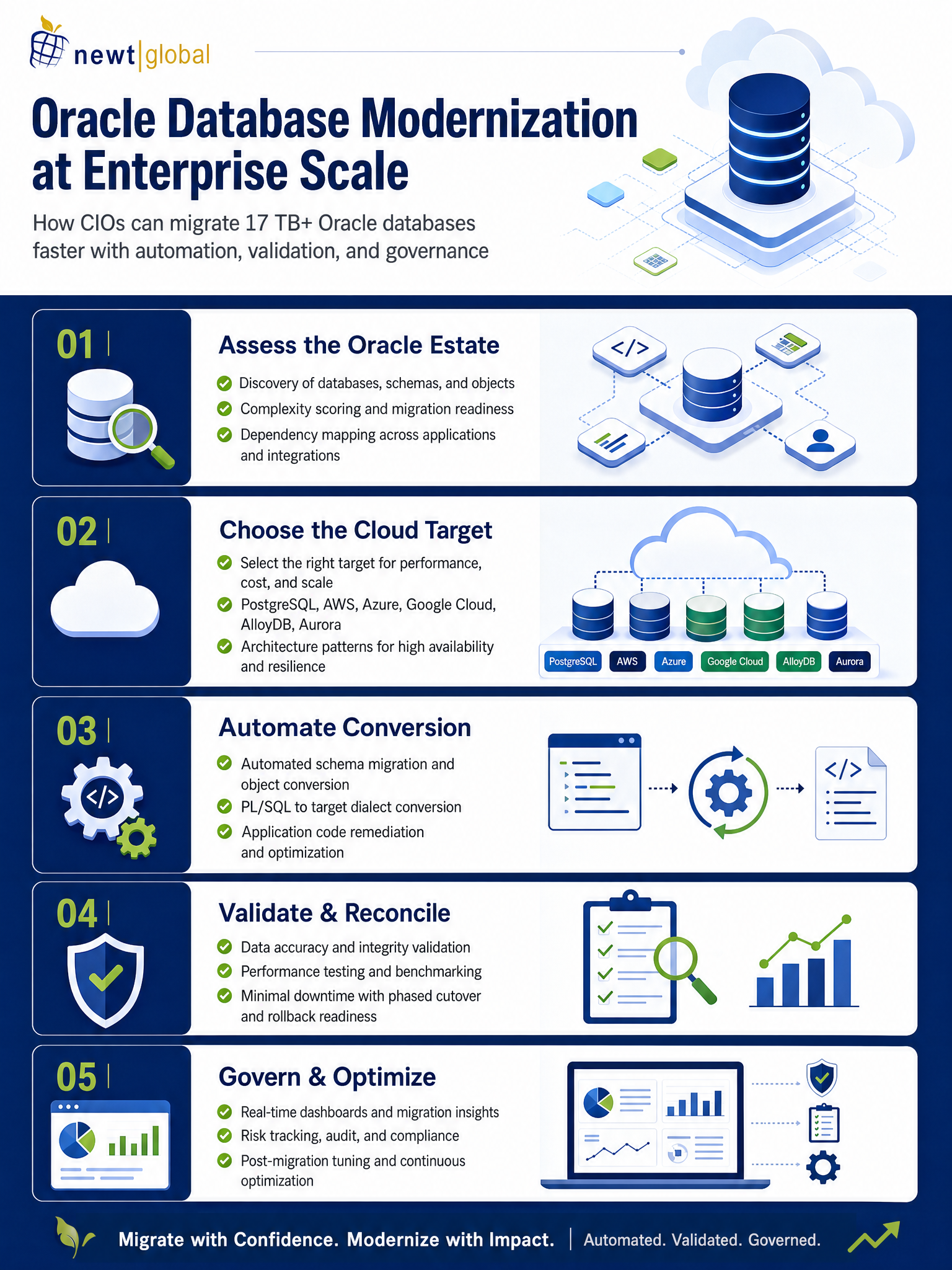
A typical Oracle to AWS migration includes estate discovery, complexity scoring, schema conversion, PL/SQL remediation, data migration planning, replication setup, validation, performance testing, cutover execution, and post-migration optimization.
For CIOs, AWS provides multiple modernization paths. The right choice depends on whether the enterprise wants short-term operational improvement, long-term licensing reduction, or broader application modernization.
Oracle to Azure and Google Cloud Migration Options
For enterprises standardized on Microsoft technologies, Oracle to Azure PostgreSQL migration can be a strong modernization path. Azure offers managed PostgreSQL services and integrates closely with Microsoft’s broader ecosystem for identity, security, DevOps, monitoring, and governance.
Azure is often attractive for enterprises that already use Microsoft Azure infrastructure, Microsoft Entra ID, Azure DevOps, Microsoft security tools, .NET or Java application frameworks, and hybrid cloud management capabilities.
An Oracle to Azure migration usually involves Oracle database assessment, schema conversion planning, PL/SQL remediation, data type mapping, application data access changes, data migration, validation, performance tuning, and compliance review.
Oracle to Google Cloud migration is increasingly relevant for enterprises building data, analytics, and AI strategies on Google Cloud. Within this path, Oracle to AlloyDB migration is an important option for organizations seeking a PostgreSQL-compatible managed database service.
Google Cloud AlloyDB is designed for demanding enterprise workloads and can support transactional applications while connecting to the broader Google Cloud data ecosystem. It may be a strong fit when the enterprise requires PostgreSQL compatibility, strong transactional performance, and closer integration with analytics and AI services such as BigQuery or Vertex AI.
For CIOs, Azure and Google Cloud provide strong modernization options. The right platform depends on enterprise standards, workload requirements, compliance needs, application architecture, and long-term data strategy.
How to Migrate Large Oracle Databases with Minimal Downtime
For mission-critical systems, minimal downtime database migration is a top executive priority. When a database is 17 TB or larger, downtime planning becomes one of the most important parts of the migration strategy.
Large Oracle databases cannot always be moved through simple backup and restore methods within acceptable business windows. Enterprises often need replication-based migration, phased validation, and carefully planned cutover execution.
A minimal downtime migration strategy usually includes source and target assessment, network planning, initial bulk load, continuous replication, change data capture where applicable, parallel validation, application freeze planning, final synchronization, cutover readiness review, and rollback planning.
For CIOs, the most important question is not only, “How fast can we move the data?” It is also, “How confidently can we prove that the target system is ready?”
That confidence comes from validation, reconciliation, testing, and governance.
Database Migration Assessment and PL/SQL Conversion
A successful database migration assessment is the foundation of every Oracle modernization program. Without it, enterprises risk underestimating complexity, missing dependencies, and committing to unrealistic timelines.
An effective assessment should evaluate database size, schema complexity, object counts, stored procedures, functions, packages, triggers, PL/SQL complexity, data type compatibility, application dependencies, reporting dependencies, performance requirements, compliance needs, and cutover constraints.
The assessment should also classify workloads by migration strategy: retire, retain, rehost, replatform, refactor, replace, or modernize.
PL/SQL conversion and Oracle schema conversion are often among the most challenging parts of database modernization. Oracle databases frequently contain extensive business logic inside packages, procedures, functions, triggers, cursors, views, materialized views, sequences, scheduler jobs, and dynamic SQL.
When moving to PostgreSQL-compatible platforms, this logic must be converted, tested, and optimized. Automation improves consistency and speed. It can identify conversion patterns, flag exceptions, and reduce repetitive effort. However, human expertise remains essential for complex business logic, performance-sensitive queries, and architecture decisions.
How Newt Global’s DMAP Accelerates Oracle Database Migration and Modernization
Enterprise CIOs need speed, control, and confidence when modernizing Oracle estates. Newt Global’s DMAP supports this goal by bringing automation, intelligence, and governance into the migration lifecycle.
DMAP helps enterprises manage complex database modernization programs by supporting automated Oracle database assessment, schema conversion analysis, PL/SQL conversion, code dependency visibility, application remediation planning, data validation, migration tracking, governance reporting, and cloud target readiness assessment.
The value of DMAP is not limited to automation alone. It helps teams improve decision-making by providing better visibility into complexity, effort, risk, and readiness.
For enterprise CIOs, this matters because database modernization programs involve database teams, application teams, infrastructure teams, cloud architects, security teams, compliance teams, business owners, and executive sponsors.
DMAP helps create a more coordinated migration process. It enables teams to identify blockers earlier, prioritize remediation, validate outcomes, and report progress clearly.
By using DMAP, organizations can reduce repetitive effort, improve consistency, strengthen governance, and accelerate migration from Oracle to modern platforms such as PostgreSQL-compatible services, AWS, Azure, and Google Cloud.
Conclusion: Faster Oracle Database Modernization with Automation, Governance, and Cloud Strategy
Enterprise Oracle database migration and modernization is complex, especially when databases exceed 17 TB, support mission-critical workloads, and connect to many downstream applications. However, modern automation platforms and cloud-native database services have changed what CIOs can realistically achieve.
The most successful organizations follow a disciplined approach. They assess the Oracle estate in detail, segment workloads by value and complexity, choose the right cloud target, automate assessment and validation, remediate PL/SQL and application dependencies, validate data accuracy, govern the program with executive visibility, and optimize continuously after migration.
Cloud platforms such as AWS, Azure, and Google Cloud offer strong options for Oracle modernization. PostgreSQL-compatible services, Amazon RDS, Amazon Aurora, Azure PostgreSQL, and Google Cloud AlloyDB all provide different paths depending on business and technical goals.
The key is choosing the right path and executing it with precision.
Platforms such as Newt Global’s DMAP help enterprises reduce manual effort, improve migration confidence, and accelerate the transition from legacy Oracle databases to modern cloud database platforms.
For CIOs, Oracle modernization should not be viewed as a high-risk technical burden. With the right strategy, automation, governance, and execution model, it becomes a strategic opportunity to reduce cost, strengthen resilience, and enable faster innovation.