
Optimize GCP Database Performance with AI-Driven Oracle to PostgreSQL Migration
Legacy Oracle databases are reliable—but expensive, inflexible, and increasingly incompatible with the agile economics of modern cloud platforms. In 2026, the question for most enterprises is no longer whether to leave Oracle, but how fast they can execute that exit without disrupting business continuity.
Google Cloud Platform’s Cloud SQL for PostgreSQL and AlloyDB have emerged as the de facto destination for organizations seeking a future-proof, open-source foundation. GCP brings a global network, cutting-edge infrastructure, and deep AI/ML capabilities. What has historically held enterprises back is the migration journey itself—and the critical post-migration performance tuning required to ensure workloads meet or exceed legacy benchmarks.
Enter DMAP AI: The Intelligence Layer for GCP Database Optimization
DMAP AI (Database Modernization Acceleration Platform) from Newt Global is an enterprise-grade, AI-powered platform that automates the complete end-to-end migration of Oracle, SQL Server, DB2, and Informix to PostgreSQL on Google Cloud. But DMAP’s value extends far beyond migration day—it serves as a continuous optimization engine for GCP DB performance, query optimization, indexing strategies, and workload tuning.
Deployed as Docker containers directly within your GCP VPC, DMAP ensures your data never leaves your environment. It is certified and validated on Google Cloud SQL for PostgreSQL and AlloyDB, supported by a formal GCP partnership and GCP-certified delivery teams.
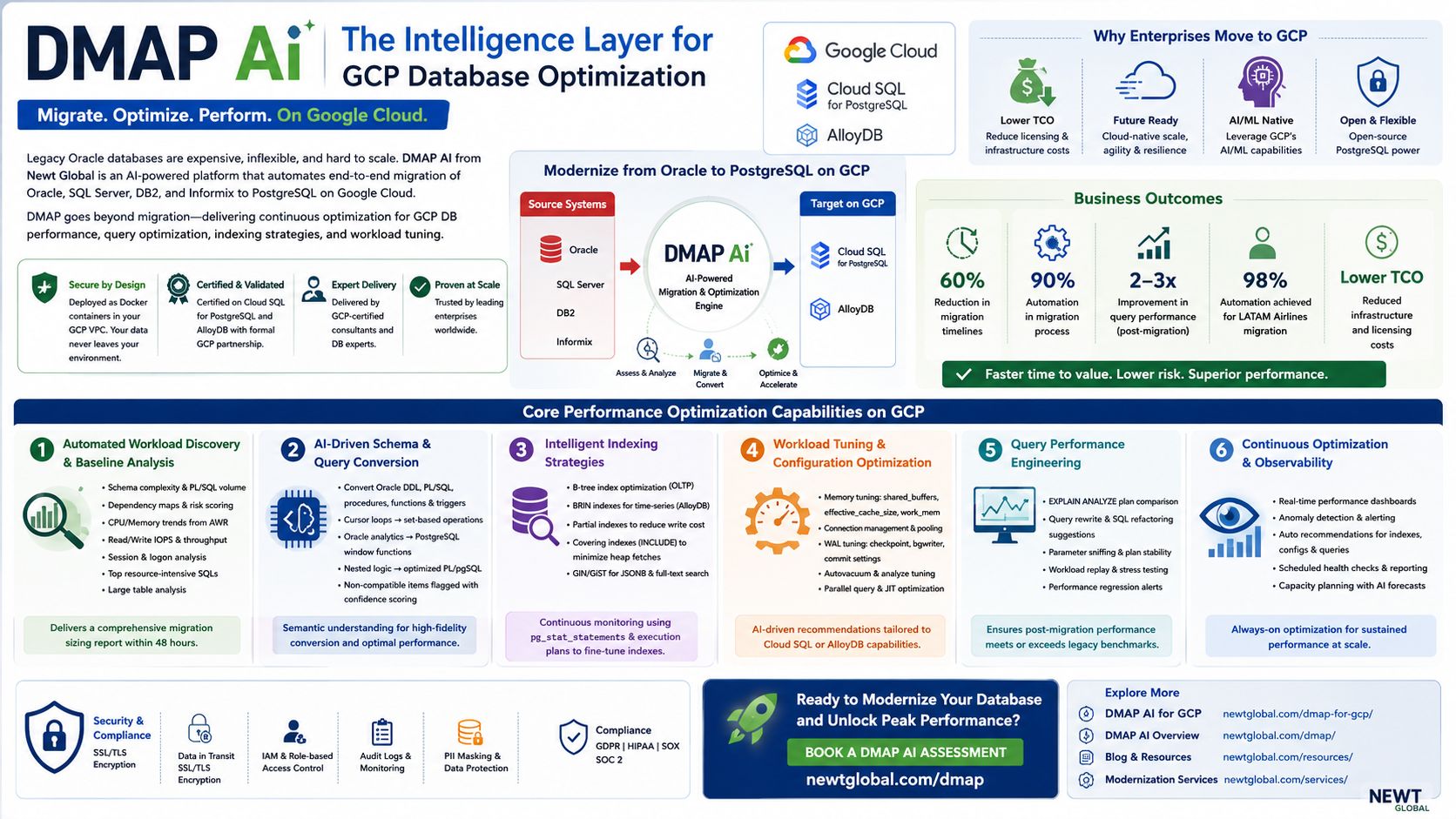
Core Performance Optimization Capabilities on GCP
1. Automated Workload Discovery & Baseline Analysis
Before optimization begins, DMAP scans your entire Oracle environment and delivers a comprehensive migration sizing report within 48 hours. This assessment captures:
- Schema complexity and PL/SQL volume
- Dependency maps and risk-scored project estimates
- CPU/memory utilization trends from Oracle AWR reports
- Read/write IOPS and throughput IO statistics
- Session and logon details
- Top resource-intensive SQLs and large table analysis
This baseline becomes the foundation for all subsequent query optimization GCP efforts, ensuring that post-migration performance is measured against empirical legacy benchmarks rather than guesswork.
2. AI-Driven Schema & Query Conversion
Oracle DDL, stored procedures, functions, and triggers are automatically converted to PostgreSQL equivalents for Cloud SQL or AlloyDB. DMAP’s GenAI engine doesn’t just perform syntax translation—it understands intent:
- Cursor loops are refactored into set-based operations
- Oracle-specific analytical functions are mapped to PostgreSQL window functions
- Nested procedural logic is flattened into optimized PL/pgSQL
- Non-compatible constructs are flagged for review with confidence scoring
This semantic comprehension ensures that converted queries leverage PostgreSQL’s query planner effectively from day one, eliminating performance anti-patterns that plague rule-based migration tools.
3. Intelligent Indexing Strategies
Index optimization is where many migrations succeed or fail. DMAP AI analyzes your Oracle index topology and workload patterns to recommend indexing strategies specifically tailored for GCP PostgreSQL:
- B-tree index optimization for OLTP workloads on Cloud SQL
- BRIN indexes for large time-series tables common in AlloyDB deployments
- Partial indexes to reduce write amplification on high-velocity tables
- Covering indexes (INCLUDE clauses) to minimize heap fetches
- GIN/GiST index recommendations for JSONB and full-text search workloads
Post-migration, DMAP continuously monitors pg_stat_statements and execution plans to identify missing indexes, redundant indexes consuming write overhead, and opportunities for index consolidation.
4. Workload Tuning & Configuration Optimization
Workload tuning on GCP requires balancing PostgreSQL’s configuration parameters against Cloud SQL’s managed constraints or AlloyDB’s advanced capabilities. DMAP AI automates this tuning through:
- Memory parameter optimization:
shared_buffers,effective_cache_size, andwork_memcalibration based on instance tier and workload profile - Connection pooling strategies: Recommendations for pgBouncer or AlloyDB’s native pooling to handle high-concurrency ERP workloads
- Vacuum and autovacuum tuning: Preventing transaction ID wraparound and maintaining query plan stability on large datasets
- Checkpoint and WAL optimization: Balancing durability guarantees with I/O throughput on GCP’s persistent disk
- Parallel query tuning: Leveraging Cloud SQL’s parallel worker capabilities for analytical workloads
For a deep dive into the migration architecture, see our guide on Oracle to AlloyDB Migration on Google Cloud with DMAP AI.
Post-Migration Performance Engineering
Migrating to Cloud SQL for PostgreSQL does not end at cutover. Performance engineering must validate that workloads meet operational baselines. DMAP’s continuous optimization capabilities include:
- Query plan comparison: Oracle execution plans vs. PostgreSQL EXPLAIN ANALYZE output
- Execution plan analysis: Identifying sequential scans, nested loop inefficiencies, and hash join opportunities
- Index recreation recommendations: When existing indexes underperform due to data distribution changes
- Query rewrite suggestions: Converting suboptimal patterns to PostgreSQL-idiomatic constructs
- Controlled stress testing: Validating peak-load behavior before production promotion
Learn more about our comprehensive Database Migration services and how we ensure performance parity.
Real-World Outcomes: Performance at Enterprise Scale
DMAP AI’s optimization capabilities have been validated in production across some of the world’s most demanding Oracle environments:
- 60% reduction in migration timelines through automated schema conversion and parallel execution
- 90% automation rate for database objects, minimizing manual DBA intervention
- 98% automation achieved for LATAM Airlines’ 17TB Oracle estate
- Post-migration query regression resolution without manual DBA intervention through AI-surfaced index and rewrite recommendations
Explore how DMAP AI drives Enterprise Modernization through unified intelligence.
Security, Compliance, and Trust
Performance optimization must never compromise governance. DMAP integrates compliance controls directly into the tuning lifecycle:
- Encryption at rest and in transit via Cloud SQL’s native SSL/TLS
- IAM authentication and Private IP networking
- Immutable audit logs capturing every optimization recommendation and change
- PII masking during performance testing using format-preserving anonymization
- GDPR, HIPAA, and SOX alignment throughout the optimization process
For regulated industries, these controls ensure that GCP DB performance improvements are achieved within a compliant, auditable framework.
Getting Started with DMAP AI on GCP
DMAP deploys as Docker containers directly into your GCP VPC. Within 48 hours, you receive a comprehensive assessment covering schema complexity, PL/SQL volume, dependency maps, and performance risk scoring. Newt Global’s GCP-certified team then executes a proof-of-concept, converting a representative schema and tuning queries for Cloud SQL or AlloyDB before full-scale migration begins.
For more insights on database modernization strategies, visit our DMAP AI Blog Archive or explore our Database Modernization Consulting services.
Ready to optimize your GCP database performance with AI? Contact Newt Global today to learn how DMAP AI can transform your Oracle workloads into high-performance PostgreSQL on Google Cloud.