
DMAP AI: Connecting the Dots in Enterprise Modernization (Without the Usual Complexity)
Modernization, in theory, sounds straightforward. Upgrade systems, migrate databases, adopt the cloud, and move faster. But in practice, it’s rarely that simple.
Most enterprises find themselves navigating a maze of dependencies—legacy databases tightly coupled with applications, outdated infrastructure supporting critical workloads, and DevOps pipelines that don’t quite connect the way they should. Add to that the constant pressure to avoid downtime, and modernization quickly becomes a high-stakes balancing act.
The real challenge isn’t the lack of tools or technologies. It’s the lack of cohesion.
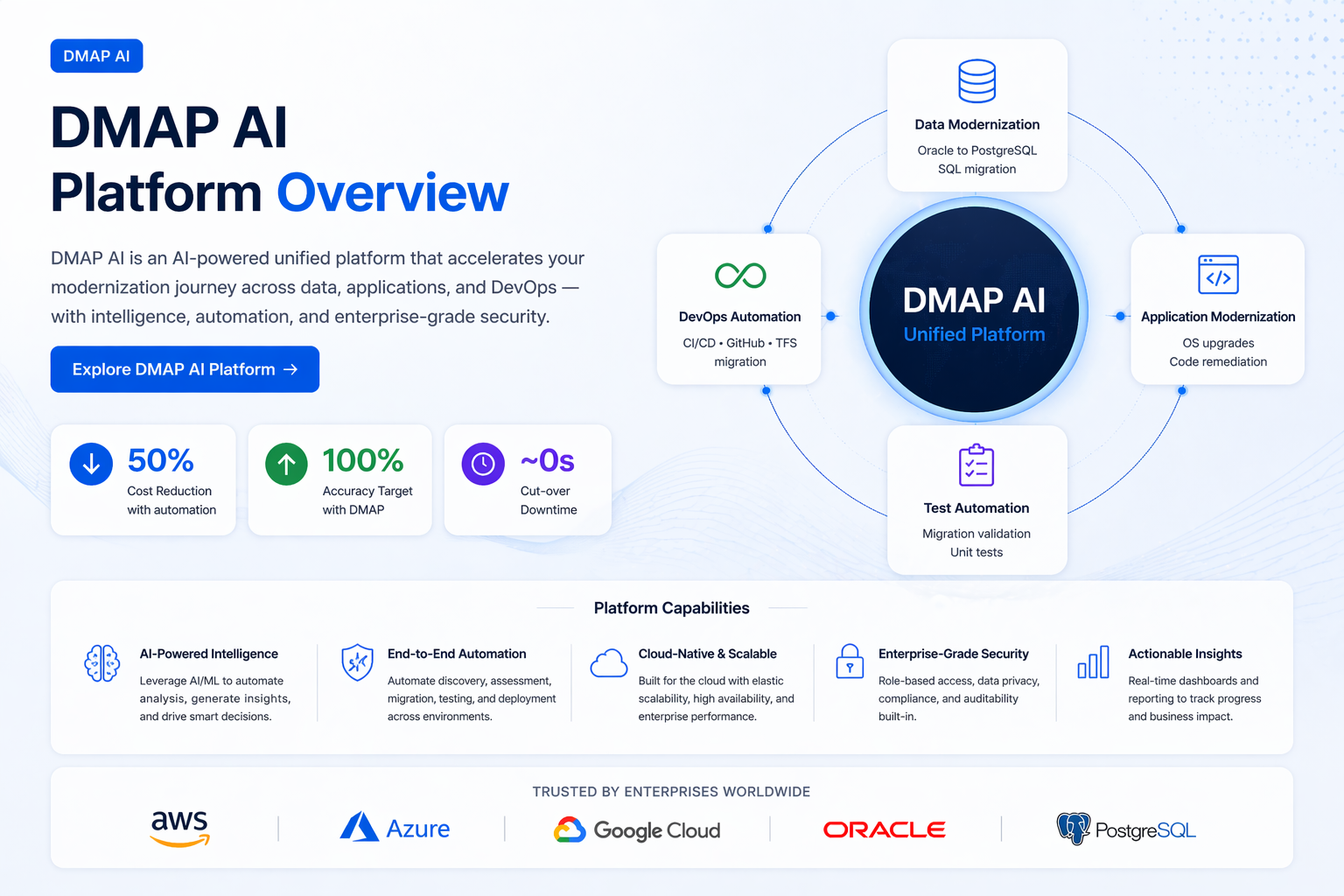
This is exactly the gap that DMAP AI, developed by Newt Global, is designed to address. It brings together the scattered pieces of modernization into a single, intelligent platform—turning what used to be a fragmented process into a connected journey.
Why Most Modernization Efforts Feel Slower Than They Should
If you step inside a typical enterprise transformation program, you’ll notice something interesting. Teams are busy, tools are in place, and progress is being made—but it doesn’t feel efficient.
That’s because most modernization efforts are still approached in silos.
Data teams are focused on migration strategies. Application teams are working on compatibility and upgrades. DevOps teams are managing pipelines. QA teams are validating outcomes. Each function operates with its own tools, timelines, and priorities.
Individually, this works. Collectively, it creates friction.
This fragmented approach is one of the key reasons why large-scale migrations—especially database transformations—become slow and unpredictable. As discussed in Newt Global’s database migration insights, relying on multiple disconnected tools often leads to inefficiencies, inconsistencies, and governance challenges.
Modernization doesn’t fail because of effort—it fails because of disconnection.
DMAP AI: Turning Disconnected Processes Into One Continuous Flow
DMAP AI approaches this problem differently. Instead of adding another tool to the mix, it acts as a unifying layer across the entire modernization lifecycle.
It connects:
- Data modernization
- Application transformation
- DevOps automation
- Continuous testing
What this creates is not just integration, but flow.
Processes that were previously sequential can now happen in parallel. Tasks that required manual coordination become automated. And most importantly, teams gain visibility into the entire lifecycle rather than just their individual components.
This philosophy aligns closely with the “Simplify, Automate, Validate” framework that Newt Global emphasizes across its solutions, as outlined in the DMAP platform overview.
Instead of managing complexity, organizations can start eliminating it.
Rethinking Data Modernization: From Risky to Repeatable
Data modernization is often where transformation begins—and where it slows down.
Migrating from legacy systems like Oracle or SQL Server to PostgreSQL offers clear benefits in cost and flexibility. But the process itself is complex, involving schema conversion, query rewriting, and extensive validation.
Traditionally, this has been a manual, resource-intensive effort.
DMAP AI changes that by introducing automation and intelligence into every step. It analyzes existing database structures, converts schemas, translates SQL logic, and validates results in a unified workflow.
What makes this particularly powerful is not just the automation, but the consistency it brings. Instead of reinventing the process for every migration, organizations can follow a repeatable, governed approach.
This is why strategies like those discussed in modern database migration with DMAP are gaining traction—they move away from one-off efforts and toward scalable transformation models.
Speed Without Compromising Accuracy
One of the biggest misconceptions about modernization is that speed comes at the cost of quality.
In reality, the opposite is often true. The more manual a process is, the higher the likelihood of errors.
DMAP AI leverages AI-driven automation to accelerate migrations while maintaining high levels of accuracy. Tasks that previously required weeks of manual effort can now be executed in significantly less time, with built-in validation ensuring reliability.
As highlighted in Oracle to PostgreSQL migration in weeks with DMAP AI, enterprises are able to compress timelines dramatically—without increasing risk.
This balance between speed and precision is what makes modernization sustainable at scale.
Modernizing Applications Without Breaking What Works
Applications are often the most sensitive part of modernization. They support critical business functions, and any disruption can have immediate consequences.
That’s why a full rewrite is rarely the best option.
DMAP AI takes a more practical approach by focusing on intelligent remediation. It identifies compatibility issues, upgrades operating systems, and adjusts code to work within modern environments—all while preserving the core functionality of the application.
This approach allows enterprises to evolve their systems gradually, rather than replacing them entirely.
If you look at broader modernization strategies, including discussions around application transformation and architecture evolution, the emphasis is increasingly on incremental improvement rather than disruption.
And that’s exactly what DMAP AI enables.
DevOps That Feels Less Like Overhead
DevOps was meant to simplify delivery, but in many organizations, it has introduced its own complexity.
Multiple tools, inconsistent configurations, and manual processes often slow things down instead of speeding them up.
DMAP AI integrates DevOps into the modernization workflow itself. Instead of treating pipelines as separate systems, it aligns them with data and application processes.
This creates a more cohesive environment where:
- Builds, testing, and deployments are automated
- Pipelines are standardized across teams
- Releases become more predictable
The shift here is subtle but important. DevOps moves from being something teams manage to something that supports them seamlessly.
Continuous Testing: Confidence at Every Step
Testing is often where transformation projects lose momentum.
When validation happens at the end, issues surface late, timelines stretch, and confidence drops.
DMAP AI embeds testing throughout the lifecycle, turning it into a continuous process rather than a final checkpoint. It generates automated tests, performs validation during migrations, and ensures that every change is verified in real time.
As discussed in DMAP AI’s role in migration validation, this approach significantly reduces risk while improving overall reliability.
The result is not just better outcomes—but a smoother, more predictable journey.
Designed for Real-World Enterprise Complexity
One of the reasons DMAP AI resonates with enterprises is its ability to work within existing environments.
It supports:
- Hybrid and multi-cloud ecosystems
- Legacy and modern systems
- Complex data architectures
This flexibility means organizations don’t need to overhaul everything at once. They can modernize incrementally, building on their existing investments.
As reflected across Newt Global’s digital transformation solutions, the goal is not to replace complexity overnight—but to simplify it step by step.
A Shift in How Modernization Is Done
What DMAP AI ultimately represents is a shift in mindset.
Modernization is no longer about managing multiple tools and coordinating across disconnected teams. It’s about creating a unified system where everything works together.
It’s about:
- Replacing fragmentation with integration
- Replacing manual effort with automation
- Replacing uncertainty with continuous validation
And perhaps most importantly, it’s about making modernization feel less like a risk—and more like a controlled, strategic process.
Final Thoughts
Enterprise modernization will always involve challenges. Systems are complex, dependencies are real, and change is never easy.
But the way organizations approach these challenges is evolving.
Platforms like DMAP AI, built by teams such as Newt Global, are redefining what’s possible by bringing intelligence, automation, and integration into a single ecosystem.
Instead of navigating modernization as a series of disconnected efforts, enterprises can now approach it as a cohesive journey—one that is faster, more predictable, and far less stressful.
And in today’s environment, that shift makes all the difference.