
COST ANALYSIS • ENTERPRISE TECHNOLOGY
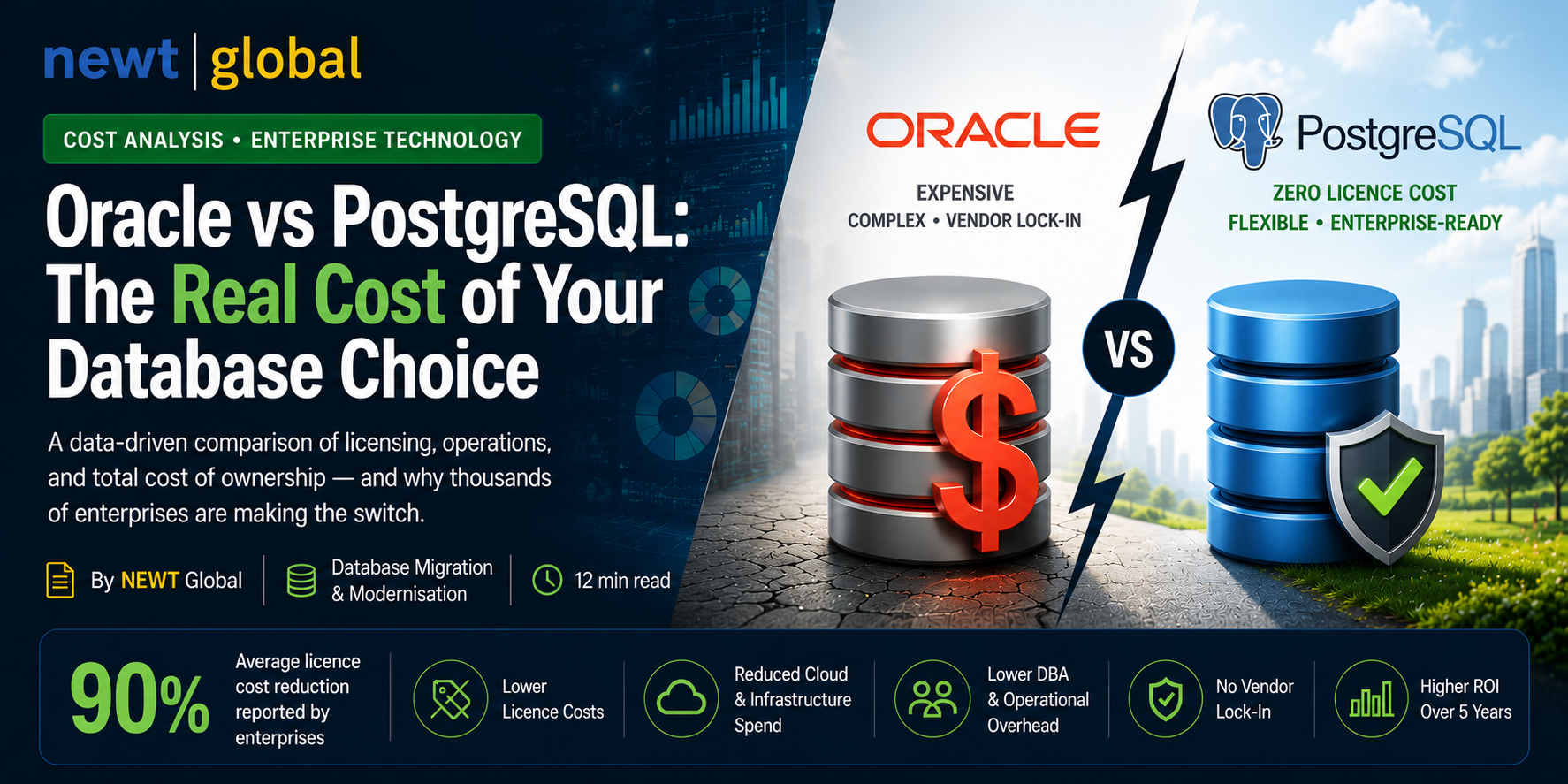
Oracle vs PostgreSQL: The Real Cost of Your Database Choice
For many enterprises, Oracle licensing is the single largest software expenditure — and often the least scrutinised. Here’s what the numbers actually look like, and why thousands of organisations are making the switch.
By NEWT Global • Database Migration & Modernisation • 12 min read
Every quarter, enterprise CFOs review their software spend and find the same line item: Oracle database licensing. It’s large, it’s recurring, and it almost always grows. Yet for most of the workloads it powers, a fully capable, enterprise-grade open-source alternative exists — PostgreSQL.
This article breaks down the true cost difference between Oracle and PostgreSQL, from licensing to operations, and presents a pre-calculated ROI model so you can estimate your own organisation’s potential savings.
90%
Average licence cost reduction reported by enterprises migrating from Oracle to PostgreSQL
The headline number is striking. But the real story is more nuanced — and more compelling — once you factor in support costs, hardware requirements, cloud flexibility, and operational overhead.
Understanding Oracle’s Licensing Model
Oracle’s pricing is deliberately complex. The two main licensing options — Named User Plus (NUP) and Processor licensing — both carry substantial price tags, and neither is straightforward.
Oracle Enterprise Edition: The Real Numbers
| Licence Type | List Price (USD) | Annual Support (22%) | Effective 5-Year Cost |
| Enterprise Edition — Per Processor | $47,500 | $10,450/yr | $99,750 per core |
| Standard Edition 2 — Per Socket | $17,500 | $3,850/yr | $36,750 per socket |
| Named User Plus (min 25) | $950/user | $209/user/yr | $1,995 per user |
| PostgreSQL (all editions) | $0 | $0 | $0 |
These are list prices. Oracle rarely sells at list — but negotiated discounts of 50–70% still leave enterprises spending hundreds of thousands per year, often for databases that could be replaced with PostgreSQL at zero licence cost.
Additionally, Oracle’s processor core factor multiplier means that licensing modern multi-core servers can rapidly multiply costs. A single 32-core server with a 0.5 core factor still requires 16 processor licences — at $47,500 each, that’s $760,000 in licence cost alone, before annual support.
Total Cost of Ownership: A Full Picture
Licence costs are just the beginning. A thorough total cost of ownership (TCO) analysis must include infrastructure, staffing, support contracts, cloud costs, and the opportunity cost of vendor lock-in.
| Cost Category | Oracle (Annual) | PostgreSQL (Annual) | Annual Savings |
| Database Licensing | $180,000 | $0 | $180,000 |
| Annual Support & Maintenance | $39,600 | $12,000 | $27,600 |
| Infrastructure / Cloud | $95,000 | $38,000 | $57,000 |
| DBA Staffing Premium | $45,000 | $18,000 | $27,000 |
| Audit & Compliance Overhead | $20,000 | $2,000 | $18,000 |
| Total Annual TCO | $379,600 | $70,000 | $309,600 |
In this illustrative mid-market scenario (4 processor licences, modest cloud footprint), the annual saving exceeds $300,000. Over five years, that’s well over $1.5 million — enough to fund an entire modernisation programme and still come out ahead.
ROI Model: What Does Your Organisation Save?
The table below shows a worked example for a mid-market enterprise running 4 Oracle Enterprise Edition processor licences over five years, including a one-time migration investment of $120,000.
ROI Estimator (Sample: 4 EE Processor Licences, 5 Years)
|
Oracle 5-Yr TCO $2.1M |
PostgreSQL 5-Yr TCO $0.5M |
Net Savings $1.6M |
ROI Estimator — sample scenario: 4 Enterprise Edition processor licences. Includes 22% annual Oracle support, 60% infrastructure reduction, and 60% DBA cost reduction on PostgreSQL. Migration cost is one-time.
For a personalised estimate based on your actual licence count, infrastructure spend, and timeline, contact NEWT Global’s migration practice.
Why PostgreSQL Is Enterprise-Ready
A common objection to PostgreSQL migration is that it “lacks enterprise features.” That was largely true in the 1990s. Today, PostgreSQL 16+ supports virtually every feature that most Oracle workloads require — and several that Oracle doesn’t offer at any price.
| ACID Compliance & Transactions
Full multi-version concurrency control (MVCC), serialisable isolation, and row-level locking — matching Oracle EE capabilities. |
Logical & Streaming Replication
Built-in logical replication, hot standby, and streaming replication for HA architectures — no licence surcharge required. |
| Partitioning & Parallelism
Declarative table partitioning, parallel query execution, and JIT compilation for complex analytical workloads. |
Row-Level Security
Granular row-level security policies and transparent data encryption — enterprise governance without add-on licensing. |
| Procedural Languages (PL/pgSQL)
PL/pgSQL is functionally equivalent to PL/SQL. Automated converters handle most migration work. |
Cloud-Native Flexibility
Available natively on AWS Aurora, Azure Database, Google Cloud SQL — no single-cloud lock-in, fully managed at commodity pricing. |
“The question is no longer whether PostgreSQL can handle enterprise workloads — it can. The question is how much longer organisations can justify the Oracle premium.”
— NEWT Global Database Migration Practice — www.newtglobal.com
Migration Complexity: What to Expect
A successful Oracle-to-PostgreSQL migration is a structured project, not a lift-and-shift. The typical engagement covers four phases:
Phase 1 — Assessment (2–4 weeks)
Catalogue all Oracle schemas, stored procedures, packages, and application-level SQL. Identify compatibility gaps (e.g. ROWNUM, CONNECT BY, Oracle-specific data types) and estimate conversion effort. NEWT Global’s assessment tooling automates this for most workloads.
Phase 2 — Schema & Code Conversion (4–12 weeks)
Convert DDL, PL/SQL packages, triggers, and sequences to PostgreSQL-compatible equivalents. Most organisations find 60–80% of code converts automatically; the remainder requires expert intervention on complex business logic.
Phase 3 — Testing & Validation (4–8 weeks)
Run parallel workloads, validate query results, and conduct performance benchmarking. This phase is critical — it’s where edge cases surface and where confidence is built before cutover.
Phase 4 — Cutover & Hypercare (2–4 weeks)
Phased or big-bang cutover, with a hypercare period of close monitoring. Most organisations achieve full cutover within a single maintenance window for smaller databases, or a rolling cutover for larger estates.
| Database Size | Est. Duration | Typical Migration Cost | Break-Even vs Oracle |
| Small (<100 GB) | 6–10 weeks | $40,000–$80,000 | < 4 months |
| Medium (100 GB – 2 TB) | 3–6 months | $80,000–$250,000 | 6–12 months |
| Large (>2 TB, complex) | 6–18 months | $250,000–$700,000 | 12–24 months |
Even for large, complex migrations, the break-even point typically falls within two years — after which every year represents pure savings that can be reinvested in innovation, headcount, or further modernisation.
Common Objections — Addressed
“We rely on Oracle-specific features”
Most Oracle-specific constructs have direct PostgreSQL equivalents. ROWNUM becomes ROW_NUMBER() or LIMIT. CONNECT BY becomes recursive CTEs. Oracle sequences map directly. The most complex cases — Advanced Queuing, Oracle Label Security — do require redesign, but these affect a small minority of workloads.
“We’re concerned about PostgreSQL support”
Enterprise support for PostgreSQL is available from specialist partners like NEWT Global, as well as EDB, Percona, and all major cloud providers. SLA-backed support is commercially available at a fraction of Oracle’s annual maintenance cost.
“The migration risk is too high”
Risk is managed through phasing, parallel running, and automated testing. Modern migration tooling has matured significantly — the risk of a well-planned PostgreSQL migration is substantially lower than the risk of remaining on an increasingly expensive, vendor-controlled platform.
Ready to Quantify Your Oracle Savings?
NEWT Global’s database migration practice has helped enterprises across industries migrate from Oracle to PostgreSQL — delivering measurable cost savings and architectural freedom. Start with a no-obligation assessment at www.newtglobal.com
Get a Free Assessment → www.newtglobal.com
Tags: Database Migration • Oracle • PostgreSQL • Cost Optimisation • Open Source • Enterprise Technology • Oracle Licensing • Postgres Savings