
Why Oracle to PostgreSQL Migration Costs Always Run Over Budget
Oracle-to-PostgreSQL migration projects almost never finish at the price on the original estimate. What begins as a straightforward modernization initiative quietly doubles in cost as timeline slippage, unexpected PL/SQL complexity, and cutover surprises eat through the budget.
This is not bad luck. It is a structural problem with how most enterprise Oracle to PostgreSQL migrations are planned and executed. This post breaks down where the real cost lives, what enterprises genuinely spend across different approaches, and how DMAP, Newt Global’s Oracle to PostgreSQL migration automation platform, consistently brings that cost down.
The Real Oracle to PostgreSQL Migration Cost: Where Enterprise Budget Goes
Most organizations budget for the visible work and underestimate the invisible work that quietly consumes the majority of the project budget.
The single biggest Oracle migration cost driver is PL/SQL remediation, which typically accounts for a large share of total effort. Oracle packages, cursor loops, CONNECT BY PRIOR hierarchical queries, and Oracle-specific constructs like SYS_REFCURSOR have no direct PostgreSQL equivalents. Every single one requires a senior DBA to understand the intent, rewrite the logic, and test it thoroughly.
At scale, with hundreds of Oracle packages and thousands of stored procedures, this is where projects fall months behind schedule and run well over budget. Add application layer changes such as JDBC updates, ORM mappings, and embedded SQL rework, along with QA cycles and risk overhead, and the true Oracle to PostgreSQL migration cost often ends up being significantly higher than the original estimate.
Three Enterprise Oracle Migration Approaches and What Each One Costs
1. Fully Manual Oracle Migration: Highest Cost, Highest Risk
For a mid-sized Oracle estate with a large volume of PL/SQL code and hundreds of stored procedures, a fully manual Oracle to PostgreSQL migration is a lengthy and expensive undertaking. Timeline slippage is the norm, not the exception, and every extra month means another month of Oracle licensing fees accumulating in the background.
2. Point Tools Like AWS SCT or Ora2Pg: Partial Savings
AWS SCT and Ora2Pg automate DDL conversion and simple data type mapping, but they only cover a portion of the objects in a typical enterprise estate. The remaining complex PL/SQL still requires manual engineering effort. The engineering bottleneck gets deferred, not eliminated, and the cost savings over a fully manual approach are modest at best.
3. DMAP, Newt Global’s Oracle to PostgreSQL Migration Automation Platform: Maximum Cost Reduction
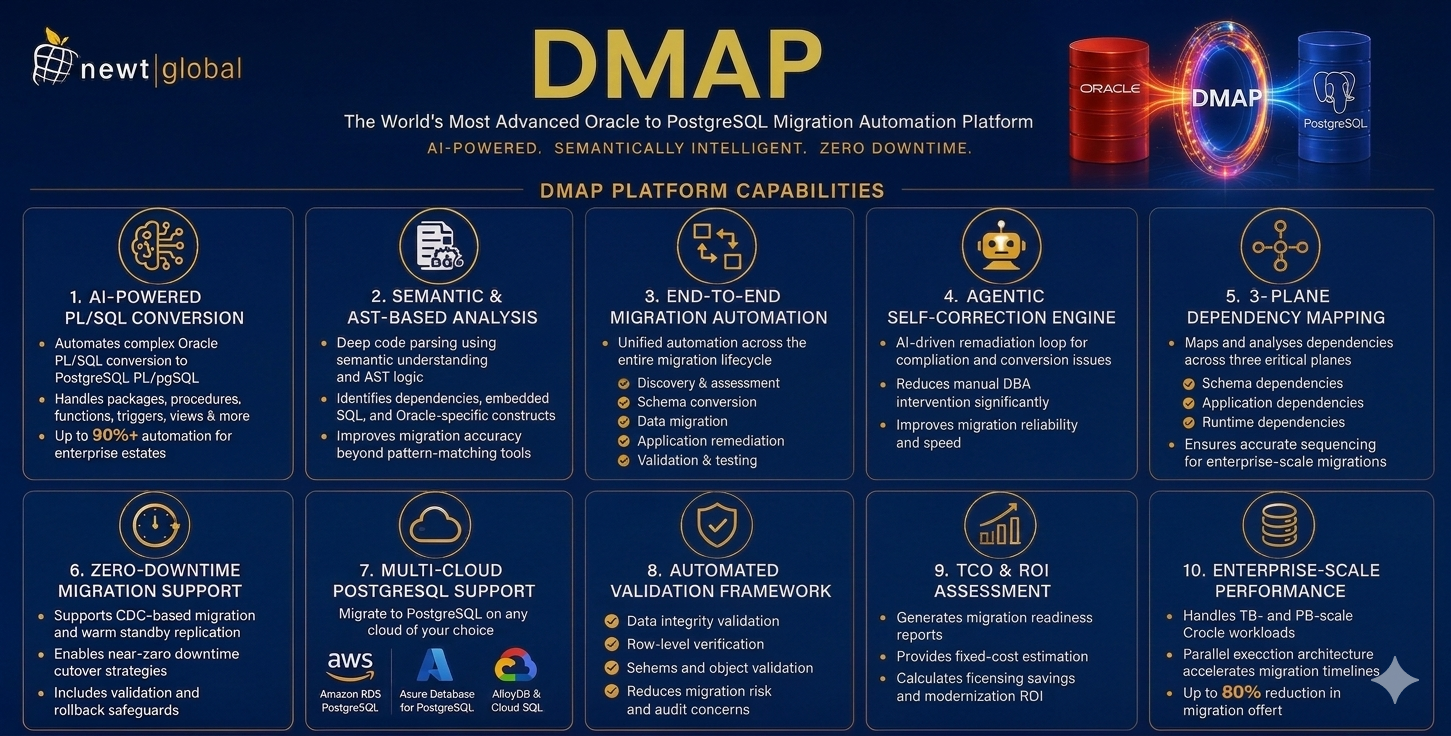
DMAP’s agentic AI engine achieves very high automation rates on complex Oracle PL/SQL, reduces manual intervention to a small fraction of objects, and compresses the entire migration timeline significantly. The result is a total Oracle to PostgreSQL migration cost that runs substantially lower than fully manual approaches.
DMAP vs AWS SCT vs Ora2Pg: Oracle to PostgreSQL Migration Cost Compared
Here’s how the leading Oracle migration tools compare on the dimensions that actually drive project cost:
| Capability | DMAP | AWS SCT | Ora2Pg |
|---|---|---|---|
| PL/SQL automation (complex estates) | Very High | Partial | Partial |
| Semantic / AST code understanding | Full AI+AST | Pattern match | Pattern match |
| Agentic self-correction loop | ✔Yes | ✖No | ✖No |
| 3-plane dependency mapping | ✔Yes | Schema only | Schema only |
| Zero-downtime CDC cutover | ✔Built-in | Via AWS DMS | Not built-in |
| Multi-cloud (AWS / Azure / GCP) | ✔All three | AWS only | Any |
| TCO / ROI business case | ✔Automated | ✖No | ✖No |
| Oracle migration cost reduction | Significant | Modest | Modest |
Oracle to AlloyDB Migration on GCP: Why It’s the Fastest ROI Path in 2026
Enterprises running Google Cloud workloads are increasingly choosing AlloyDB as their PostgreSQL target when migrating from Oracle. AlloyDB is Google Cloud’s fully managed, PostgreSQL-compatible database, which means DMAP’s Oracle conversion output works directly with it and requires no additional translation layer.
The cost case for Oracle to AlloyDB migration is compelling. Oracle Extended Support pricing in 2026 means a large enterprise can recover the entire AlloyDB migration cost through licensing savings within 18 to 24 months. DMAP integrates with Google Cloud DMS for CDC warm standby replication, enabling a zero-downtime cutover from Oracle to AlloyDB with all data staying inside the client’s GCP VPC.
The Hidden Oracle Migration Cost Nobody Budgets For: Audit Risk
Oracle compliance audits regularly produce unexpected true-up bills worth millions of dollars for enterprises running Oracle in virtualized or cloud environments. This audit exposure almost never appears in Oracle migration project estimates, but it is real and unpredictable. The moment you complete your Oracle exit, it disappears entirely.
Oracle to PostgreSQL Migration Cost in Practice: A Real-World Enterprise Example
One of our enterprise clients in the aviation sector had one of the most demanding Oracle environments we have encountered. It was a large, multi-terabyte estate with deeply coupled PL/SQL business logic and absolutely no tolerance for service interruption.
DMAP delivered an exceptionally high automation rate, meaning only a very small fraction of migrated Oracle objects required any manual DBA intervention. The migration completed well ahead of the original manual estimate, saving several months of Oracle licensing fees that never accrued. At enterprise Oracle EE pricing, that time saving alone often exceeds the entire cost of the DMAP engagement.
Oracle Exit Strategy: Four Phases to a Fixed-Cost PostgreSQL Migration
- Phase 1 – Oracle Estate Assessment: DMAP scans your Oracle environment and produces a migration readiness report with a fixed-cost, fixed-timeline plan and TCO/ROI business case.
- Phase 2 – Pilot Oracle Migration: A representative Oracle application cluster migrates end-to-end, validating DMAP automation rates in your specific environment.
- Phase 3 – Parallel Full Oracle Migration: The full Oracle estate migrates in parallel waves, sequenced by DMAP’s three-plane dependency graph, compressing elapsed time significantly.
- Phase 4 – Oracle Licence Termination: All workloads run on PostgreSQL. Oracle licensing is formally terminated, which is the point at which Oracle migration ROI begins delivering.
It varies by PL/SQL complexity and estate size. Smaller Oracle estates typically cost less with DMAP automation, mid-size estates fall in a moderate range, and large enterprises with extensive PL/SQL codebases can save significantly compared to what a fully manual approach would cost at the same scale.
DMAP uses grammar-based AST parsing combined with a semantic AI layer to achieve very high automation rates on complex Oracle PL/SQL, including constructs like CONNECT BY PRIOR, Oracle packages, and DBMS_SCHEDULER that break pattern-matching tools. An agentic self-correction loop autonomously resolves compilation errors, eliminating a substantial amount of manual DBA remediation. Parallel execution at scale compresses elapsed time considerably, also eliminating months of Oracle licensing fees during the migration window.
AWS SCT covers a portion of Oracle objects and focuses on AWS-native schema conversion. DMAP automates a much higher proportion of complex Oracle PL/SQL across AWS, Azure, and GCP, and includes three-plane dependency mapping, automated test generation, CDC-based zero-downtime cutover, and TCO/ROI business case generation. In benchmarks, DMAP outperforms AWS SCT considerably on automation depth, delivering a much greater Oracle migration cost reduction.
The Oracle to AlloyDB migration cost using DMAP is comparable to Oracle to Cloud SQL for PostgreSQL, since DMAP uses the same AI conversion pipeline for both GCP targets. AlloyDB’s columnar engine and intelligent caching layer often eliminate post-migration performance tuning effort. For OLTP-heavy Oracle workloads, AlloyDB typically delivers better PostgreSQL performance out of the box, reducing optimization work after cutover.
DMAP compresses Oracle migration timelines considerably compared to manual approaches. A mid-sized Oracle estate typically migrates in a fraction of the time a manual project would take. Large complex Oracle estates that would require well over a year manually often complete in a much shorter window with DMAP’s parallel execution architecture.
Yes. DMAP implements a CDC-based warm standby model using Oracle LogMiner or Debezium to stream every committed Oracle transaction to the PostgreSQL target in near real-time. An AI-sequenced cutover executes connection pool rotation, sequence synchronization, and validation gates automatically, with rollback triggers if any check fails. This eliminates the freeze-dump-restore downtime window that most Oracle migration approaches require.
Newt Global offers a DMAP Assessment, which is a fixed-scope Oracle estate scan that produces a migration readiness report, a validated automation rate projection for your specific Oracle environment, and a fixed-cost, fixed-timeline Oracle to PostgreSQL migration plan. There are no approximations or post-engagement surprises.
Ready to get a fixed-cost migration plan for your Oracle estate?