
Oracle → Cloud SQL for PostgreSQL Migration Overview with DMAP AI
Modern database modernization initiatives are no longer experimental IT upgrades—they are strategic business transformations. Among the most significant of these initiatives is Oracle → Cloud SQL for PostgreSQL Migration, a move increasingly adopted by enterprises seeking long-term cost control, architectural flexibility, and cloud-native scalability.
Organizations running large Oracle estates—particularly those supporting ERP systems, financial platforms, healthcare applications, and other mission-critical database workloads—are reassessing long-term licensing exposure, infrastructure rigidity, and operational complexity. Migrating to Cloud SQL for PostgreSQL on Google Cloud Platform (GCP) provides a managed, secure, and scalable alternative. However, the migration path requires deep technical expertise, structured governance, and disciplined execution.
When supported by automation platforms such as DMAP AI (Database Modernization Acceleration Platform), this transformation becomes measurable, auditable, and significantly lower risk.
Why Enterprises Are Moving from Oracle to Cloud SQL for PostgreSQL
The primary driver behind Oracle database modernization is often financial sustainability. Oracle licensing models—particularly in large enterprise deployments—can significantly impact long-term operating costs. By transitioning to PostgreSQL, organizations adopt an open-source model that supports database TCO optimization and reduces vendor lock-in.
However, mature enterprises do not migrate databases solely for cost reasons. The broader objective is cloud database transformation. Cloud SQL for PostgreSQL enables:
-
Managed infrastructure with automated patching and backups
-
Multi-zone high availability configurations
-
Secure private networking
-
Integrated monitoring and logging
-
Native integration with analytics and AI services
These capabilities align with enterprise cloud-first strategies and modern DevOps operating models.
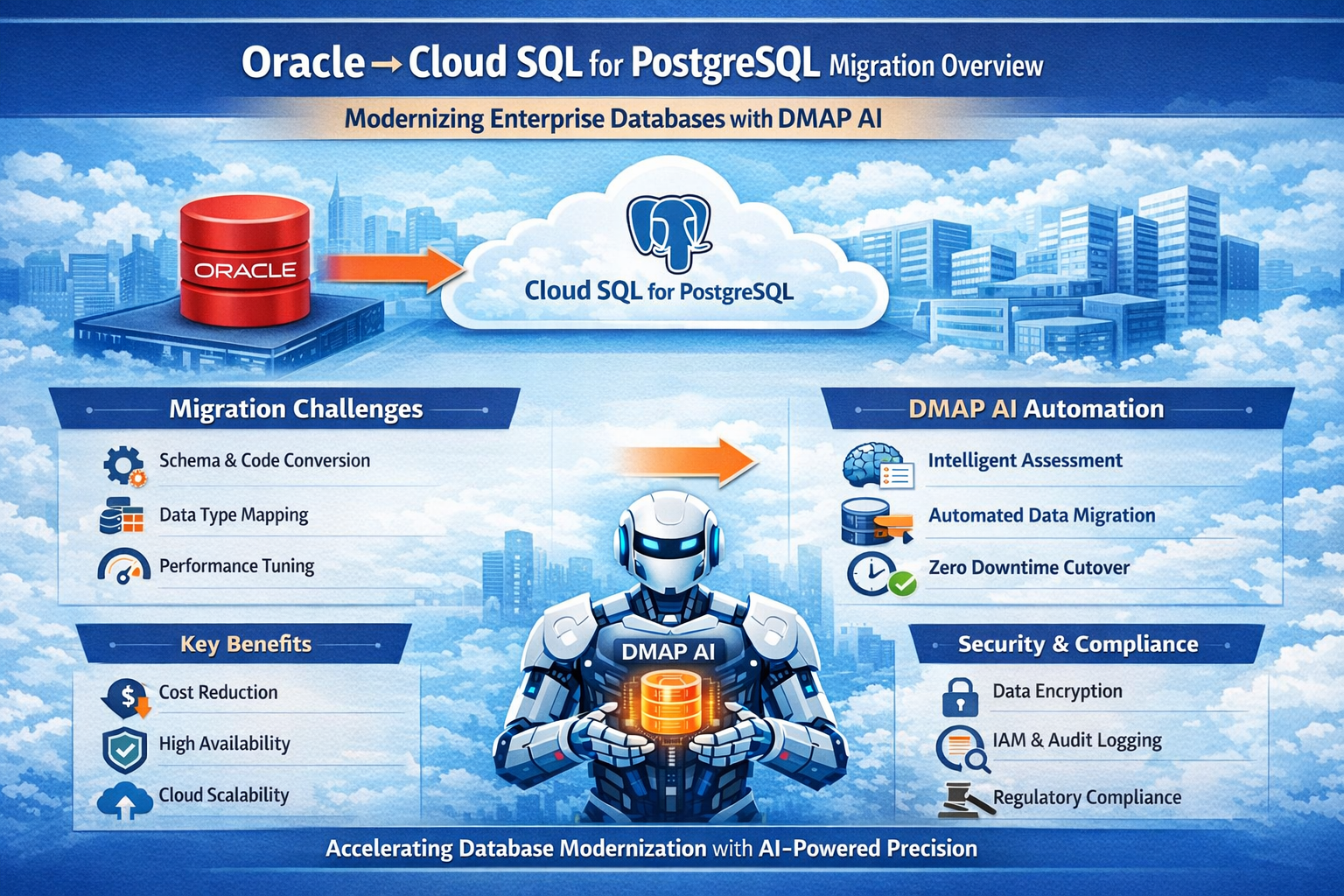
Understanding the Technical Complexity of Oracle → PostgreSQL Migration
From a technical standpoint, Oracle → Cloud SQL for PostgreSQL Migration is a heterogeneous database migration. Oracle and PostgreSQL differ significantly in procedural language design, system catalogs, optimizer behavior, and security models.
Oracle environments frequently include:
-
Extensive PL/SQL logic
-
Packages and nested procedures
-
Advanced indexing strategies
-
Custom data types
-
Embedded application-level SQL
During migration, Oracle PL/SQL must be transformed into PostgreSQL PL/pgSQL. Stored procedure migration requires structural adjustments. Data type mapping from Oracle to PostgreSQL must preserve precision and integrity. Indexes, triggers, and sequences must be re-engineered in alignment with PostgreSQL architecture.
Performance tuning also requires careful attention. The Oracle optimizer and PostgreSQL planner operate differently. Execution plan comparison is essential to ensure that queries do not degrade post-migration. This is particularly important in transaction-heavy systems where latency sensitivity is high.
Without structured methodology, these differences introduce operational risk.
DMAP AI at Google Cloud Marketplace
The Role of Structured Assessment and Governance
Before migration begins, a formal database compatibility assessment is required. This includes:
-
Schema complexity analysis
-
Object dependency mapping
-
Application interaction mapping
-
Migration risk assessment
-
Regulatory and compliance review
In enterprise environments, governance frameworks must define regression testing strategies, rollback procedures, and validation checkpoints. This ensures that migration is controlled, auditable, and aligned with business continuity objectives.
DMAP AI strengthens this phase by providing automated discovery and analysis, reducing blind spots in large database estates.
How DMAP AI Enhances Migration Precision
DMAP AI is designed to industrialize the Oracle to PostgreSQL migration lifecycle through automation and repeatability. Rather than relying exclusively on manual code review and remediation, it applies structured transformation logic across schema conversion and code remediation processes.
During schema transformation, DMAP AI supports:
-
Oracle PL/SQL to PostgreSQL PL/pgSQL conversion
-
Stored procedure and function transformation
-
Package restructuring
-
Index and constraint migration
-
Partitioning realignment
For data migration, a phased approach is implemented. Initial bulk data load migration may be followed by Change Data Capture (CDC) to support near real-time replication. This enables zero downtime migration strategies, particularly critical for financial systems database migration and ERP workloads.
Cutover strategies are carefully orchestrated to preserve transactional integrity. Post-migration validation ensures data accuracy and referential consistency.
This structured automation significantly reduces manual error rates and improves predictability in enterprise database migration programs.
Performance Optimization After Migration
Migrating to Cloud SQL for PostgreSQL does not end at cutover. Performance engineering must validate that workloads meet operational baselines.
This includes:
-
Query performance tuning in PostgreSQL
-
Execution plan comparison
-
Index optimization
-
PostgreSQL configuration tuning
-
Workload benchmarking
-
Controlled stress testing
Routine maintenance processes, such as vacuum and analyze operations, maintain performance stability. For high concurrency workloads, connection pooling strategies ensure optimal resource utilization.
These post-migration measures reinforce trustworthiness and operational reliability.
Security, Compliance, and Trust
Database security migration is foundational to enterprise credibility. Oracle user accounts must be accurately mapped to PostgreSQL roles, and privilege hierarchies must be preserved.
Cloud SQL for PostgreSQL supports:
-
Encryption at rest
-
SSL/TLS encryption in transit
-
Cloud SQL IAM authentication
-
Private IP networking
-
Centralized GCP IAM governance
-
Audit logging for compliance tracking
For regulated sectors—including healthcare and financial services—these controls ensure compliance-ready database migration and maintain audit traceability.
Trustworthiness in migration programs is built through documented governance, validation transparency, and security alignment—not marketing claims.
Architectural Modernization and Long-Term Resilience
Oracle → Cloud SQL for PostgreSQL Migration often supports broader infrastructure transformation initiatives. Organizations modernizing legacy environments may adopt:
-
Multi-zone high availability configurations
-
Disaster recovery PostgreSQL planning
-
Infrastructure as Code (Terraform on GCP)
-
VPC peering for secure networking
-
Hybrid cloud database strategies
These enhancements improve system resilience and reduce operational fragility.
Business Outcomes of a Well-Executed Migration
When executed with expertise and structured methodology, Oracle → Cloud SQL for PostgreSQL Migration delivers measurable outcomes:
-
Reduced long-term licensing exposure
-
Improved scalability and elasticity
-
Lower infrastructure management overhead
-
Enhanced operational transparency
-
Stronger security posture
-
Greater innovation agility
Organizations that approach migration as a disciplined transformation—not a rushed replatforming—achieve durable competitive advantage.
Conclusion
Oracle → Cloud SQL for PostgreSQL Migration is a high-impact modernization initiative that requires technical precision, governance discipline, and performance validation. When approached strategically and supported by intelligent automation through DMAP AI, organizations can transition from legacy Oracle environments to scalable, secure, and cost-efficient managed PostgreSQL on GCP.
Successful migrations are not defined by speed alone—but by stability, auditability, and sustained performance after go-live.
Related Content
Oracle to PostgreSQL: Cloud Migration for APAC Enterprises
On-Premises to Cloud Migration: An Enterprise-Grade Blueprint
Migrate Oracle/SQL Databases to PostgreSQL in 12 Weeks with DMAP & Cloud Migration Cockpit (CMC™)
Google Cloud Summit Nordics 2025: Newt Global’s AI-Driven Oracle to PostgreSQL Migration
Frequently Asked Questions (FAQs)
Is Oracle → Cloud SQL for PostgreSQL Migration suitable for large enterprise systems?
Yes. With structured planning, performance validation, and governance oversight, Cloud SQL for PostgreSQL can support mission-critical workloads including ERP systems and financial platforms.
How is data integrity maintained during migration?
Integrity is maintained through staged bulk migration, Change Data Capture replication, structured validation checkpoints, and controlled cutover strategies. Post-migration reconciliation confirms transactional consistency.
What is the most significant technical challenge in Oracle to PostgreSQL migration?
Procedural language conversion and optimizer behavior differences represent the most complex aspects. Execution plan comparison and performance tuning are essential to avoid regressions.
How does DMAP AI reduce migration risk?
DMAP AI introduces automation across discovery, schema transformation, replication orchestration, and validation processes. This reduces manual error exposure and improves migration predictability.
Is Cloud SQL secure enough for regulated industries?
Cloud SQL supports encryption, IAM integration, audit logging, private networking, and compliance alignment. When implemented correctly, it satisfies enterprise-grade security requirements.