
SQL Server to PostgreSQL Migration Strategy: A Complete Enterprise Modernization Guide
A well-structured SQL Server to PostgreSQL Migration Strategy is no longer just a database transition plan—it is a foundational step in enterprise database modernization. As organizations confront rising SQL Server licensing costs, evolving cloud mandates, and the need for vendor independence, PostgreSQL has emerged as a scalable, open-source alternative capable of supporting mission-critical workloads across AWS, Azure, and hybrid environments.
However, migrating from SQL Server to PostgreSQL requires more than schema conversion. It demands architectural redesign, performance re-engineering, intelligent automation, and a modernization roadmap aligned with long-term digital transformation goals. Enterprises adopting a structured approach—supported by advanced platforms like DMAP AI—achieve faster execution, reduced risk, and measurable cost optimization.
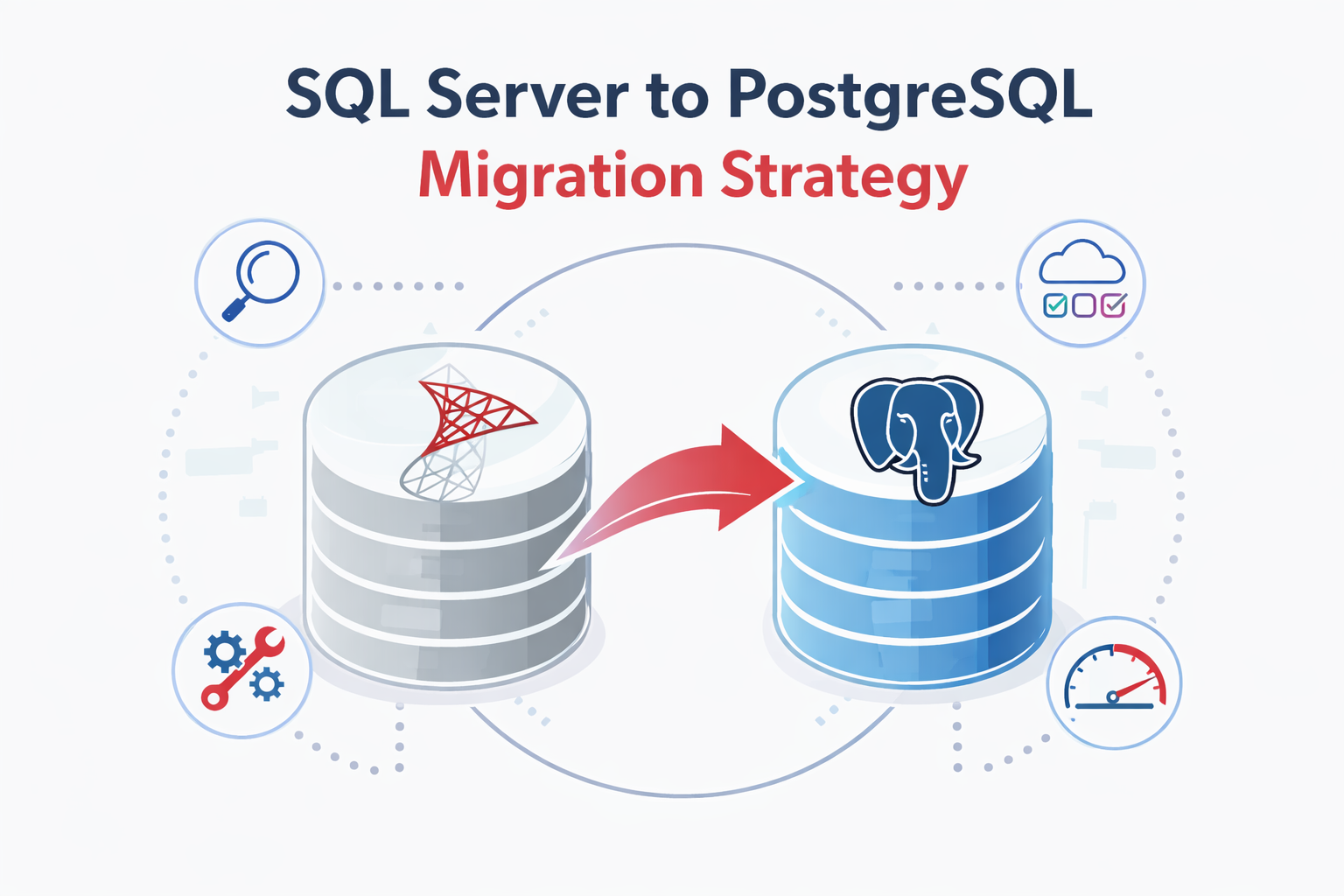
Why Enterprises Need a Structured SQL Server to PostgreSQL Migration Strategy
Organizations operating large SQL Server estates often face escalating licensing and infrastructure expenses, particularly in virtualized and cloud environments. Transitioning to PostgreSQL eliminates proprietary licensing costs while enabling greater flexibility, scalability, and DevOps integration.
A strategic migration initiative typically aligns with broader Database Modernization Services, where database transformation is treated as part of a larger cloud and application modernization journey. Rather than performing a simple lift-and-shift, enterprises benefit from re-architecting workloads to maximize cloud efficiency and performance.
A disciplined SQL Server to PostgreSQL Migration Strategy ensures that compatibility differences, procedural code variations, and indexing behaviors are addressed systematically—minimizing operational disruption during the transition.
Understanding the Core Differences Between SQL Server and PostgreSQL
Before initiating migration, it is critical to understand architectural distinctions between the two platforms. SQL Server relies on T-SQL for procedural logic, whereas PostgreSQL uses PL/pgSQL. Data types such as UNIQUEIDENTIFIER, MONEY, and NVARCHAR require careful mapping, and SQL Server’s clustered index model differs significantly from PostgreSQL’s heap-based storage and advanced indexing options like GIN and BRIN.
Scheduling mechanisms such as SQL Server Agent must be replaced with PostgreSQL-compatible alternatives. Additionally, query execution plans and transaction isolation behavior differ, making performance validation a key component of any SQL Server migration strategy.
These technical differences reinforce why structured frameworks—rather than ad hoc conversion scripts—are essential for enterprise-grade transformation.
Phase 1: Assessment and Migration Readiness Analysis
Every successful SQL Server to PostgreSQL Migration Strategy begins with comprehensive discovery. This includes analyzing database size, schema complexity, stored procedures, SSIS packages, triggers, cross-database dependencies, and application integrations.
Modern enterprises are increasingly leveraging AI-driven platforms to accelerate this phase. Solutions such as DMAP AI automate code scanning, dependency mapping, and compatibility scoring—transforming manual assessment into a data-driven readiness evaluation. This structured approach reduces uncertainty and provides stakeholders with clear visibility into remediation effort, migration timelines, and risk exposure.
Organizations seeking a scalable transformation model often adopt frameworks similar to those described in Newt Global’s approach to Oracle and SQL Server to PostgreSQL Migration, where automation and expert validation work together to accelerate modernization.
Designing the Target PostgreSQL Architecture
Migration is not simply about moving data—it is an opportunity to modernize infrastructure. A comprehensive SQL Server to PostgreSQL Migration Strategy defines the target-state architecture based on scalability, availability, and performance objectives.
Enterprises may choose managed services such as AWS RDS or Azure Database for PostgreSQL, or deploy containerized PostgreSQL clusters within Kubernetes environments. Aligning migration with broader Cloud Services initiatives ensures that high availability, disaster recovery, and workload scaling are embedded into the design phase.
For AWS-focused modernization initiatives, structured frameworks like DMAP on AWS integrate database migration with cloud-native optimization, enabling seamless transformation while maintaining enterprise governance standards.
Schema Conversion and Code Remediation Strategy
Schema conversion is often the most technically intensive stage of SQL Server migration. Tables, constraints, indexes, views, and sequences must be converted accurately into PostgreSQL-compatible formats. Complex T-SQL stored procedures typically require refactoring rather than direct syntax translation.
Automation platforms significantly reduce manual remediation effort, but expert validation remains critical for mission-critical systems. Enterprises engaging specialized SQL Server to PostgreSQL migration services benefit from structured workflows that combine automated conversion with performance tuning and code optimization.
This hybrid approach ensures data integrity, preserves business logic, and prepares workloads for long-term scalability.
Data Migration Strategy: Minimizing Downtime and Risk
A core component of any SQL Server to PostgreSQL Migration Strategy is selecting the appropriate data migration methodology. While offline migration may be acceptable for non-critical systems, enterprise workloads typically demand near-zero downtime execution.
Techniques such as change data capture (CDC), logical replication, and phased cutover models enable continuous synchronization between SQL Server and PostgreSQL environments. Validation checkpoints, checksum verification, and rollback mechanisms ensure transactional consistency throughout the process.
When orchestrated within a structured migration framework, data transfer becomes predictable and controlled rather than disruptive.
Performance Optimization After Migration
Post-migration performance tuning distinguishes a technically completed migration from a production-ready deployment. PostgreSQL’s query planner, autovacuum mechanisms, and indexing structures differ significantly from SQL Server’s architecture.
Workload benchmarking, query plan analysis, and index redesign are essential to achieving optimal performance. Enterprises leveraging structured PostgreSQL expertise—such as those offered through specialized PostgreSQL services—can fine-tune configurations for concurrency, storage efficiency, and workload optimization.
Performance engineering ensures that PostgreSQL not only replaces SQL Server but enhances overall system efficiency.
Cost Optimization and Long-Term Business Impact
One of the primary drivers behind SQL Server to PostgreSQL migration is cost reduction. Eliminating licensing fees and optimizing cloud infrastructure can significantly reduce total cost of ownership. Additionally, PostgreSQL’s open-source ecosystem supports containerization, DevOps automation, and CI/CD integration—enabling faster innovation cycles.
When integrated with broader application modernization and DevOps transformation strategies, database migration becomes a catalyst for enterprise-wide digital acceleration rather than a standalone infrastructure initiative.
Accelerating Migration with Intelligent Automation
As database environments grow more complex, automation becomes indispensable. AI-powered modernization platforms like DMAP AI unify assessment, schema conversion, data migration orchestration, and performance validation into a repeatable migration factory model.
This structured automation framework transforms SQL Server migration from a high-risk, labor-intensive project into a predictable, scalable modernization capability. By combining intelligent tooling with deep engineering expertise, enterprises can execute phased migrations across multiple databases while maintaining governance and operational continuity.
Conclusion: Building a Future-Ready PostgreSQL Data Platform
A comprehensive SQL Server to PostgreSQL Migration Strategy integrates discovery, architecture redesign, schema transformation, intelligent data migration, and performance optimization into a cohesive modernization roadmap.
When supported by automation frameworks such as DMAP AI and aligned with enterprise cloud and database modernization initiatives, migration becomes a strategic accelerator—delivering cost efficiency, scalability, and long-term platform independence.
Organizations that approach SQL Server to PostgreSQL migration with structured methodology and intelligent automation do more than replace a database engine—they establish a resilient, cloud-ready PostgreSQL data platform built for sustained digital growth.
Frequently Asked Questions
What is a SQL Server to PostgreSQL Migration Strategy?
A SQL Server to PostgreSQL Migration Strategy is a structured framework for transitioning databases from Microsoft SQL Server to PostgreSQL while minimizing risk, downtime, and performance disruption. It includes assessment, schema conversion, data migration planning, architecture redesign, application remediation, testing, and post-migration optimization. A well-defined strategy ensures compatibility, cost efficiency, and long-term scalability.
Why do enterprises migrate from SQL Server to PostgreSQL?
Enterprises migrate from SQL Server to PostgreSQL primarily to reduce licensing costs, avoid vendor lock-in, and enable cloud-native scalability. PostgreSQL provides enterprise-grade reliability, open-source flexibility, and strong support across AWS, Azure, and hybrid environments. Additionally, PostgreSQL supports advanced indexing, JSON workloads, and DevOps integration, making it suitable for modern application architectures.
What are the key challenges in SQL Server to PostgreSQL migration?
The main challenges include T-SQL to PL/pgSQL conversion, data type mapping differences, indexing architecture changes, transaction isolation behavior, and replacing SQL Server Agent jobs. Complex stored procedures and tightly coupled application logic often require refactoring rather than direct translation. Performance optimization after migration is also critical due to differences in query planning and storage models.
How long does SQL Server to PostgreSQL migration take?
The timeline depends on database size, schema complexity, number of stored procedures, integration dependencies, and downtime tolerance. Small databases may migrate in weeks, while enterprise-scale environments with multiple interdependencies may take several months. AI-driven assessment platforms like DMAP AI can significantly accelerate discovery and code conversion phases.
Can SQL Server to PostgreSQL migration be done with zero downtime?
Yes, near-zero downtime migration is achievable using techniques such as change data capture (CDC), logical replication, and phased cutover strategies. These methods allow continuous synchronization between SQL Server and PostgreSQL until final switchover, minimizing business disruption.
How is schema conversion handled during migration?
Schema conversion involves transforming tables, indexes, constraints, views, triggers, and stored procedures into PostgreSQL-compatible formats. Automated tools can convert a large percentage of schema objects, but complex procedural logic typically requires expert review and refactoring. A hybrid approach combining automation and validation ensures accuracy and performance stability.
Will PostgreSQL perform as well as SQL Server after migration?
With proper optimization, PostgreSQL can match or exceed SQL Server performance. Post-migration tuning includes query plan analysis, index redesign, autovacuum configuration, and workload benchmarking. Performance engineering is an essential phase of any SQL Server to PostgreSQL Migration Strategy.
What cost savings can be achieved by migrating to PostgreSQL?
Organizations typically achieve significant cost savings by eliminating SQL Server licensing fees and optimizing cloud infrastructure usage. Savings vary depending on workload scale and architecture, but many enterprises report meaningful reductions in total cost of ownership over time.
Is PostgreSQL suitable for enterprise-scale workloads?
Yes. PostgreSQL is widely used for enterprise applications requiring high availability, ACID compliance, scalability, and advanced analytics capabilities. It supports large transactional systems, microservices architectures, and cloud-native deployments across major cloud platforms.
How does automation improve SQL Server migration?
Automation platforms such as DMAP AI enhance migration by performing code analysis, dependency mapping, schema conversion, and validation at scale. Automation reduces manual effort, shortens timelines, minimizes errors, and enables repeatable migration processes across multiple databases.