
On-Premises to Cloud Migration: An Enterprise-Grade Blueprint Powered by Newt Global’s DMAP™
On-premises to cloud migration has evolved from a technology refresh initiative into a core enterprise transformation mandate. As organizations modernize legacy systems, rationalize data centers, and adopt cloud-native operating models, migrating from on-premises infrastructure to the cloud becomes a critical enabler of agility, resilience, and innovation.
However, cloud migration at enterprise scale is complex. Without a structured approach, organizations risk cost overruns, security gaps, operational disruption, and limited business value. Newt Global addresses this challenge through its proven DMAP™ framework—Discover, Mobilize, Accelerate, Perform, delivering a disciplined, outcome-driven blueprint for enterprise cloud migration and cloud transformation.
On-Premises to Cloud Migration as a Strategic Transformation
On-premises to cloud migration is not simply about moving workloads from data centers to public cloud platforms. It is about re-architecting IT to support modern business demands such as scalability, speed, security, and continuous optimization.
Enterprises pursue on-prem to cloud migration to:
-
Enable data center exit and consolidation
-
Modernize legacy applications and infrastructure
-
Improve business continuity and disaster recovery
-
Support digital, analytics, and AI-driven initiatives
-
Shift from CapEx-heavy infrastructure to consumption-based models
When executed correctly, cloud migration becomes the foundation for long-term cloud adoption and digital transformation.
The Need for an Enterprise-Grade Migration Blueprint
Traditional lift-and-shift approaches often fail to deliver sustained value. Enterprises must balance:
-
Speed vs. modernization
-
Risk vs. innovation
-
Cost efficiency vs. performance
-
Governance vs. agility
Newt Global’s DMAP™ framework provides a structured path that aligns business objectives, enterprise architecture, security, and operating models—ensuring cloud migration delivers measurable outcomes, not just technical completion.
Read 2 Mins: Database Modernization at Scale: Simplify, Automate, and Validate Oracle & SQL Server to PostgreSQL Migration with DMAP
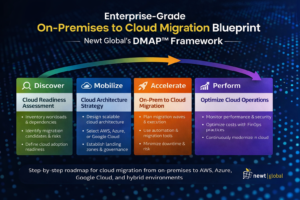
DMAP™ Phase 1: Discover — Establishing Cloud Readiness and Migration Clarity
The Discover phase focuses on building a comprehensive understanding of the current-state environment and defining cloud readiness.
Key Discover Activities
-
Application and infrastructure inventory
-
Dependency mapping and workload profiling
-
Legacy system assessment
-
Cloud suitability and risk analysis
-
Compliance, security, and data residency evaluation
This phase enables enterprises to determine:
-
Which workloads are candidates for lift-and-shift cloud migration
-
Which require application modernization or refactoring
-
Which should remain in hybrid cloud environments
-
Which can be retired to reduce technical debt
Discover ensures that on-prem to cloud migration strategy decisions are data-driven, prioritized, and aligned with business outcomes.
DMAP™ Phase 2: Mobilize — Designing the Target Cloud Architecture
During Mobilize, Newt Global translates discovery insights into a scalable, secure cloud migration architecture.
Mobilize Capabilities
-
Cloud platform selection (AWS, Azure, Google Cloud)
-
Hybrid cloud and multi-cloud architecture design
-
Network connectivity (VPN, Direct Connect, ExpressRoute)
-
Identity and access management (IAM)
-
Cloud landing zones and governance frameworks
-
Migration wave planning and sequencing
This phase addresses critical on-prem vs cloud infrastructure trade-offs and establishes architectural guardrails that support performance, security, and compliance from day one.
Mobilize ensures cloud adoption is intentional, governed, and enterprise-ready.
DMAP™ Phase 3: Accelerate — Executing Migration and Modernization at Scale
The Accelerate phase focuses on executing on-premises to cloud migration efficiently while minimizing business disruption.
Migration Execution Patterns
Enterprises typically apply a mix of the 6Rs migration strategies:
-
Rehosting (lift and shift) for speed
-
Replatforming for infrastructure optimization
-
Refactoring for cloud-native modernization
-
Repurchasing through SaaS adoption
-
Retiring redundant workloads
-
Retaining systems in hybrid cloud models
Understanding rehosting vs refactoring cloud migration allows organizations to balance rapid migration with long-term modernization goals.
Execution Focus Areas
-
On-prem to cloud data migration using replication and CDC
-
Application migration from on-prem to cloud
-
Database modernization and managed services adoption
-
Containerization and Kubernetes enablement
-
DevOps, CI/CD, and infrastructure-as-code automation
Accelerate emphasizes automation, repeatability, and security by design, reducing migration risk and accelerating time-to-value.
DMAP™ Phase 4: Perform — Optimizing Cloud Operations and Business Value
Cloud migration success is measured after go-live. The Perform phase ensures cloud environments continuously deliver performance, cost efficiency, and resilience.
Perform Capabilities
-
Cloud performance monitoring and observability
-
Cloud cost optimization and FinOps practices
-
Security posture management and compliance automation
-
SLA-driven cloud operations and SRE models
-
Continuous optimization and workload modernization
This phase addresses long-term on-prem to cloud migration cost management and ensures cloud platforms remain aligned with evolving business needs.
Perform transforms cloud from an infrastructure platform into a high-performing digital foundation.
Read 2 Mins: Oracle to PostgreSQL Migration Tool: Schema, Data & Cloud Strategy
Supporting Hybrid Cloud and Data Center Exit Strategies
Many enterprises adopt hybrid cloud architectures as part of phased migration and regulatory compliance strategies. Newt Global designs hybrid environments that support:
-
Secure connectivity between on-prem and cloud
-
Unified identity and access control
-
Consistent governance and monitoring
-
Progressive data center exit without disruption
Hybrid cloud enables controlled transformation while maintaining operational stability.
AWS, Azure, and Google Cloud Migration Expertise
Newt Global supports enterprise migration across leading cloud platforms:
-
AWS on-prem to cloud migration for complex, large-scale workloads
-
Azure cloud migration for Microsoft-centric enterprises
-
Google Cloud migration for analytics and data-driven platforms
Platform selection is driven by workload requirements, enterprise standards, and long-term transformation objectives—not vendor bias.
Best Practices for Successful Enterprise Cloud Migration
-
Align migration initiatives with business outcomes
-
Use phased, wave-based migration approaches
-
Standardize architectures and security controls
-
Embed governance and compliance from the start
-
Automate infrastructure and deployment pipelines
-
Invest in cloud operating models and skills
These best practices are embedded into every Newt Global DMAP™ engagement.
Conclusion: Cloud Migration as a Catalyst for Enterprise Transformation
On-premises to cloud migration is a strategic catalyst for enterprise modernization, agility, and innovation. When executed through a structured, outcome-driven framework like Newt Global’s DMAP™, cloud migration becomes more than an infrastructure move—it becomes a foundation for sustained digital advantage.
By combining deep technical expertise, enterprise architecture rigor, and proven delivery methodology, Newt Global enables organizations to migrate from on-prem to cloud with confidence, control, and measurable business impact.
Ready to Begin Your Cloud Transformation?
Newt Global helps enterprises:
-
Assess cloud readiness
-
Design scalable cloud architectures
-
Execute secure, large-scale migrations
-
Optimize cloud operations for performance and cost
Talk with Cloud Migration Expert: Book a Demo
Frequently Asked Questions (FAQs)
1. What is on-premises to cloud migration?
On-premises to cloud migration is the process of moving applications, data, and infrastructure from on-premise data centers to cloud platforms such as AWS, Microsoft Azure, or Google Cloud. For enterprises, this often includes infrastructure migration, application modernization, security redesign, and operational transformation as part of a broader cloud adoption strategy.
2. Why do enterprises migrate from on-premises to the cloud?
Enterprises migrate from on-prem to cloud to improve scalability, reduce infrastructure costs, enhance security, enable faster innovation, and support digital transformation initiatives. Cloud platforms also enable data center exit strategies, improved disaster recovery, and adoption of modern DevOps and cloud-native operating models.
3. What are the biggest challenges in on-prem to cloud migration?
Common on-prem to cloud migration challenges include application dependency complexity, legacy system compatibility, data migration risks, security and compliance concerns, downtime during cutover, and unexpected cloud costs. A structured framework like Newt Global’s DMAP™ helps mitigate these risks through phased planning and governance.
4. What is Newt Global’s DMAP™ framework for cloud migration?
Newt Global’s DMAP™ framework is a proven enterprise migration methodology that includes:
-
Discover: Cloud readiness and migration assessment
-
Mobilize: Cloud architecture and migration planning
-
Accelerate: Migration execution and modernization
-
Perform: Cloud optimization, governance, and operations
DMAP™ ensures on-premises to cloud migration is aligned with business outcomes and long-term performance.
5. What is the difference between lift-and-shift and cloud modernization?
Lift-and-shift cloud migration (rehosting) moves applications to the cloud with minimal changes for speed and lower upfront effort. Cloud modernization (refactoring) involves re-architecting applications to use cloud-native services for improved scalability, resilience, and cost efficiency. Enterprises often use a combination of both approaches.
6. How long does an enterprise cloud migration take?
The timeline for enterprise cloud migration depends on application complexity, data volume, security requirements, and modernization scope. Most large organizations adopt a phased migration approach over several months, with hybrid cloud environments supporting continuity during the transition.
7. What is a hybrid cloud and why is it important during migration?
A hybrid cloud combines on-prem infrastructure with public cloud platforms. It allows enterprises to migrate incrementally, meet regulatory or latency requirements, and maintain business continuity while executing data center exit or cloud transformation strategies.
8. How much does on-prem to cloud migration cost?
On-prem to cloud migration cost varies based on workload size, migration approach, cloud provider, and level of modernization. Costs typically include assessment, migration tooling, data transfer, cloud infrastructure usage, and ongoing optimization. FinOps practices are critical for managing long-term cloud spend.
9. How does cloud migration improve security and compliance?
Cloud platforms provide advanced security capabilities such as identity-based access control, encryption, automated compliance checks, and continuous monitoring. When designed correctly, cloud security and governance models often exceed traditional on-prem security postures.
10. Which cloud platform is best for on-premises to cloud migration?
There is no one-size-fits-all answer. AWS, Azure, and Google Cloud each offer strong migration capabilities. The best platform depends on workload requirements, existing technology stacks, enterprise standards, and long-term transformation goals. Platform selection is a key part of the Mobilize phase in DMAP™.
11. What happens after workloads are migrated to the cloud?
Post-migration, enterprises enter the Perform phase, focusing on cloud optimization, performance monitoring, cost management (FinOps), security posture management, and continuous modernization. Cloud migration is an ongoing journey, not a one-time event.
12. How can Newt Global help with on-premises to cloud migration?
Newt Global provides end-to-end cloud migration services powered by the DMAP™ framework, helping enterprises assess readiness, design scalable architectures, execute secure migrations, and optimize cloud operations for long-term business value.
13. Is cloud migration suitable for legacy and ERP systems like SAP?
Yes. Legacy systems and ERP platforms such as SAP can be migrated using phased, hybrid cloud strategies. Newt Global specializes in enterprise application modernization, ensuring performance, security, and compliance requirements are met throughout the migration lifecycle.
14. When is the right time to migrate from on-prem to cloud?
Enterprises should consider migrating when infrastructure costs are rising, scalability is limited, legacy systems restrict innovation, or digital transformation initiatives require greater agility. A cloud readiness assessment helps determine the right timing and approach.