
Newt Global Insights · Database Migration Series · 2026
The dirty secret your DBA won’t say out loud — and the platform that makes it a reality.
In This Article
Your business doesn’t stop at 2 a.m. Neither do your customers. So when your engineering team tells you that the upcoming database migration will require a “maintenance window of 8–12 hours” — or worse, a full weekend offline — the stakes are immediately clear: lost revenue, damaged trust, and a competitor ready to scoop up every frustrated user.
The question echoing across enterprise IT floors right now is deceptively simple: Can you migrate a live production database without taking it offline? The short answer is yes — but it demands the right strategy and the right tooling. Let’s unpack both.
The Painful Truth About Database Downtime
For most organizations, database migration is the single most feared event in a digital transformation roadmap. And for good reason. The risks are real, well-documented, and financially devastating.
Revenue Hemorrhage
Even a single hour of unplanned downtime can cost enterprises between $100,000 and $1M+ depending on industry. An e-commerce platform offline during peak hours? The math is ugly.
Irreversible Data Drift
While the migration runs, your live system keeps generating transactions. Without a robust change-data-capture layer, those writes are gone — and reconciliation becomes a forensic nightmare.
Regulatory Exposure
Healthcare, banking, and government sectors operate under strict SLA and audit requirements. Downtime isn’t just inconvenient — it can trigger compliance violations and formal penalties.
Team Burnout & Error Risk
Weekend migrations run by exhausted engineers under pressure are exactly when critical mistakes happen — misconfigurations, missed rollback points, botched cut-overs.
The traditional playbook — freeze writes, dump, transfer, validate, restore — was designed for a slower era. In 2025, with Oracle licensing costs spiraling and cloud-native PostgreSQL offering genuine freedom, the demand for a better migration method has never been higher.
The Zero-Downtime Myth — and Why It Persists
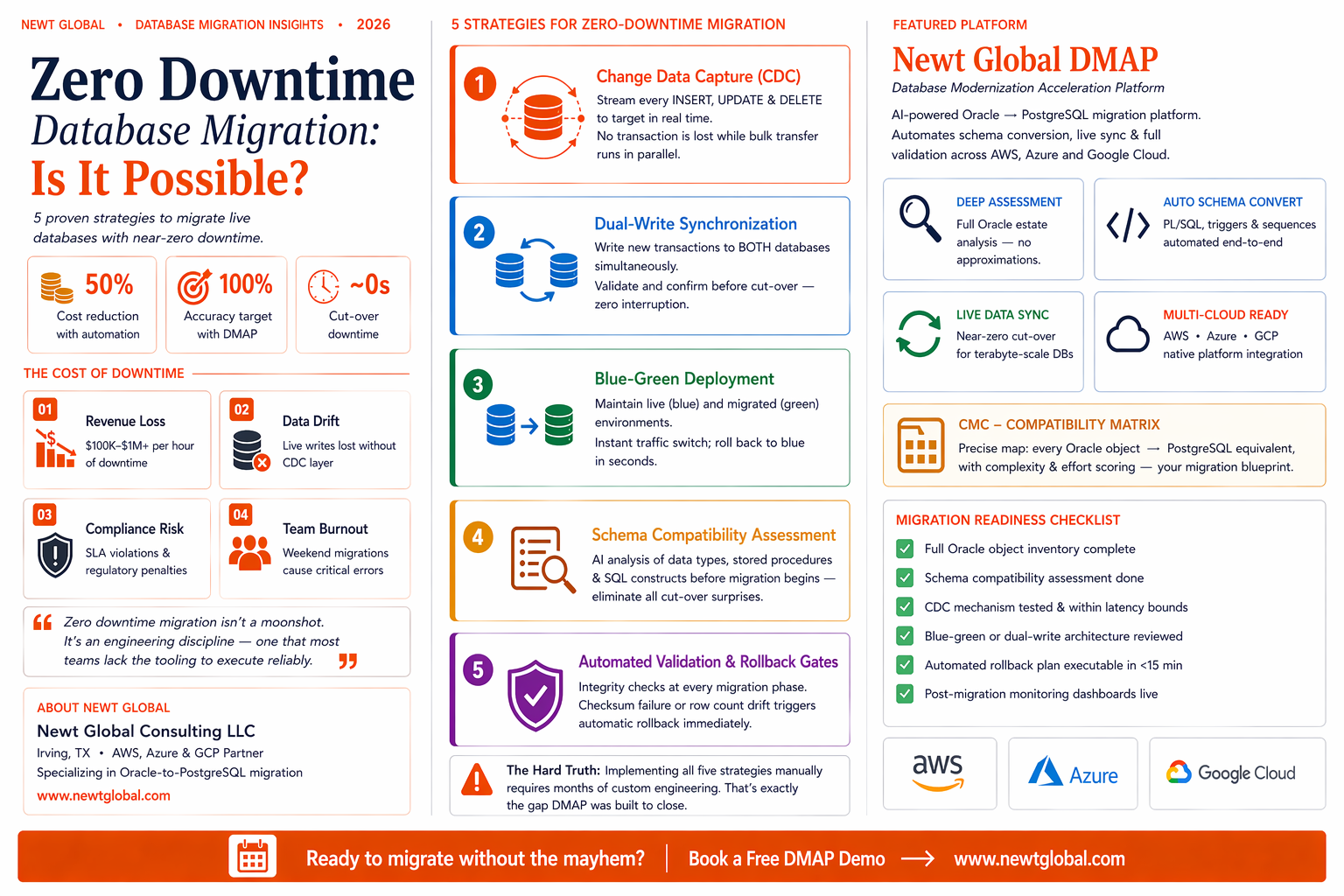
Zero downtime migration isn’t a moonshot. It’s an engineering discipline — one that most teams lack the tooling to execute reliably.
The myth isn’t that zero downtime is impossible — it’s that it’s too complex for most teams to pull off without custom-built infrastructure. That complexity has historically made extended downtime feel like the “safer” option. Executives accept the weekend window. DBAs accept the stress. Users accept the “We’re improving your experience!” banner.
But that calculus has fundamentally changed. The emergence of AI-powered migration platforms, intelligent change-data capture, and dual-write synchronization has moved zero-downtime migration from “experimental” to “enterprise-grade repeatable.”
Reduction in migration costs with automation-first platforms
Accuracy target with DMAP’s assessment engine
Target cut-over downtime using live synchronization
5 Proven Strategies for Near-Zero Downtime Migration
Whether you’re moving from Oracle to PostgreSQL on AWS, Azure, or GCP, these core techniques form the architecture of any serious zero-downtime migration plan:
- Change Data Capture (CDC)
Stream every INSERT, UPDATE, and DELETE from your source database to the target in real time during migration. Tools like Debezium or platform-native CDC ensure no transaction is missed while the bulk transfer runs in parallel. - Dual-Write Synchronization
Temporarily write all new transactions to both the old and new database simultaneously. This creates a live shadow copy, allowing validation before the final cut-over without interrupting service. - Blue-Green Database Deployment
Maintain two identical environments — the live (blue) and the migrated (green). Route traffic gradually or instantaneously to green after validation. Roll back to blue in seconds if anything goes wrong. - Schema Compatibility & Pre-Migration Assessment
Automated schema analysis identifies incompatible data types, stored procedures, and proprietary SQL constructs before migration begins. Surprises during live cut-over are the primary cause of extended downtime. - Automated Validation & Rollback Gates
Define automated data integrity checks at each migration phase. If row counts diverge, checksums fail, or latency spikes, rollback gates trigger automatically — no human needs to catch the error first.
How DMAP by Newt Global Changes the Equation
Newt Global has spent years solving exactly this problem. Their flagship product, the Database Modernization Acceleration Platform (DMAP), is an AI-powered migration engine purpose-built to move Oracle workloads to cloud-native PostgreSQL — with minimal downtime, maximum accuracy, and predictable fixed costs.
Featured Platform
Newt Global DMAP
The only AI-powered platform that automates the full Oracle → PostgreSQL migration lifecycle — from deep assessment to final validation — across AWS, Azure, and Google Cloud.
Deep Pre-Migration Assessment
DMAP unveils every component in your Oracle estate — no approximations, no hidden surprises. Precise project estimates from day one.
Automated Schema Conversion
PL/SQL procedures, triggers, sequences, and custom data types are converted automatically, slashing the most time-consuming part of any migration.
Live Data Synchronization
DMAP keeps source and target in sync during migration, enabling near-zero cut-over downtime even for terabyte-scale databases.
DMAP doesn’t just move data — it transforms the entire migration experience. Teams that previously spent 18–24 months on manual Oracle migrations are completing the same scope in a fraction of the time, with fixed-cost confidence and zero weekend war rooms.
Unlike generic migration tools that rely on approximations, DMAP delivers a comprehensive compatibility matrix (CMC) — a precise map of every Oracle object, its PostgreSQL equivalent, the conversion complexity, and the expected effort. This CMC becomes the single source of truth for project scoping, client proposals, and stakeholder reporting.
The result? Your team walks into a migration with a blueprint, not a best guess. Engineers execute against a validated plan. Cut-overs are measured in minutes, not days. And post-migration, automated validation confirms data fidelity before a single user is affected.
Your Migration Readiness Checklist
Before you begin any live database migration, work through this checklist. If you can’t check all boxes with confidence, it’s a signal to bring in automated tooling — or expert support.
- Full inventory of Oracle objects (tables, procedures, triggers, sequences, views) is complete
- Schema compatibility assessment against target PostgreSQL version is done
- Change Data Capture mechanism is tested and latency is within acceptable bounds
- Dual-write or blue-green architecture is designed and reviewed
- Automated data validation scripts are written and tested on a staging clone
- Rollback plan is documented, tested, and can execute in under 15 minutes
- Application connection strings are parameterized for instant endpoint switch
- Stakeholders are aligned on a cut-over window (even if it’s just 60 seconds)
- Post-migration monitoring dashboards are live before the migration begins
The Verdict: Possible? Absolutely.
Zero downtime database migration is not a fantasy. It is a discipline — one that requires architectural clarity, the right toolset, and a platform that automates the complexity you cannot afford to get wrong.
For enterprises trapped under Oracle’s licensing weight, facing escalating cloud costs, or simply ready to embrace the performance and freedom of PostgreSQL, the path forward is clearer than ever.
Newt Global‘s DMAP was built precisely for this moment. It turns a 12-month manual ordeal into a structured, automated, and predictable journey — one where “zero downtime” shifts from aspiration to expectation.
The next time your team mentions a maintenance window, ask a different question: What if we didn’t need one?
Ready to Migrate Without the Mayhem?
See DMAP in action. Schedule a free demo with the Newt Global team and get a live assessment of your Oracle estate — no commitment required.