
Oracle to PostgreSQL Migration on AWS: A Complete Modernization Guide with DMAP Acceleration
Enterprises modernizing their data infrastructure are increasingly prioritizing Oracle to PostgreSQL migration on AWS as a strategic initiative rather than a tactical database replacement. Rising licensing costs, inflexible scaling models, and vendor lock-in have prompted organizations to evaluate open-source alternatives that align with cloud-native architectures. PostgreSQL on AWS—deployed through Amazon RDS or Aurora PostgreSQL—offers a scalable, cost-efficient, and enterprise-ready foundation for long-term digital transformation.
When combined with automation frameworks such as DMAP on AWS, organizations can significantly accelerate migration timelines while reducing operational risk. The result is not just a database migration, but a structured database modernization program aligned with business outcomes.
Why Enterprises Are Migrating from Oracle to PostgreSQL on AWS
The financial case for migrating from Oracle to PostgreSQL is compelling. Oracle’s core-based licensing model, especially in virtualized or cloud environments, often leads to escalating costs. PostgreSQL eliminates licensing fees entirely while maintaining enterprise-grade reliability and performance.
Beyond cost optimization, enterprises seek architectural flexibility. PostgreSQL integrates seamlessly with AWS services including IAM, CloudWatch, S3, KMS, and VPC networking. This native integration supports automated backups, high availability configurations, encryption at rest, and elastic scaling without complex administrative overhead.
PostgreSQL’s maturity has also expanded significantly. It supports advanced indexing, JSON workloads, partitioning, logical replication, and extensibility—capabilities that meet modern enterprise requirements across transactional and analytical workloads.
AWS Marketplace: DMAP: App & Data Modernization for Oracle to AWS RDS & Aurora PostgreSQL
Oracle vs PostgreSQL on AWS: Architecture, Cost, and Scalability
Oracle has long been recognized for enterprise robustness, particularly with features such as RAC clustering and Data Guard replication. However, these capabilities require additional licensing and operational expertise.
PostgreSQL on AWS provides comparable availability and performance features through managed services. Amazon RDS for PostgreSQL offers automated patching, multi-AZ failover, and read replicas. Aurora PostgreSQL enhances performance further with distributed storage architecture and rapid failover mechanisms.
From a cost standpoint, PostgreSQL removes licensing complexity while AWS enables predictable infrastructure pricing. Operational overhead is reduced through managed service automation, allowing teams to focus on performance engineering rather than infrastructure maintenance.
Migration Strategies for Oracle to PostgreSQL on AWS
A successful Oracle to PostgreSQL migration strategy depends on workload complexity, business continuity requirements, and modernization objectives.
A rehost (lift-and-shift) approach moves Oracle workloads to AWS-managed PostgreSQL with minimal redesign. This method reduces time to cloud but may not fully optimize performance.
A replatform strategy introduces moderate schema adjustments and performance tuning to leverage AWS-native capabilities while maintaining core application structures.
A refactor strategy involves substantial code transformation, including conversion of PL/SQL logic to PL/pgSQL or application-layer services. Although more resource-intensive, refactoring delivers maximum scalability and modernization benefits.
Selecting the appropriate approach requires structured assessment and dependency mapping.
Migrating to AWS with DMAP: Accelerating Oracle to PostgreSQL Transformation
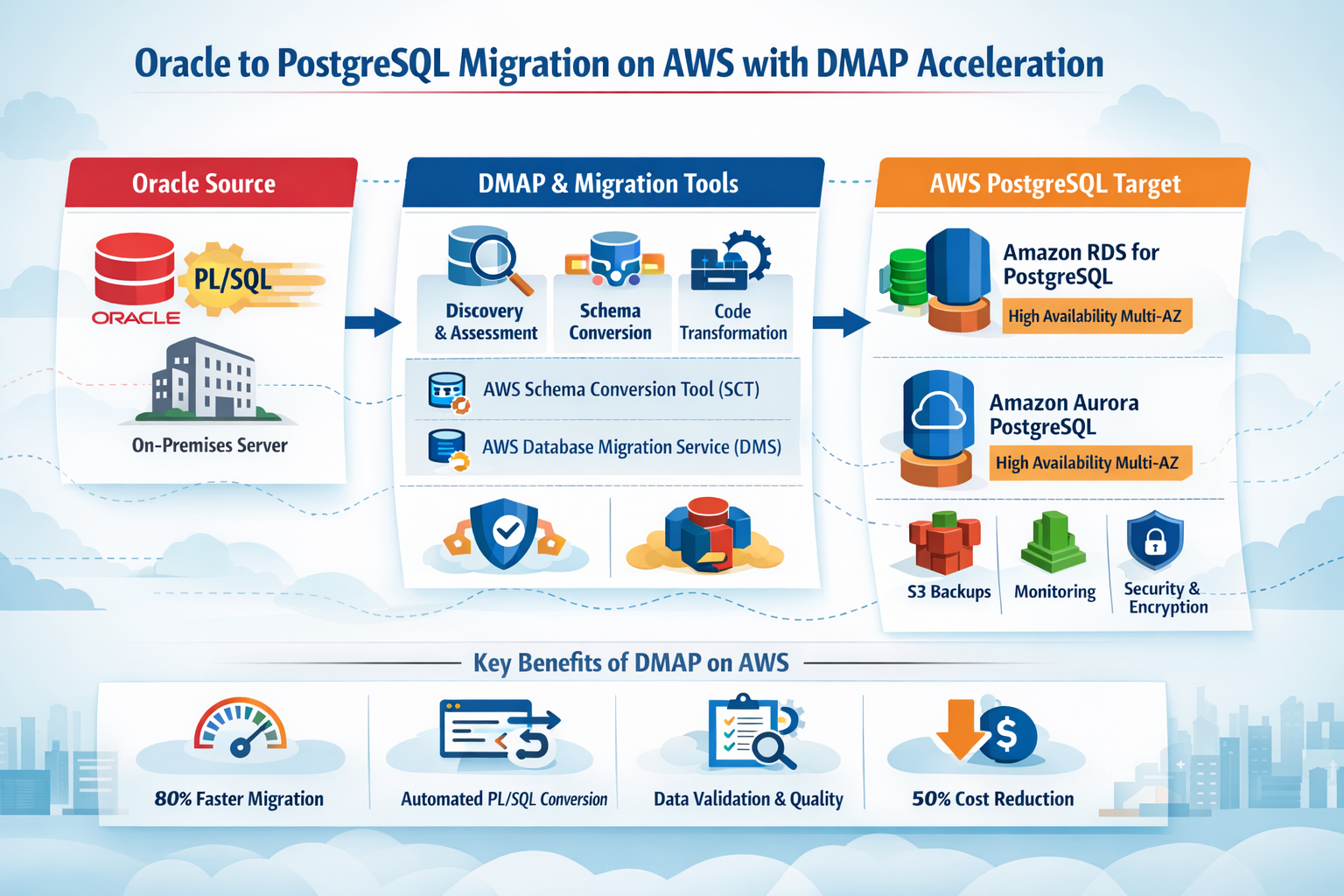
Database migrations often stall due to complexity in schema conversion, procedural logic transformation, and validation cycles. DMAP on AWS (Database Modernization Acceleration Platform) addresses these challenges by automating discovery, assessment, schema conversion, code transformation, and validation processes.
When migrating to AWS with DMAP, enterprises gain:
-
Automated schema and object discovery
-
Accelerated PL/SQL to PostgreSQL conversion
-
Built-in validation and reconciliation frameworks
-
Reduced manual intervention
-
Improved accuracy and reduced risk
DMAP integrates with AWS-native tools such as AWS Schema Conversion Tool (SCT) and AWS Database Migration Service (DMS), enhancing automation while preserving AWS best practices. This structured acceleration can significantly reduce migration timelines and lower project costs compared to traditional manual approaches.
For organizations seeking predictable outcomes, DMAP introduces repeatability, transparency, and governance into the modernization lifecycle.
Step-by-Step Oracle to PostgreSQL Migration Process on AWS
1. Assessment and Discovery
Migration begins with a comprehensive evaluation of schema complexity, stored procedures, dependencies, data volume, and performance baselines. Tools such as AWS SCT and DMAP generate readiness assessments that quantify conversion effort and highlight compatibility gaps.
Clear success metrics, rollback strategies, and downtime windows must be defined during this stage.
2. Schema Conversion
Oracle and PostgreSQL differ in data types, indexing behavior, partitioning structures, and constraint handling. Automated conversion tools translate most structural elements, while proprietary Oracle constructs may require redesign.
DMAP enhances this stage through deeper schema analysis and structured transformation workflows across multi-schema enterprise environments.
3. Code Conversion (PL/SQL to PL/pgSQL)
Converting procedural logic is often the most complex aspect of migration. Oracle packages, triggers, cursors, and exception handling mechanisms must be adapted to PostgreSQL equivalents.
Automation accelerates this transformation, but expert review ensures semantic equivalence, optimized execution plans, and adherence to PostgreSQL best practices.
4. Data Migration Using AWS DMS
AWS Database Migration Service supports both full-load data transfers and Change Data Capture (CDC) replication. CDC enables near-zero downtime cutovers by synchronizing changes between source and target environments until final switchover.
Performance tuning of replication instances ensures optimal throughput for large-scale enterprise databases.
5. Testing and Validation
Data integrity checks, checksum comparisons, and application regression testing confirm accuracy. Performance benchmarking compares query execution times and concurrency behavior between Oracle and PostgreSQL environments.
Validation frameworks embedded within DMAP further reduce reconciliation errors.
6. Optimization and Performance Tuning
Post-migration optimization may involve query rewriting, index restructuring, partition adjustments, and configuration tuning (e.g., memory allocation and connection pooling). Aurora PostgreSQL deployments may require additional parameter optimization to leverage distributed storage architecture fully.
Oracle to Aurora PostgreSQL Migration on AWS
For high-availability and high-throughput workloads, Aurora PostgreSQL often represents the optimal target platform. Its decoupled storage layer automatically scales up to petabytes while providing fault tolerance across availability zones.
Aurora supports read replicas, automated backups, and rapid failover, making it suitable for mission-critical applications. Organizations with variable workloads may also benefit from Aurora Serverless v2, which dynamically adjusts capacity based on demand.
Selecting between Amazon RDS and Aurora depends on workload intensity, scalability requirements, and cost considerations.
Cost Savings and Total Cost of Ownership
Oracle to PostgreSQL migration on AWS typically results in substantial total cost of ownership (TCO) reductions. Eliminating licensing fees can produce immediate savings, while AWS managed services reduce administrative overhead.
Infrastructure right-sizing, automated backups, and scalable storage further optimize costs. Over a multi-year horizon, organizations often achieve measurable financial benefits while simultaneously increasing agility and scalability.
Tools Supporting Oracle to PostgreSQL Migration
A successful migration leverages a combination of technologies:
-
AWS Schema Conversion Tool (SCT) for schema assessment and translation
-
AWS Database Migration Service (DMS) for data replication and synchronization
-
ora2pg for open-source code extraction
-
Enterprise migration toolkits for advanced procedural conversion
-
DMAP on AWS for end-to-end automation and governance
Together, these tools form a structured modernization framework that reduces risk and accelerates execution.
Common Migration Challenges and Mitigation
Migration challenges include PL/SQL incompatibilities, proprietary Oracle feature dependencies, data type precision differences, and performance regressions. Early discovery and automated analysis significantly reduce these risks.
Hierarchical queries, sequence behavior, and date/time handling often require careful redesign. Performance benchmarking and parallel validation environments ensure stable production cutovers.
A disciplined methodology mitigates risk while preserving business continuity.
Why Choose a Specialized Oracle to PostgreSQL Migration Partner
Oracle to PostgreSQL migration on AWS requires cross-platform expertise in Oracle internals, PostgreSQL optimization, and AWS architecture design. A specialized partner provides structured assessment models, automation accelerators such as DMAP, and proven migration playbooks that reduce downtime and ensure performance parity.
Expert-led migrations prioritize security hardening, compliance alignment, and scalability planning from the outset, preventing costly post-migration remediation.
Conclusion
Oracle to PostgreSQL migration on AWS is a strategic modernization initiative that delivers cost optimization, scalability, and cloud alignment. By combining AWS managed services with automation frameworks such as DMAP on AWS, enterprises can reduce migration timelines, mitigate risk, and accelerate time to value.
Organizations that adopt a structured, automation-driven migration strategy position themselves for long-term innovation, operational efficiency, and competitive advantage in an increasingly cloud-first world
Get Started for FREE: Book a Call with our solution expert
Related Content
Oracle to PostgreSQL Conversion Tool DMAP™ by Newt Global for Enterprise AI-Driven Database Modernization
Oracle to Postgres Conversion Using Newt Global DMAP™
Oracle to PostgreSQL Migration in Weeks with DMAP AI
Oracle to PostgreSQL Migration Tool: Schema, Data & Cloud Strategy
Frequently Asked Questions
How long does Oracle to PostgreSQL migration on AWS take?
The timeline depends on database size, schema complexity, volume of PL/SQL logic, integration dependencies, and downtime constraints. Small to mid-sized databases may take a few weeks, while complex enterprise environments can require several months. Using automation platforms such as DMAP on AWS significantly reduces assessment, conversion, and validation timelines.
What is DMAP on AWS?
DMAP (Database Modernization Acceleration Platform) on AWS is an automation-driven framework designed to accelerate migration from legacy databases such as Oracle to cloud-native platforms like PostgreSQL on Amazon RDS or Aurora. It automates schema discovery, conversion, code transformation, validation, and governance, reducing manual effort and minimizing migration risk.
Can PL/SQL be automatically converted to PostgreSQL?
A significant portion of PL/SQL code can be automatically converted using tools such as AWS SCT, ora2pg, enterprise migration toolkits, and DMAP. However, complex business logic, proprietary Oracle constructs, and performance-critical procedures typically require expert validation and optimization to ensure semantic accuracy and efficiency.
What are the cost savings of moving from Oracle to PostgreSQL on AWS?
Organizations typically reduce total cost of ownership by eliminating Oracle licensing fees, optimizing compute resources, and leveraging AWS managed services. Over a three-year period, enterprises often achieve substantial cost reductions while improving scalability and operational efficiency.
Should we choose Amazon RDS PostgreSQL or Aurora PostgreSQL?
Amazon RDS PostgreSQL is suitable for many production workloads and offers managed automation. Aurora PostgreSQL is recommended for high-throughput, mission-critical applications requiring enhanced availability, distributed storage scaling, and faster failover capabilities. The choice depends on workload intensity, scalability requirements, and budget considerations.