
Oracle to Azure Database for PostgreSQL Migration: A Modernization Playbook with DMAP AI
A Technical Whitepaper on Enterprise Oracle Database Modernization on Azure
Executive Summary
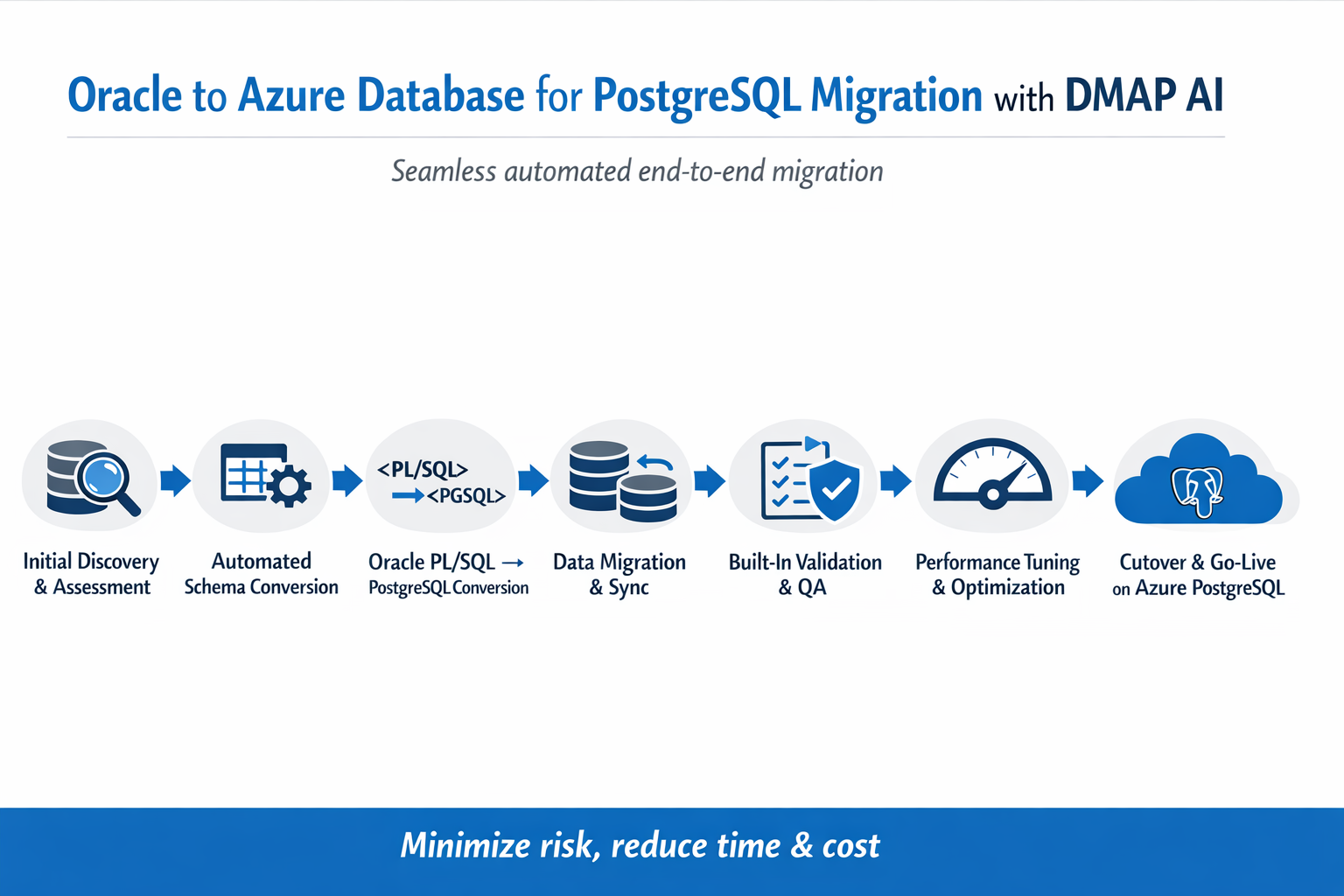
Oracle to Azure Database for PostgreSQL Migration is no longer a tactical IT initiative—it is a strategic transformation imperative. Enterprises seeking cost optimization, operational agility, and cloud-native scalability are increasingly adopting structured Oracle to PostgreSQL migration strategies on Microsoft Azure.
However, large-scale Oracle database modernization requires precision across schema conversion, Oracle PL/SQL to PostgreSQL conversion, data synchronization, application remediation, validation, and performance tuning.
This whitepaper provides a comprehensive modernization framework for executing enterprise-grade Oracle to Azure PostgreSQL migration using DMAP AI (Database Modernization Acceleration Platform)—an AI-powered database migration automation engine designed to industrialize cloud database migration at scale.
1. Strategic Imperative for Oracle to Azure Database for PostgreSQL Migration
1.1 Economic Drivers
Traditional Oracle environments involve:
-
High perpetual licensing costs
-
Annual support and maintenance fees
-
Infrastructure overhead
-
Complex RAC clustering costs
-
Hardware refresh cycles
Migrating to Azure Database for PostgreSQL eliminates proprietary database licensing while leveraging consumption-based cloud pricing models.
Oracle to Azure Database for PostgreSQL migration enables measurable reductions in Total Cost of Ownership (TCO).
1.2 Technical Drivers for Oracle to PostgreSQL Migration
Organizations pursuing Azure PostgreSQL migration benefit from:
-
Managed High Availability
-
Built-in automated backups
-
Native monitoring (Azure Monitor)
-
Elastic compute scaling
-
Secure networking (Private Endpoints)
-
DevOps-native database integration
Database modernization on Azure allows enterprises to move from monolithic Oracle architectures to scalable, resilient cloud-native data platforms.
2. Enterprise Reference Architecture for Oracle to Azure PostgreSQL Migration
Below is a text-based architecture diagram for web deployment.
2.1 Logical Architecture Diagram
3. Technical Deep Dive: Oracle to Azure PostgreSQL Migration Lifecycle
3.1 Discovery & Assessment
A successful Oracle to Azure Database for PostgreSQL migration begins with deep technical assessment.
Key Assessment Metrics:
-
Total schema count
-
Object count (tables, views, indexes)
-
PL/SQL lines of code
-
Data volume (TB)
-
Peak transaction rate
-
Oracle-specific features usage
Sample Schema Inventory Query (Oracle)
DMAP AI automates:
-
Schema inventory
-
Object dependency graph generation
-
PL/SQL complexity scoring
-
Migration effort estimation
This enables predictable Oracle to PostgreSQL migration planning.
3.2 Schema Conversion for Oracle to PostgreSQL Migration
Data Type Mapping Matrix
| Oracle Data Type | PostgreSQL Equivalent |
|---|---|
| NUMBER | NUMERIC / BIGINT |
| VARCHAR2 | VARCHAR |
| DATE | TIMESTAMP |
| CLOB | TEXT |
| BLOB | BYTEA |
| RAW | BYTEA |
Example: Complex Table Conversion
Oracle
PostgreSQL
During Oracle to Azure PostgreSQL migration, special attention is required for:
-
Partitioned tables
-
Materialized views
-
Synonyms
-
Database links
DMAP AI automatically flags non-compatible constructs.
3.3 Oracle PL/SQL to PostgreSQL Conversion
Enterprise Oracle to PostgreSQL migration requires converting business logic.
Oracle Exception Handling
PostgreSQL Equivalent
Key differences in Oracle PL/SQL to PostgreSQL conversion:
-
Packages must be refactored
-
Autonomous transactions must be redesigned
-
BULK COLLECT syntax differs
-
DBMS_SCHEDULER jobs require reimplementation
DMAP AI accelerates large-scale PL/SQL transformation.
3.4 Data Migration Strategy for Azure PostgreSQL Migration
Migration Modes
Offline Migration
-
Suitable for smaller systems
-
Acceptable downtime window
Online Migration (Recommended for Enterprise)
-
Bulk load
-
Change Data Capture (CDC)
-
Minimal downtime cutover
Validation Query Example
Row count validation and checksum validation ensure data integrity in Oracle to Azure Database for PostgreSQL migration.
3.5 Performance Tuning After Oracle to PostgreSQL Migration
Key PostgreSQL parameters:
Query Plan Analysis
Post-migration optimization ensures Azure PostgreSQL meets or exceeds Oracle performance.
4. AI-Powered Acceleration with DMAP AI
Manual Oracle database modernization introduces:
-
Migration delays
-
Conversion inaccuracies
-
Cost overruns
DMAP AI enhances:
-
Schema automation
-
Code transformation
-
Validation automation
-
Risk prediction
-
Cutover orchestration
This makes Oracle to Azure Database for PostgreSQL migration scalable across hundreds of databases.
5. Enterprise Case Study: Large-Scale Oracle to Azure PostgreSQL Migration
Client Profile
-
Fortune 500 Enterprise
-
70+ TB Oracle database
-
1200+ stored procedures
-
300+ applications integrated
Challenges
-
Zero downtime requirement
-
Heavy PL/SQL usage
-
Complex partitioning logic
Solution
-
Automated schema transformation
-
AI-driven Oracle PL/SQL to PostgreSQL conversion
-
Parallel data migration pipelines
-
Incremental sync for zero-downtime cutover
-
Performance tuning on Azure Flexible Server
Results
-
60% migration time reduction
-
45% infrastructure cost reduction
-
Improved query performance
-
Eliminated Oracle licensing costs
FAQ: Oracle to Azure Database for PostgreSQL Migration
What is Oracle to Azure Database for PostgreSQL migration?
Oracle to Azure Database for PostgreSQL migration is the process of converting Oracle database workloads to Azure-managed PostgreSQL environments while preserving data integrity, schema structure, and application functionality.
How complex is Oracle to PostgreSQL migration?
Oracle to PostgreSQL migration complexity depends on schema size, PL/SQL code volume, Oracle-specific features, and data scale. Enterprise migrations require structured automation.
What are the benefits of Azure Database for PostgreSQL migration?
-
Lower TCO
-
Built-in high availability
-
Elastic scaling
-
Cloud-native integration
-
Managed infrastructure
How is PL/SQL converted to PostgreSQL?
Oracle PL/SQL is converted to PL/pgSQL through syntax translation, logic restructuring, and package refactoring. AI-powered tools like DMAP AI automate this process.
How long does Oracle to Azure PostgreSQL migration take?
Timelines vary by complexity. With AI-powered database migration automation, enterprises can reduce migration time by up to 50–80%.
7. Conclusion: Enterprise-Grade Oracle Database Modernization on Azure
Oracle to Azure Database for PostgreSQL migration represents a transformational opportunity for enterprises seeking modernization, cost efficiency, and scalability.
However, success requires:
-
Deep technical planning
-
Automated schema and PL/SQL conversion
-
Structured validation
-
Performance optimization
-
Controlled cutover execution
By combining:
-
Azure Database for PostgreSQL
-
AI-powered database migration via DMAP AI
-
Structured Oracle to PostgreSQL migration methodology
Organizations can confidently execute large-scale database modernization on Azure with reduced risk and accelerated timelines.