
Database Modernization with DMAP
Simplify, Automate, Validate: Modernizing the Data Estate with DMAP Across Clouds
Database modernization with DMAP transforms fragmented, high‑risk migration initiatives into a governed, automated, and fully validated transformation engine for the entire data estate.
Modern enterprises can no longer rely solely on legacy databases. They require a clear, scalable path to database modernization that balances speed, risk, and cost. DMAP (Database Modernization Acceleration Platform) enables organizations to modernize their data estates by simplifying toolchains, automating end‑to‑end workflows, and validating every step across on‑premises and multi‑cloud environments.
Why Data Estate Modernization Fails
Although most organizations recognize the need for data estate modernization, many initiatives stall or fail due to complexity, fragmentation, and operational risk.
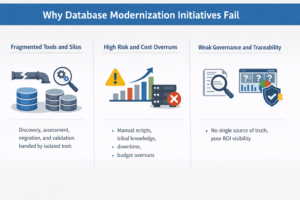
Fragmented Tools and Silos
Discovery, assessment, schema conversion, migration, validation, and application remediation are often handled by disconnected tools and teams, with no single source of truth.
High Risk and Cost Overruns
Manual scripts, tribal knowledge, and ad‑hoc processes increase the likelihood of downtime, data inconsistencies, performance regressions, and budget overruns.
Weak Governance and Traceability
Without a governed modernization pipeline, organizations struggle to trace decisions, demonstrate compliance, or clearly articulate ROI to business stakeholders.
As a result, many Oracle‑to‑PostgreSQL and SQL Server‑to‑PostgreSQL migration initiatives never scale beyond pilot phases, even with strong executive sponsorship.
The “Simplify, Automate, Validate” Approach
A “Simplify, Automate, Validate” strategy treats data estate modernization as a single, integrated lifecycle rather than a series of disconnected tasks.
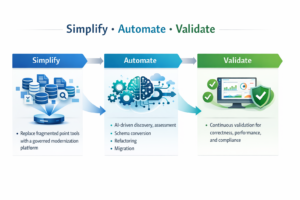
Simplify
Replace a patchwork of point tools with one governed database modernization platform that understands the entire estate across on‑premises and multi‑cloud environments.
Automate
Apply AI‑driven and rules‑based automation for deep discovery, assessment, schema conversion, code refactoring, and cloud database migration at scale.
Validate
Embed continuous validation at every stage to prove correctness, performance, and compliance for each migrated workload.
This approach converts database modernization from a risky, one‑time initiative into a repeatable, industrialized enterprise capability.
What Is DMAP?
DMAP (Database Modernization Acceleration Platform) from Newt Global is an AI‑powered, containerized platform designed to industrialize database modernization and cloud database migration.
End‑to‑End Automation
DMAP integrates discovery, assessment, schema conversion, data migration, validation, and application remediation into a single orchestrated pipeline.
Heterogeneous Platform Support
Built for complex enterprise environments, DMAP supports large‑scale Oracle‑to‑PostgreSQL and SQL Server‑to‑PostgreSQL migrations, including managed PostgreSQL services on leading cloud platforms.
Cloud‑Aligned Modernization Programs
DMAP underpins joint modernization initiatives with hyperscalers such as Google Cloud, enabling confident adoption of cloud‑native databases.
Enterprises adopt DMAP as their modernization control plane, replacing dozens of scripts and niche tools with one governed, auditable engine.
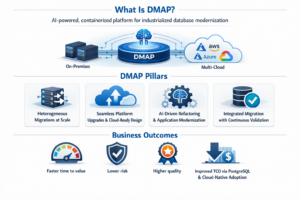
Four DMAP Pillars for Modernizing the Data Estate
A DMAP‑driven “Simplify, Automate, Validate” strategy aligns with four core pillars that reflect how large enterprises modernize at scale.
1. Heterogeneous Migrations at Scale
Enterprises typically operate a mix of Oracle, SQL Server, and other legacy databases that must be consolidated and modernized to PostgreSQL and cloud‑native platforms.
Estate‑Wide Discovery and Assessment
DMAP automatically discovers and catalogs heterogeneous environments, identifying schemas, objects, dependencies, and complexity hotspots across thousands of databases and applications.
Industrialized Cross‑Platform Conversion
DMAP automates schema and code conversion from Oracle and SQL Server to PostgreSQL, including PL/SQL, T‑SQL, packages, and dynamic SQL, while flagging exceptions for targeted remediation.
This provides CIOs and data leaders with a quantified, evidence‑based view of effort, risk, and timelines.
2. Seamless Platform Upgrades and Cloud‑Ready Design
Not every modernization step involves cross‑platform migration. Many organizations must first execute in‑place upgrades.
Oracle‑to‑Oracle Refresh
DMAP supports Oracle‑to‑Oracle upgrades through automated impact analysis, remediation, migration planning, and cutover management.
Cloud‑Ready Architecture
Managing upgrades and migrations within the same framework avoids new technical debt and prepares workloads for future moves to PostgreSQL and managed cloud databases.
Each upgrade becomes a strategic step toward the target modern architecture.
3. AI‑Driven Refactoring and Application Modernization
True data estate modernization extends beyond data movement to transforming application logic and integration patterns.
Intelligent Code Transformation
DMAP uses AI‑driven and rules‑based engines to analyze and refactor application code, including PL/SQL‑heavy logic, toward Java and PostgreSQL‑compatible, cloud‑native patterns.
Deterministic and Explainable Outcomes
Transformations are deterministic and auditable, preserving business rules and simplifying code reviews.
This enables teams to modernize databases and applications in parallel, reducing timelines and long‑term maintenance costs.
4. Integrated Motion with Continuous Validation
Many database migration initiatives fail at handoff points between stages.
Single Modernization Pipeline
DMAP orchestrates assessment, conversion, migration, and refactoring within one unified workflow, maintaining consistent metadata, governance, and observability.
Built‑In Validation and Certification
Continuous validation ensures data integrity, functional accuracy, and performance, with evidence captured for compliance, audit, and stakeholder assurance.
This integrated approach transforms modernization into a fully traceable, low‑risk journey.
Business Outcomes of DMAP‑Driven Modernization
Organizations adopting a DMAP‑driven strategy realize measurable improvements across speed, quality, and economics.
- Faster Time to Value: AI‑driven automation and standardized playbooks reduce migration timelines from months to weeks for many workloads.
- Lower Risk and Higher Quality: Dependency analysis and continuous validation minimize post‑cutover incidents and regressions.
- Improved Total Cost of Ownership: Migration from high‑license‑cost legacy platforms to PostgreSQL and cloud‑native services delivers sustained cost savings and strategic flexibility.
These outcomes help technology leaders secure executive sponsorship, satisfy regulatory requirements, and demonstrate ROI.
Getting Started with DMAP
Successful enterprises treat database modernization as a structured, evidence‑driven program.
Start with a DMAP Assessment
Conduct an estate‑wide assessment to inventory platforms, quantify effort, identify quick wins, and prioritize workloads.
Align with Cloud Strategy
Use DMAP insights to define where PostgreSQL, managed cloud databases, and platform upgrades fit within the broader modernization roadmap.
Standardize the Modernization Playbook
Institutionalize the “Simplify, Automate, Validate” model to ensure future initiatives reuse proven automation and governance.