
Beyond Migration: A CIO’s Playbook for Operating PostgreSQL in Mission-Critical Environments
The Day-2 Problem Most Migration Plans Skip
Migration projects are scoped around Day 1: schema conversion, code translation, data movement, validation, cutover. Those are finite, well understood, and increasingly automated. Day 2 is everything after cutover, and it never ends. It covers high availability, patching, upgrades, monitoring, backup and recovery, performance tuning, capacity planning, security hardening, and the human expertise to run all of it.
The reason Day 2 gets underplanned is simple. On proprietary databases, much of it came bundled with the license and the support contract. You paid for it whether you noticed or not. On PostgreSQL, those responsibilities do not disappear, they shift to you. That shift is the whole point of the move, because it is where the savings and the flexibility come from, but it only pays off if the operating model is deliberate rather than assumed.
Can PostgreSQL Replace proprietary database in Production?
This is the question that stalls proprietary database exits, and the honest answer is yes, with a caveat. PostgreSQL is a mature, enterprise-grade database that runs mission-critical workloads across banking, insurance, government, and large-scale digital platforms. The engine is not the concern. The concern is the operating discipline around it.
Proprietary database enterprises are used to a single vendor owning the stack, the tooling, and the escalation path. PostgreSQL is open source, which means the ecosystem is broader and the choices are yours to make. High availability, backup, monitoring, and support are all solved problems in the PostgreSQL world, but they are assembled rather than bought as one box. So the real question is not whether PostgreSQL can replace Oracle in production. It can. The question is whether you have designed the operating model, or the support relationship, to run it with the same confidence you had before.
The rest of this playbook walks through the decisions that answer that question.
Designing for PostgreSQL High Availability and Resilience
Mission-critical means the database cannot be a single point of failure. In a PostgreSQL estate, PostgreSQL high availability is achieved through replication, automated failover, and connection routing, rather than through a proprietary clustering product. The building blocks are well established: streaming replication for standby copies, a failover mechanism to promote a standby when the primary fails, and a routing layer so applications reconnect without manual intervention.
The design decisions that matter here are recovery objectives, not tools. How much data can the business afford to lose if a node fails, and how quickly must service resume? Those answers dictate whether you run synchronous or asynchronous replication, how many standbys you keep, and whether you spread them across availability zones or regions. Enterprises coming from Proprietary databases often carry strict continuity requirements, and PostgreSQL high availability can meet them, but only when the topology is designed around those targets from the start rather than retrofitted after an incident.
Performance and Scale in Enterprise PostgreSQL
PostgreSQL performance tuning is where the difference between a database that runs and a database that runs well shows up. Proprietary database workloads carry years of accumulated optimization: indexing strategies, query plans, memory settings, and partitioning schemes tuned to the platform. Those do not transfer directly. PostgreSQL rewards a fresh look at how queries are written, how indexes are structured, how autovacuum is configured, and how connection pooling is handled at scale.
For high-throughput systems, connection management alone can make or break performance, since PostgreSQL handles connections differently from Proprietary database and benefits from pooling in front of the database. Partitioning, parallel query, and workload-appropriate extensions extend the engine to analytical, spatial, time-series, and other specialized needs. The takeaway for leadership is that performance at scale is a continuous operating activity, not a one-time migration output. Budget for tuning as an ongoing capability, whether that lives in-house or with a partner.
Backup, Disaster Recovery, and Business Continuity
A production database is only as trustworthy as its recovery story. PostgreSQL supports full and incremental backups, point-in-time recovery, and continuous archiving, which together let you restore to a precise moment before an error or failure. The tooling is robust and battle-tested.
What enterprises need to formalize is the policy layer on top: how often backups run, how long they are retained, where copies live, and how often restores are actually tested. A backup that has never been restored is a hope, not a plan. Disaster recovery for enterprise PostgreSQL should be documented, rehearsed, and measured against the same recovery objectives that drive the high availability design. This is an area where the discipline carried over from the proprietary database years is an asset, and where it should be applied deliberately to the new platform.
Security, Compliance, and Governance
Regulated industries do not relax their controls because the database changed. PostgreSQL provides the security primitives enterprises expect: role-based access control, row-level security, encryption in transit and at rest, and detailed logging for audit. Mapping your existing proprietary database security model onto these primitives is a design exercise worth doing carefully, because the concepts are similar but not identical.
Governance also means patching and version currency. PostgreSQL has a predictable release and support lifecycle, and staying on supported versions is a security requirement, not a nice-to-have. An operating model that lets versions drift out of support quietly reintroduces the kind of risk the modernization was meant to reduce. Build patching and upgrade cadence into the plan from the beginning.
The Skills Question: Build, Buy, or Blend
Every decision above eventually comes back to people. The most common reason an proprietary database exit underdelivers is not the technology, it is the assumption that the existing team will simply operate the new platform on day one. Oracle DBA expertise is deep and valuable, and much of it transfers, but PostgreSQL has its own operational idioms that take time to master.
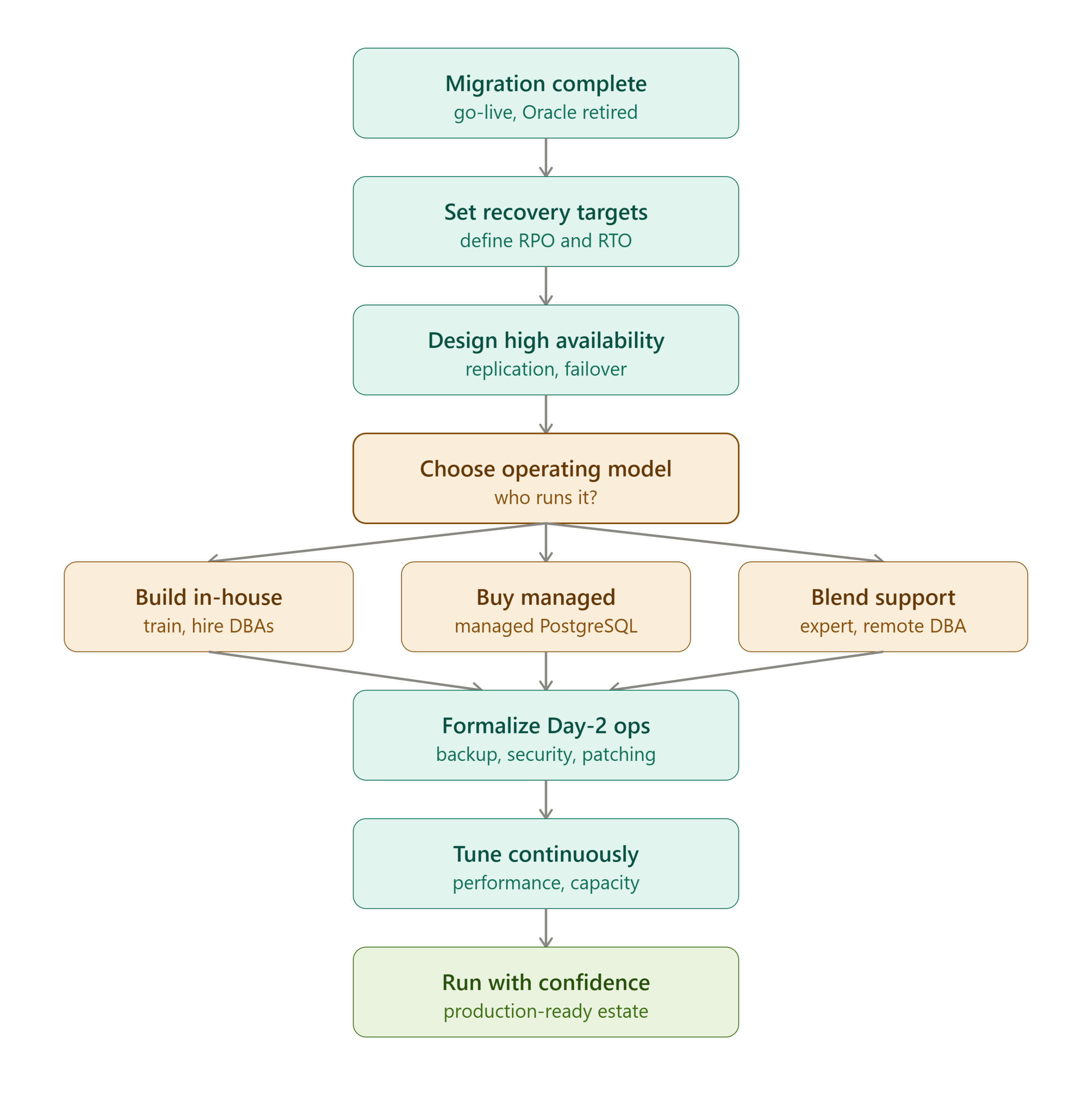
Enterprises generally have three paths, and most blend them.
Build the capability in-house
Invest in training, hire PostgreSQL DBA talent, and grow an internal team. This gives you the most control and works well when the estate is large and databases are core to the business. It takes time and a competitive hiring market to get there.
Buy managed PostgreSQL
A managed PostgreSQL service, whether a cloud provider offering or a partner-run environment, takes operational responsibility for availability, backups, and patching. This reduces the internal burden and speeds time to a stable operating state, in exchange for a service relationship and recurring cost.
Blend with expert support
Many enterprises keep ownership of the estate but add enterprise PostgreSQL support and remote PostgreSQL DBA services for escalation, tuning, and coverage. This preserves control while removing the risk of a thin internal bench, and it is often the pragmatic middle path during the first year after migration.
There is no single right answer. The right answer depends on the size of the estate, the criticality of the workloads, and the maturity of the internal team. What matters is deciding deliberately, before an incident forces the decision for you. Engaging PostgreSQL consulting services early to design the operating model is usually cheaper than untangling one that grew by accident.
The Real Total Cost of Ownership
The business case for leaving proprietary database usually leads with licensing savings, and those are real. But a credible PostgreSQL total cost of ownership model looks past the license line. It accounts for the operating model you choose: the infrastructure to run high availability, the tooling for monitoring and backup, the training or hiring to build expertise, and the support or managed-service relationship if you use one.
The reason this matters is not that PostgreSQL is expensive. It is dramatically more cost-effective than the proprietary alternative in almost every case. The reason it matters is credibility. A CIO who presents savings without the operating costs baked in will face those costs later and lose trust. A total cost of ownership model that includes Day-2 operations from the start is both more honest and more defensible, and it almost always still shows a compelling case for the move. Present the whole picture and the numbers speak for themselves.
Choosing Your Operating Model
Pulling the threads together, the operating model for running PostgreSQL in production comes down to a few linked choices. Define your availability and recovery targets first, because they drive the architecture. Decide where operational responsibility sits, in-house, managed, or supported, because that drives cost and staffing. Formalize backup, security, and patching as ongoing disciplines rather than project tasks. And treat performance tuning and capacity planning as continuous capabilities.
An enterprise that makes these choices deliberately runs PostgreSQL with the same confidence it once had with proprietary database, at a fraction of the cost and with far more flexibility. An enterprise that treats go-live as the end of the project inherits all of these decisions at the worst possible moment, during an incident. The playbook is not complicated. It just has to be written before you need it.
Where DMAP AI Fits
Newt Global built DMAP AI to close the gap between migrating off proprietary database and operating confidently on PostgreSQL. The platform automates the hardest parts of the proprietary database to PostgreSQL migration itself, from assessment through schema, code, and data conversion to validation, which shortens the path to a stable production estate. Just as important, that same visibility into your database, its dependencies, and its complexity carries into the operating phase, giving your team a clear picture of what they are running and where the risks sit.
For enterprises that want more than tooling, Newt Global pairs DMAP AI with the expertise to design the operating model, stand up high availability, and provide ongoing support so the estate is production-ready from the first day and stays that way. The goal is continuity: not just a successful cutover, but a database you can run with confidence for years.