
SQL Server to PostgreSQL Migration: The First Step Toward an AI-Ready Enterprise
Why enterprises are moving away from SQL Server
The pressure to migrate SQL Server to PostgreSQL rarely comes from a single source. It builds over time:
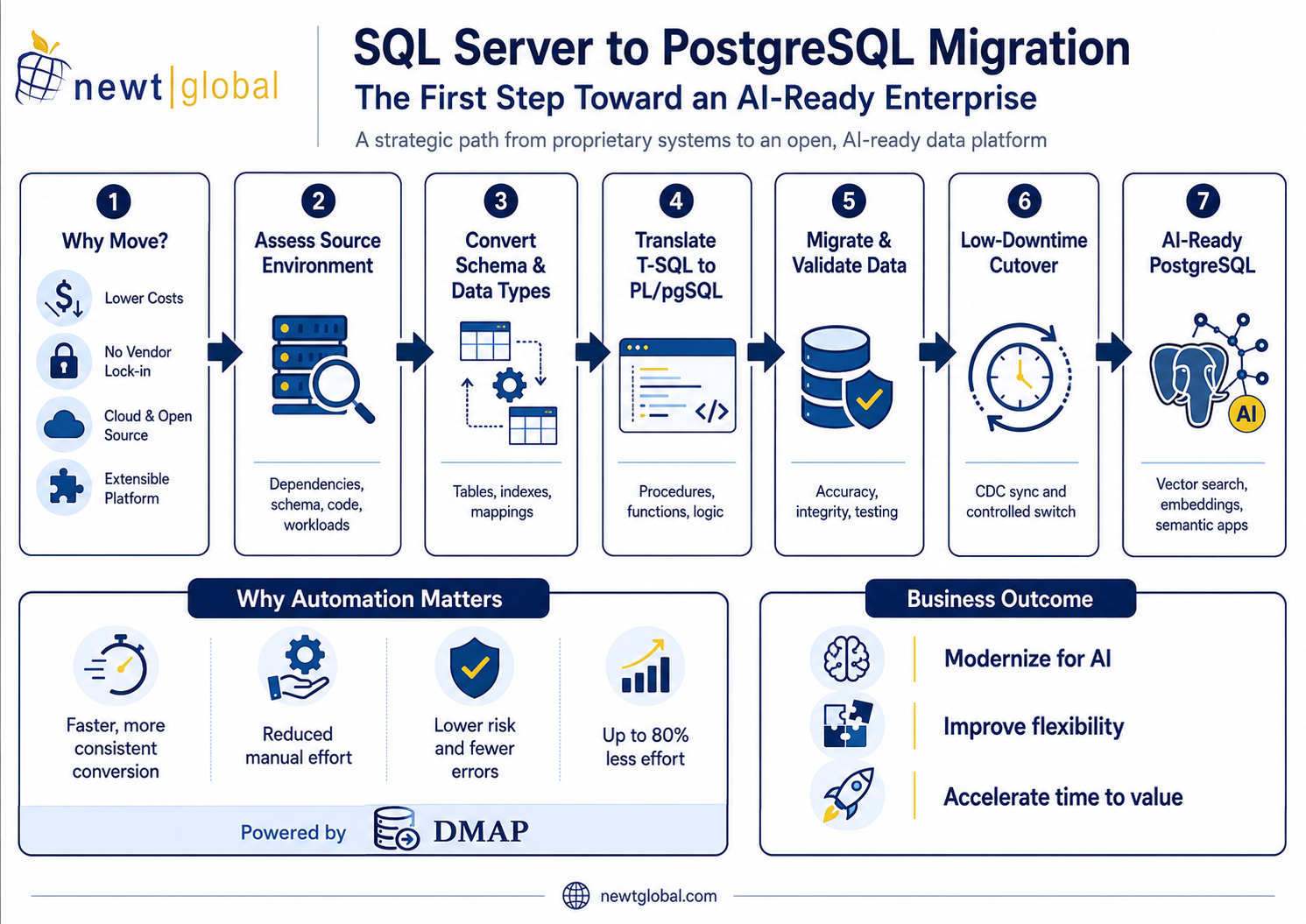
- Licensing and support costs. Proprietary database licensing continues to climb, and every renewal cycle puts more strain on IT budgets that leaders would rather spend on innovation.
- Vendor lock-in. Tightly coupled, closed ecosystems limit how freely an organization can adopt new cloud services, architectures, and tooling.
- Cloud and open source momentum. PostgreSQL is supported across every major cloud, backed by a vibrant community, and trusted for mission-critical workloads at global scale.
- Extensibility. Native support for JSONB, full-text search, geospatial data, and a deep extension ecosystem lets teams solve modern problems without bolting on separate systems.
The result is a clear strategic case. PostgreSQL delivers the flexibility and cost efficiency that a closed platform cannot, and it does so without asking teams to compromise on reliability or performance.
SQL Server vs PostgreSQL: what actually changes
When teams first compare SQL Server vs PostgreSQL, they often assume the move is a simple lift and shift. In reality it is a shift in ecosystem and mindset, not only syntax.
Both are mature relational database systems, but they diverge in meaningful ways. Procedural code written in T-SQL must be converted to PL/pgSQL. Data types do not always map one to one. Identity columns, default schemas, and query patterns such as TOP versus LIMIT all need attention. Application logic that lives deep inside the database requires the most care.
None of this is a barrier. It is simply the work that a well planned migration is designed to handle, and it is exactly where the right approach separates a smooth transition from a stalled project.
Modernize your SQL Server database for AI
Here is the shift that changes the conversation. The reason to modernize a SQL Server database for AI is not only cost. It is capability.
PostgreSQL has quickly become the default open platform for AI workloads. With extensions for vector storage and similarity search, teams can generate embeddings, run semantic search, and power retrieval augmented generation directly alongside their operational data. Managed PostgreSQL services across the major clouds now integrate natively with AI models and agent frameworks, which means the database becomes part of the intelligence layer rather than a silo behind it.
For an enterprise still running critical workloads on a proprietary engine, that gap widens every quarter. Migrating is what closes it. A move to PostgreSQL turns a legacy data store into a platform ready for intelligent, context-aware applications.
The migration challenge and why automation matters
The technical challenges of migration are real. T-SQL differences, data type mismatches, and the scale of enterprise codebases can make a manual project slow, costly, and risky. Hand conversion invites errors and drains skilled engineering time that would be better spent building.
This is where an automated SQL Server to PostgreSQL migration changes the equation. A reliable SQL Server to PostgreSQL converter handles schema mapping, code translation, and data movement with far greater speed and consistency than manual work allows. Automation reduces human error, shortens timelines, and gives teams a validated path from source to target.
The goal is not to remove human expertise. It is to focus that expertise on the decisions that matter, while automation carries the repetitive, labor-intensive conversion work.
Choosing the right tools and services
SQL Server to PostgreSQL migration tools range from lightweight open source utilities to enterprise-grade platforms. For small, simple databases, a basic converter may be enough. For mission-critical, high-complexity environments, organizations turn to comprehensive SQL Server to PostgreSQL migration services that combine automation with expert guidance.
An AI-powered platform such as DMAP is built for exactly this scenario. It provides deep assessment of the source environment, automated conversion of schema and application code, rigorous validation of data integrity, and a controlled, low-risk cutover. That combination removes the biggest barriers to migration and gives teams a clear, repeatable route to a cloud-native PostgreSQL architecture.
Migration is a strategic move, not a cost exercise
It is easy to frame a database migration as a way to trim a line item. The organizations that gain the most see it differently. They treat the move to PostgreSQL as the first step in becoming an AI-ready enterprise, freeing their data from proprietary constraints and positioning it for the applications that will define the next decade.
The question in 2026 is no longer whether to leave a proprietary database, but how quickly you can do it without disrupting the business. With the right strategy, tooling, and expertise, that transition is not just achievable. It is the foundation of everything that comes next.
Frequently asked questions
Why migrate from SQL Server to PostgreSQL?
Enterprises migrate to reduce licensing and support costs, escape vendor lock-in, gain cloud-native flexibility, and access an open, extensible platform. Increasingly, they also migrate to make their data ready for AI workloads such as vector search and retrieval augmented generation.
How do you migrate SQL Server to PostgreSQL?
A typical migration follows several stages: assess the source environment and dependencies, convert the schema and data types, translate T-SQL procedural code to PL/pgSQL, migrate and validate the data, test thoroughly, and plan a controlled cutover. Automated tools and platforms handle much of the conversion and validation work.
Is PostgreSQL a good choice for AI workloads?
Yes. PostgreSQL supports vector storage and similarity search through extensions, and managed PostgreSQL services integrate with AI models and agent frameworks. This lets teams build intelligent applications close to their operational data.
Can a SQL Server to PostgreSQL migration be automated?
To a large extent, yes. Automated migration platforms convert schema and application code, map data types, and validate results, which reduces manual effort and risk. Complex procedural logic still benefits from expert review.
What are the main challenges in migrating from SQL Server to PostgreSQL?
The most common challenges are converting T-SQL to PL/pgSQL, handling data type differences, dealing with database-centric application logic, and validating data integrity. A structured approach and automation address each of these.
Will migrating to PostgreSQL cause downtime?
It does not have to. Modern approaches use change data capture to keep the target database synchronized with the source until the moment of cutover, which supports a low-downtime transition for mission-critical systems.