
PostgreSQL Performance Clinic at PG Conf India 2026
Live Diagnosis and Tuning for Real-World Oracle to PostgreSQL Migrations
As enterprises accelerate their shift toward open-source databases, PostgreSQL continues to emerge as the preferred platform for modern, scalable, and cost-effective data infrastructure. However, migrating complex Oracle workloads to PostgreSQL brings a critical challenge: performance stability.
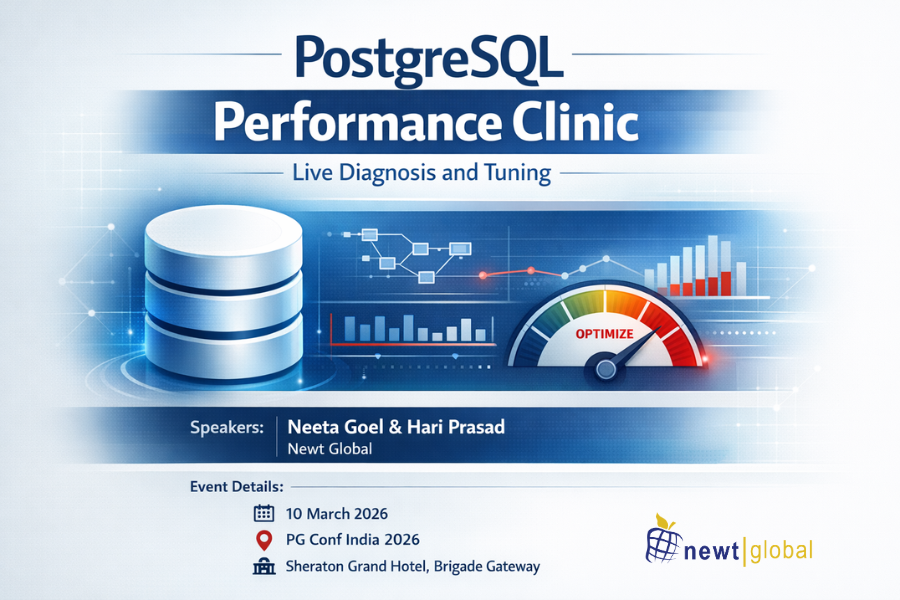
At PG Conf India 2026, Newt Global is conducting a focused training session titled:
PostgreSQL Performance Clinic: Live Diagnosis and Tuning
This interactive session is designed to help developers, DBAs, and architects understand how to diagnose, analyze, and tune PostgreSQL environments — especially in the context of Oracle-to-PostgreSQL migration.
Why Performance Matters in Database Migration
Database migration is more than schema conversion and data transfer. When workloads move from Oracle to PostgreSQL, differences in optimizer behavior, indexing strategy, concurrency control, and memory configuration can significantly impact performance.
Without structured tuning:
-
Queries may run slower than expected
-
Lock contention may increase
-
Table and index bloat can grow rapidly
-
Vacuum processes may become inefficient
-
Server resources may be underutilized or misconfigured
This session focuses on addressing those issues using practical, real-world examples.
What the PostgreSQL Performance Clinic Covers
Leveraging Database Metrics for Debugging and Tuning
Effective performance tuning begins with visibility. Participants will learn how to use PostgreSQL system views and metrics to identify bottlenecks and isolate performance constraints.
Topics include:
-
Monitoring active sessions and workload behavior
-
Identifying CPU and I/O pressure
-
Understanding query execution statistics
-
Interpreting system-level resource consumption
The goal is to develop a structured approach to performance troubleshooting rather than relying on trial and error.
Detecting Lock Contention, Deadlocks, and Bloat
Concurrency and transaction management differ significantly between Oracle and PostgreSQL. When workloads are migrated, new patterns of lock contention and transaction conflicts may emerge.
This session will cover:
-
Identifying blocking queries
-
Detecting deadlocks
-
Managing long-running transactions
-
Understanding table and index bloat
-
Optimizing vacuum and autovacuum processes
Participants will gain insight into maintaining system health under high-concurrency workloads.
Real-World Slow Query Analysis Using EXPLAIN (ANALYZE)
Query tuning is central to database performance.
Attendees will explore how to:
-
Interpret execution plans using EXPLAIN (ANALYZE)
-
Identify inefficient joins and scans
-
Improve index utilization
-
Refine query structures for better performance
Live examples will demonstrate how small query modifications can lead to measurable performance improvements.
Using pg_stat_statements, pgBadger, and auto_explain
Modern PostgreSQL performance tuning relies heavily on observability tools.
The session will demonstrate how to use:
-
pg_stat_statements to identify high-impact queries
-
pgBadger to analyze database logs and workload patterns
-
auto_explain to capture execution plans automatically
These tools enable continuous monitoring and proactive performance management in production environments.
Live Query Optimization Demo on Complex Workloads
A key highlight of the clinic is a live performance optimization exercise.
Participants will observe:
-
Baseline workload analysis
-
Execution plan interpretation
-
Index adjustments
-
Configuration tuning
-
Before-and-after performance comparison
This hands-on format ensures practical understanding of how tuning decisions translate into real improvements.
Deep Dive: Performance Optimization in Oracle to PostgreSQL Migration
Migrating complex Oracle workloads requires more than syntax translation. Differences in:
-
Query planner behavior
-
Statistics handling
-
Partitioning strategies
-
Memory configuration
-
Parallel execution
can affect how queries perform after migration.
The session will address:
-
Refactoring SQL for PostgreSQL-native efficiency
-
Aligning indexing strategies
-
Tuning server parameters for migrated workloads
-
Stabilizing performance during post-migration phases
This knowledge is particularly valuable for organizations modernizing legacy systems or adopting PostgreSQL as part of their digital transformation strategy.
Understanding and Configuring Server Parameters
PostgreSQL performance is strongly influenced by configuration settings.
Participants will learn how to approach tuning of:
-
Memory-related parameters
-
WAL and checkpoint configuration
-
Parallel query settings
-
Autovacuum behavior
Rather than applying generic templates, the session emphasizes workload-aware configuration.
Who Should Attend?
This intermediate-level session is ideal for:
-
PostgreSQL Developers
-
Database Administrators
-
Oracle DBAs planning migration
-
Solution Architects
-
Engineers involved in data migration and modernization
It is especially relevant for teams working on Oracle-to-PostgreSQL migration projects who want practical performance tuning skills.
Building Practical Performance Tuning Skills
The PostgreSQL Performance Clinic is structured to be interactive and example-driven. Participants will leave with:
-
A systematic diagnostic approach
-
Better understanding of execution plans
-
Insight into migration-related performance risks
-
Practical tuning techniques applicable to production systems
As PostgreSQL adoption continues to grow across enterprise environments, mastering performance engineering becomes essential for long-term success.
Join us at PG Conf India 2026 to gain hands-on insights into diagnosing and optimizing PostgreSQL performance in real-world migration scenarios.
Related Content
Newt Global Joins PGConf India 2026 as Platinum Sponsor
Reflections from PG Conf NYC 2025 — and How DMAP AI Is Redefining Data Modernization
Newt Global at PG Conf EU 2025: Cloud Modernization with DMAP AI
Frequently Asked Questions (FAQs)
1. Who should attend the PostgreSQL Performance Clinic?
This session is ideal for PostgreSQL developers, DBAs, Oracle DBAs planning migration, solution architects, and engineers responsible for database performance optimization in enterprise environments.
2. Is this session focused only on PostgreSQL, or does it cover Oracle as well?
The session primarily focuses on PostgreSQL performance tuning, but with special emphasis on performance considerations when migrating complex Oracle workloads to PostgreSQL.
3. What performance tools will be demonstrated?
Participants will learn how to use key PostgreSQL performance tools including:
-
EXPLAIN (ANALYZE)
-
pg_stat_statements
-
pgBadger
-
auto_explain
-
System-level monitoring tools
These tools help identify bottlenecks, optimize queries, and monitor database health.
4. Will there be live query optimization examples?
Yes. The session includes a live demonstration of diagnosing and tuning complex workloads, including slow query analysis, indexing improvements, and configuration tuning.
5. What are the common performance challenges after Oracle to PostgreSQL migration?
Typical challenges include:
-
Execution plan differences
-
Statistics misalignment
-
Lock contention
-
Table and index bloat
-
Improper memory configuration
-
Autovacuum tuning issues
The session addresses practical solutions for each of these.
6. Is prior PostgreSQL experience required?
This is an intermediate-level session. Participants should have basic familiarity with PostgreSQL and SQL. Experience reading execution plans will be beneficial.
7. Will server parameter tuning be covered?
Yes. The training includes guidance on configuring memory settings, WAL parameters, checkpoint behavior, and parallel execution to support migrated workloads efficiently.
8. How is this session different from standard PostgreSQL training?
Unlike theoretical workshops, this clinic focuses on real-world performance issues, migration-specific optimization strategies, and live diagnostic workflows used in production environments.