
Oracle-to-PostgreSQL Migration Validation with Agentic AI
A 45-Minute Technical Session by the Newt Global Team at PG Conf India 2026
As organizations accelerate their digital transformation and cloud modernization initiatives, database platforms are also undergoing significant change. Many enterprises that historically relied on Oracle databases are now migrating to PostgreSQL, an enterprise-grade open-source database known for its scalability, flexibility, and strong ecosystem support.
The shift from proprietary databases to open-source platforms helps organizations reduce licensing costs, increase platform flexibility, and avoid vendor lock-in. However, despite the advantages, large-scale database migrations remain complex—especially when it comes to ensuring application behavior remains consistent after migration.
One of the most critical challenges in Oracle-to-PostgreSQL migrations is validation and testing. While several tools can automate schema conversion and database code transformation, the process of validating that the migrated environment behaves exactly like the original Oracle system often requires significant manual effort and deep application expertise.
To address this challenge, the Newt Global team will present a 45-minute technical session at PG Conf India 2026 titled:
Oracle-to-PostgreSQL Migration Validation with Agentic AI
The session will be held on March 12, 2026, and will focus on how Agentic AI-driven validation frameworks can dramatically improve the migration testing process. The session is designed for QA engineers, database architects, and platform leaders responsible for large-scale database modernization initiatives.
The Hidden Challenge in Database Migrations
Most database migration projects begin with tools that automate the conversion of Oracle schemas, tables, stored procedures, triggers, and packages into PostgreSQL-compatible formats. While this automation significantly accelerates the early phases of migration, organizations often encounter challenges during the validation phase.
Validation requires teams to confirm that:
- Database objects behave correctly after migration
- Stored procedures and functions produce identical results
- Business logic implemented in database code remains intact
- Application queries execute correctly on PostgreSQL
- Transactions behave consistently across both environments
This stage frequently requires application subject-matter experts (SMEs) who understand how the application interacts with the database. Because SMEs are often limited resources, the validation phase can become the longest and most expensive part of the migration process.
Introducing Agentic AI for Migration Validation
To overcome these limitations, the Newt Global team introduces an Agentic AI-based migration validation framework.
Agentic AI uses specialized autonomous agents that collaborate to plan, execute, and verify complex tasks. In the context of database migrations, these agents can automatically analyze database objects, generate validation tests, detect anomalies, and escalate issues when required.
This agent-driven approach allows organizations to automate large portions of the validation process, reducing the reliance on manual testing and improving overall migration reliability.
Importantly, the framework incorporates deterministic verification gates—such as compile validation, semantic analysis, and object-level checks—to ensure that the automation produces accurate and trustworthy results.
Agentic Validation Fabric: A Multi-Agent Approach
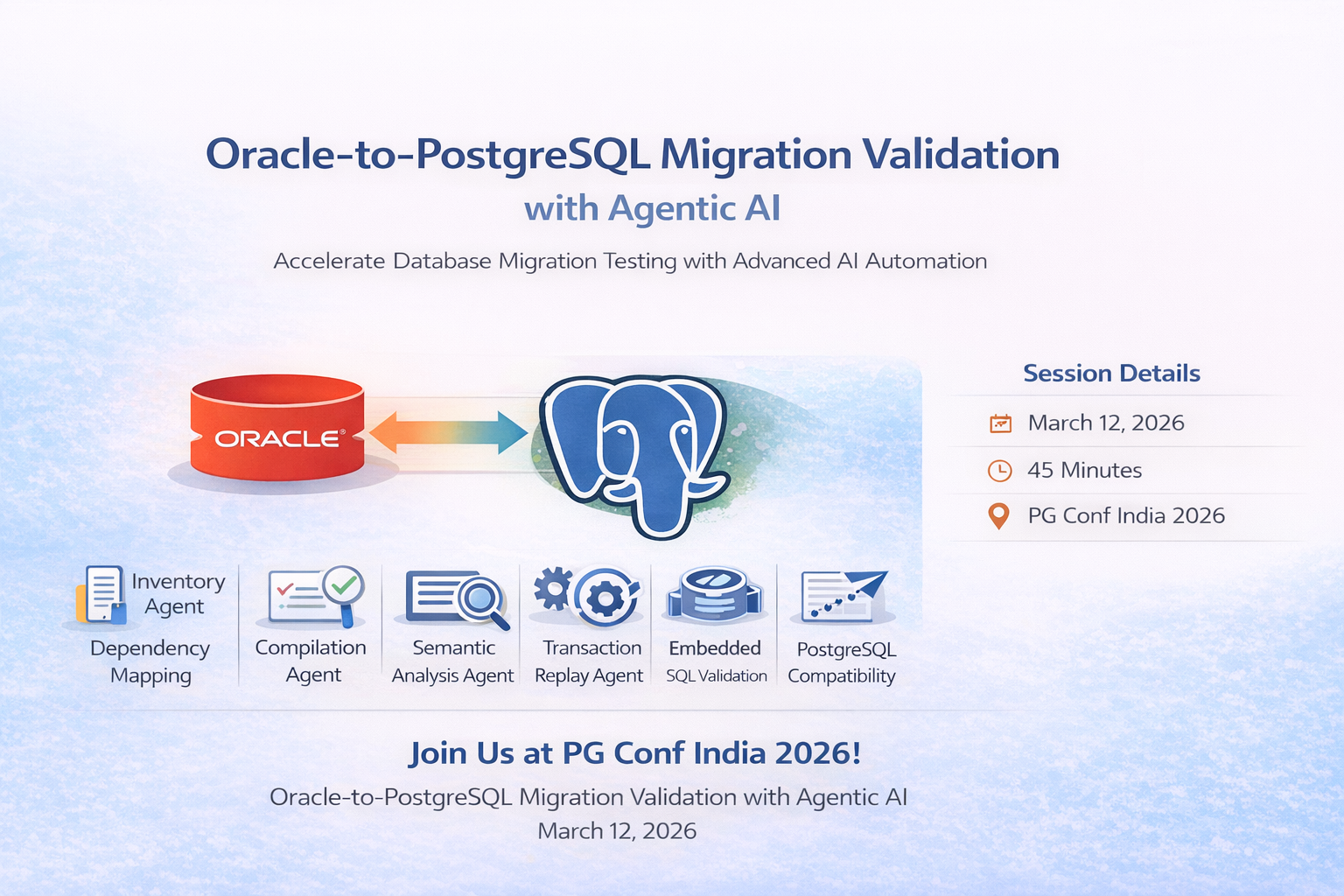
The core of this solution is an Agentic Validation Fabric, a coordinated system of specialized AI agents designed to validate different aspects of the migration.
Inventory Agent
The Inventory Agent builds a detailed dependency-aware map of database objects across both Oracle and PostgreSQL environments. It analyzes objects such as:
- Tables
- Indexes
- Constraints
- Views
- Triggers
- Functions and procedures
The agent also identifies migration risk hotspots, including Oracle packages, dynamic SQL, and bulk processing operations.
Compilation Agent
The Compilation Agent verifies that converted database objects are created in the correct order and that all dependencies are properly resolved.
It enforces strict “must compile” gates, ensuring that migrated PL/pgSQL code and DDL objects compile successfully in the PostgreSQL environment before validation proceeds further.
Lint and Semantic Analysis Agent
Some database issues may compile successfully but still contain logical or semantic problems.
The Lint & Semantic Analysis Agent performs PostgreSQL-aware static analysis to detect potential defects, including:
- Unsafe or implicit type casts
- Shadowed variables
- Invalid SQL statements within routines
- Unreachable logic branches
- Potential performance or logic inconsistencies
This ensures that the migrated database code is not only syntactically correct but also functionally reliable.
Object-Specific Validation Agents
Oracle databases contain several constructs that do not directly translate into PostgreSQL. These constructs require refactoring during migration, and improper handling can introduce functional differences.
Object-Specific Validation Agents generate targeted validation checks for constructs such as:
- Oracle packages and package global variables
- Cursor patterns and loop logic
- Exception handling semantics
- GOTO statements
- Dynamic SQL execution patterns
These agents fill validation gaps that traditional static analysis tools may miss.
Application SQL Compatibility Agent
Modern applications embed SQL queries directly in application code. During migration, these queries may require modifications to support PostgreSQL syntax and behavior.
The Application SQL Compatibility Agent identifies and validates:
- SQL syntax differences
- Data type mappings
- Sequence behavior
- Naming conventions
- NULL versus empty string handling
- Date and time function differences
This helps ensure that application-level database interactions continue to work correctly after migration.
Transaction Tracing and Replay for Real-World Validation
While schema validation is important, real applications execute complex sequences of database transactions. Testing these transactions manually is both difficult and time-consuming.
To address this challenge, the framework introduces transaction tracing and replay capabilities.
An Application Tracing Agent captures live database interactions from the application, including:
- Executed SQL statements
- Bind variables
- Execution order
- Key input parameters
- Row-count checkpoints
- Result signatures
These captured transactions are then executed against the PostgreSQL environment by a Replay Agent.
The Replay Agent compares the results of the PostgreSQL execution with the expected outcomes from the original Oracle system. Any discrepancies are flagged for investigation.
This approach allows teams to validate real application behavior rather than relying solely on schema-level testing.
Key Benefits of the Agentic AI Approach
By combining agent-driven orchestration, deterministic verification gates, and application-level transaction replay, the framework provides several benefits:
- Reduced dependency on application SMEs
- Faster migration validation cycles
- Early detection of functional regressions
- Improved migration accuracy and reliability
- Lower operational and migration risks
This enables organizations to achieve smoother and more predictable migrations to PostgreSQL platforms, including Azure Database for PostgreSQL.
Meet the Speakers
This session will be presented by experts from the Newt Global team, who bring extensive experience in enterprise database modernization and migration automation.
Neeta Goel
Neeta Goel is a technology leader specializing in database modernization, enterprise data platforms, and large-scale migration initiatives. She has helped organizations successfully transition from legacy database systems to modern open-source platforms.
Himanshu
Himanshu is a database modernization specialist focused on PostgreSQL engineering, migration automation, and AI-driven validation frameworks. His work centers on building scalable solutions that reduce migration risk and accelerate enterprise database transformations.
Session Details
- Event: PG Conf India 2026
- Session Title: Oracle-to-PostgreSQL Migration Validation with Agentic AI
- Presented By: Newt Global Team
- Speakers: Neeta Goel, Himanshu
- Date: March 12, 2026
- Duration: 45 Minutes
- Level: Intermediate
- Audience: QA engineers, database architects, and platform leaders managing distributed systems and large-scale database migrations
Join Us at PG Conf India 2026
If you are involved in database modernization, migration testing, or PostgreSQL platform engineering, this session will provide valuable insights into how Agentic AI can redefine migration validation.
Join the Newt Global team at PG Conf India 2026 to explore how intelligent automation can help organizations achieve faster, safer, and more reliable Oracle-to-PostgreSQL migrations.
Frequently Asked Questions (FAQs)
1. What is Oracle-to-PostgreSQL migration validation?
Oracle-to-PostgreSQL migration validation is the process of verifying that database schemas, stored procedures, queries, and application transactions behave the same after migrating from Oracle to PostgreSQL.
2. Why is validation the biggest challenge in database migration?
While schema and code conversion can be automated, validating business logic, application queries, and transaction behavior often requires deep application knowledge and extensive manual testing, which slows down migration timelines.
3. What is Agentic AI in database migration?
Agentic AI refers to a system of specialized AI agents that collaborate to plan, analyze, execute, and verify migration tasks automatically. In migration validation, these agents can detect issues, run tests, and validate database behavior.
4. How does Agentic AI improve migration testing?
Agentic AI automates validation tasks such as dependency analysis, schema checks, semantic validation, SQL compatibility verification, and transaction replay, helping teams detect issues earlier and reduce manual testing effort.
5. What are the key components of the Agentic Validation Framework?
The framework includes agents for inventory mapping, compilation validation, semantic analysis, object-specific checks, application SQL compatibility validation, and transaction tracing and replay.
6. What is transaction tracing and replay in migration validation?
Transaction tracing captures real application database interactions such as SQL queries and bind variables. These transactions are then replayed on PostgreSQL to ensure results match the original Oracle behavior.
7. Who should attend this session at PG Conf India 2026?
This session is ideal for QA engineers, database architects, platform engineers, and technology leaders involved in database modernization and Oracle-to-PostgreSQL migrations.
8. What are the benefits of using Agentic AI for migration validation?
Using Agentic AI can reduce dependency on subject-matter experts, accelerate validation cycles, detect migration errors earlier, and improve the reliability of Oracle-to-PostgreSQL migrations.