
DevOps Transformation Services: DevOps Automation for Financial Services with High-Availability Design Pattern for Enterprise 2026
Introduction
The financial services industry in 2026 is defined by real-time digital experiences, regulatory rigor, and zero-downtime expectations. Banks, insurance firms, and fintech organizations are under constant pressure to innovate while maintaining resilience and compliance.
This is where DevOps Transformation Services play a critical role—enabling financial enterprises to transition from legacy, siloed systems to automated, cloud-native, and high-availability architectures.
Organizations partnering with DevOps Transformation Services are leveraging automation, cloud enablement, and modern engineering practices to accelerate delivery while maintaining operational stability.
The Need for DevOps in Financial Services
Financial institutions operate in one of the most complex IT environments:
- Mission-critical systems with 24/7 availability requirements
- Strict compliance (PCI-DSS, SOX, GDPR)
- Legacy monolithic architectures
- High transaction volumes and data sensitivity
Traditional development and operations models cannot meet these demands efficiently. DevOps introduces:
- Continuous integration and delivery (CI/CD)
- Infrastructure as Code (IaC)
- Automated testing and compliance
- Real-time monitoring and observability
Newt Global’s expertise in automation and cloud transformation helps organizations stay competitive in a rapidly evolving market by combining DevOps with emerging technologies.
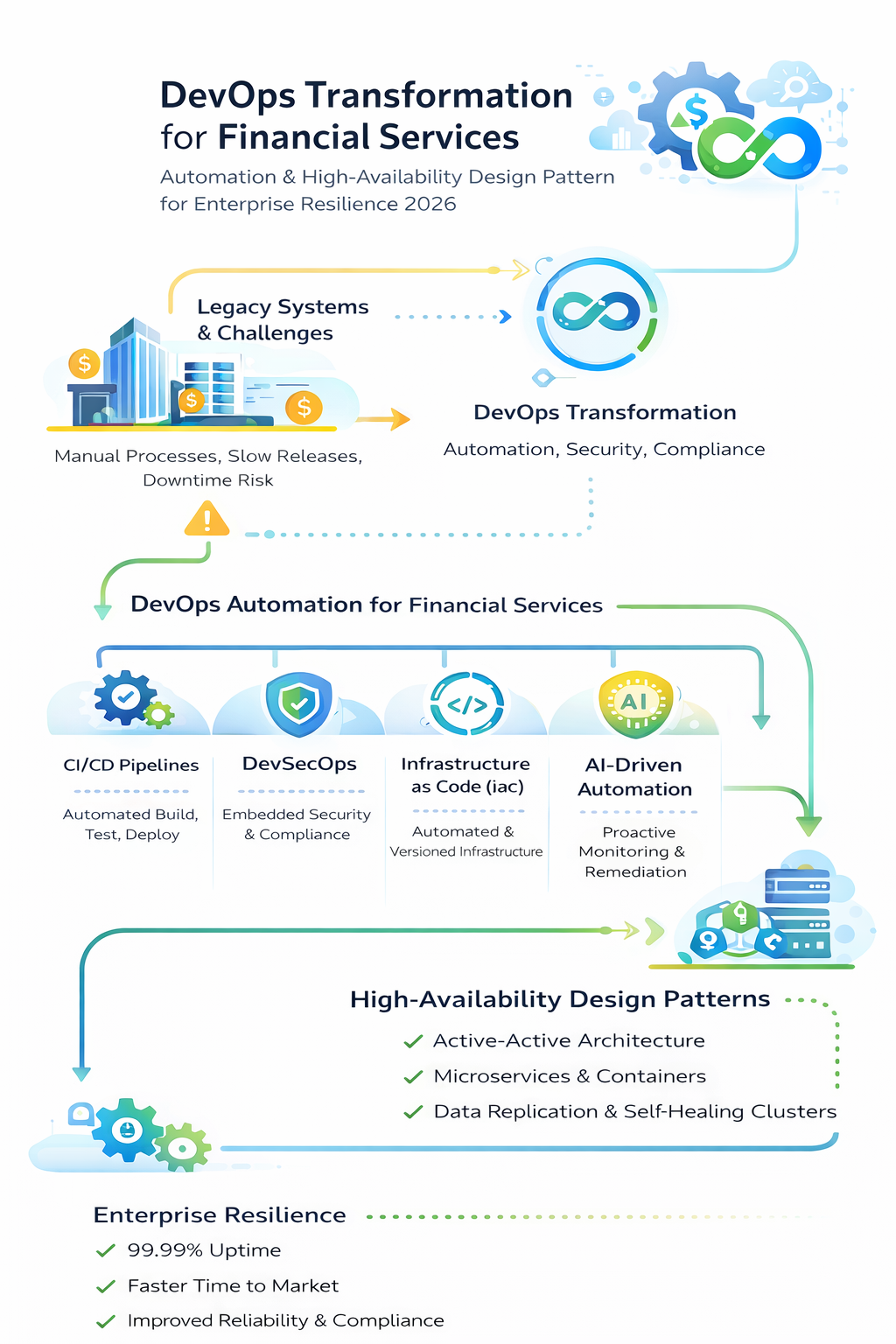
DevOps Automation for Financial Services
Automation is the cornerstone of modern DevOps transformation, especially in highly regulated industries.
1. CI/CD Pipeline Automation
Modern financial systems require secure, auditable, and automated pipelines:
- Automated builds, testing, and deployments
- Policy-driven approvals and compliance gates
- End-to-end traceability of releases
Newt Global’s pipeline migration solutions enable seamless transitions from legacy systems to modern platforms like GitHub and Azure DevOps, ensuring minimal downtime and maximum efficiency.
2. Infrastructure as Code (IaC)
Infrastructure provisioning is fully automated using tools like Terraform and CloudFormation:
- Consistent environments across dev, test, and production
- Rapid provisioning and rollback capabilities
- Reduced manual errors
This aligns with Newt Global’s cloud-native strategies that enable scalable and resilient architectures across AWS, Azure, and GCP.
3. DevSecOps: Security Built into Pipelines
Security is embedded across the lifecycle:
- Automated vulnerability scanning
- Identity and access management
- Continuous compliance validation
Through DevSecOps integration in Application Modernization Services, organizations ensure that security is proactive rather than reactive.
4. AI-Driven DevOps Automation
By 2026, DevOps is evolving with AI capabilities:
- Predictive failure detection
- Automated remediation
- Intelligent monitoring systems
These capabilities enable financial systems to become self-healing and adaptive, reducing operational risk.
High-Availability Design Patterns for Enterprise 2026
High availability (HA) is not optional in financial services—it is a core architectural requirement.
Key HA Design Patterns
1. Active-Active Multi-Region Architecture
- Deploy applications across multiple regions
- Load balancing ensures uninterrupted service
- Instant failover capabilities
2. Microservices-Based Architecture
Modern systems are built using microservices:
- Independent scaling of services
- Fault isolation
- Faster deployments
Newt Global supports microservices adoption through cloud-native modernization strategies, enabling scalable and resilient systems.
3. Containerization and Orchestration
Using Kubernetes and container platforms:
- Automated scaling
- Self-healing workloads
- Efficient resource utilization
Newt Global’s container governance services ensure secure and scalable deployments using Kubernetes environments.
4. Data Replication & Disaster Recovery
- Multi-region database replication
- Backup and recovery automation
- Zero data loss strategies
These patterns ensure business continuity even during failures.
Integrating DevOps with High Availability: The Enterprise Blueprint
A successful DevOps transformation for financial services combines:
- Cloud-native architecture
- Automated CI/CD pipelines
- Observability (logs, metrics, tracing)
- Disaster recovery frameworks
- Continuous compliance
This integrated model enables:
- 99.99% uptime
- Reduced Mean Time to Recovery (MTTR)
- Faster and safer deployments
Modernizing Legacy Systems with DevOps
Legacy systems are a major challenge in financial services.
Incremental Modernization Approach
Using strategies like:
- API enablement
- Microservices extraction
- Gradual migration to cloud
Newt Global’s modernization frameworks help organizations transition seamlessly to cloud-native environments, minimizing disruption while maximizing value.
Role of Automation Platforms like DMAP
Newt Global’s Database Modernization Acceleration Platform (DMAP) plays a key role in DevOps transformation:
- Automates database and application migration
- Reduces migration effort by up to 80%
- Ensures data integrity and minimal downtime
This enables financial institutions to modernize faster while maintaining operational continuity.
Real-World Impact: Enterprise Transformation Outcomes
Organizations leveraging Newt Global solutions have achieved:
- Up to 50% cost savings in modernization initiatives
- Improved scalability and performance
- Faster migration timelines with automation
- Enhanced reliability and security
Case studies highlight successful migrations of mission-critical systems with zero post-migration issues, demonstrating enterprise-grade execution.
DevOps Trends for Financial Services in 2026
Key trends shaping the future:
- Platform engineering and internal developer platforms
- GitOps and declarative infrastructure
- AI-driven operations (AIOps)
- Multi-cloud and hybrid strategies
- FinOps for cost optimization
Organizations adopting these trends gain competitive advantage through agility and resilience.
Why Choose Newt Global for DevOps Transformation?
Newt Global stands out as a transformation partner due to:
- Deep expertise in DevOps, cloud, and automation
- Proven frameworks for application and database modernization
- Strong focus on automation-driven efficiency and scalability
- Global delivery capabilities across industries
Their approach combines design thinking, automation, and cloud-native engineering to deliver measurable business outcomes.
Conclusion
As financial services organizations navigate the complexities of 2026, the convergence of DevOps automation and high-availability architecture is essential.
DevOps Transformation Services empower enterprises to:
- Innovate faster
- Ensure continuous availability
- Maintain compliance
- Deliver superior customer experiences
By partnering with leaders like Newt Global, organizations can transform their IT landscape into a resilient, intelligent, and future-ready ecosystem.
Frequently Asked Questions
1. What are DevOps Transformation Services in financial services?
DevOps Transformation Services refer to the strategic adoption of DevOps practices, tools, and cultural changes to modernize software delivery and operations within financial institutions. These services focus on automating development pipelines, improving collaboration between teams, and ensuring compliance with regulatory requirements while maintaining high system reliability.
Organizations leveraging solutions like DevOps Transformation Services can accelerate digital initiatives while maintaining governance and control.
2. Why is DevOps important for financial services organizations?
DevOps is critical in financial services because it enables organizations to deliver applications faster while maintaining strict compliance and security standards. It helps reduce deployment risks, improve system uptime, and ensure continuous delivery of digital services in an environment where downtime and errors can have significant financial and reputational impacts.
3. How does DevOps automation improve compliance and security?
DevOps automation integrates compliance and security directly into the software delivery pipeline through practices like DevSecOps. Automated testing, policy enforcement, and audit trails ensure that every deployment meets regulatory standards. This reduces manual errors and ensures consistent enforcement of security policies across environments.
4. What are high-availability design patterns in DevOps?
High-availability (HA) design patterns are architectural approaches that ensure systems remain operational even during failures. These include active-active deployments, multi-region architectures, microservices, and automated failover mechanisms. In financial services, HA patterns are essential to guarantee uninterrupted access to critical systems and services.
5. How do DevOps and high availability work together?
DevOps enables rapid and automated deployments, while high-availability design ensures those systems remain resilient and continuously operational. Together, they create a robust environment where changes can be deployed quickly without compromising system stability or uptime.
6. What role does cloud computing play in DevOps transformation?
Cloud platforms provide the scalability, flexibility, and resilience required for modern DevOps practices. They enable organizations to implement Infrastructure as Code, automate deployments, and design multi-region architectures that support high availability and disaster recovery.
7. How can financial institutions modernize legacy systems using DevOps?
Financial institutions can adopt an incremental modernization approach by integrating APIs, migrating workloads to the cloud, and gradually refactoring monolithic applications into microservices. Services like Application Modernization help organizations transition without disrupting existing operations.
8. What is the role of AI in DevOps for financial services?
AI enhances DevOps by enabling predictive monitoring, anomaly detection, and automated incident resolution. These capabilities help financial institutions move from reactive troubleshooting to proactive system management, reducing downtime and improving overall system performance.
9. What challenges do financial organizations face during DevOps transformation?
Common challenges include managing legacy systems, ensuring regulatory compliance, integrating security into pipelines, and overcoming organizational resistance to change. Partnering with experienced providers like Newt Global helps address these challenges through proven frameworks and automation tools.
10. How does Newt Global support DevOps transformation for financial services?
Newt Global provides end-to-end DevOps solutions, including strategy, automation, cloud enablement, and modernization. Their expertise in high-availability architecture and compliance-driven DevOps ensures that financial institutions can achieve faster delivery cycles while maintaining reliability and security.
11. What are the key benefits of implementing DevOps in financial services?
Key benefits include faster time-to-market, improved system reliability, enhanced security, reduced operational costs, and better customer experiences. DevOps also enables organizations to innovate continuously while maintaining compliance with industry regulations.
12. What trends will shape DevOps in financial services by 2026?
Key trends include AI-driven DevOps (AIOps), platform engineering, GitOps, multi-cloud strategies, and increased adoption of automation across the software lifecycle. These trends will help organizations build more resilient, scalable, and efficient systems.