
From Legacy to Cloud-Native: The DMAP AI Advantage on Azure
Cloud Modernization · Azure Migration · AI-Powered Tools
How Newt Global’s Database Modernization Acceleration Platform is reshaping how enterprises move legacy Oracle workloads to Microsoft Azure — faster, cheaper, and with far less risk.
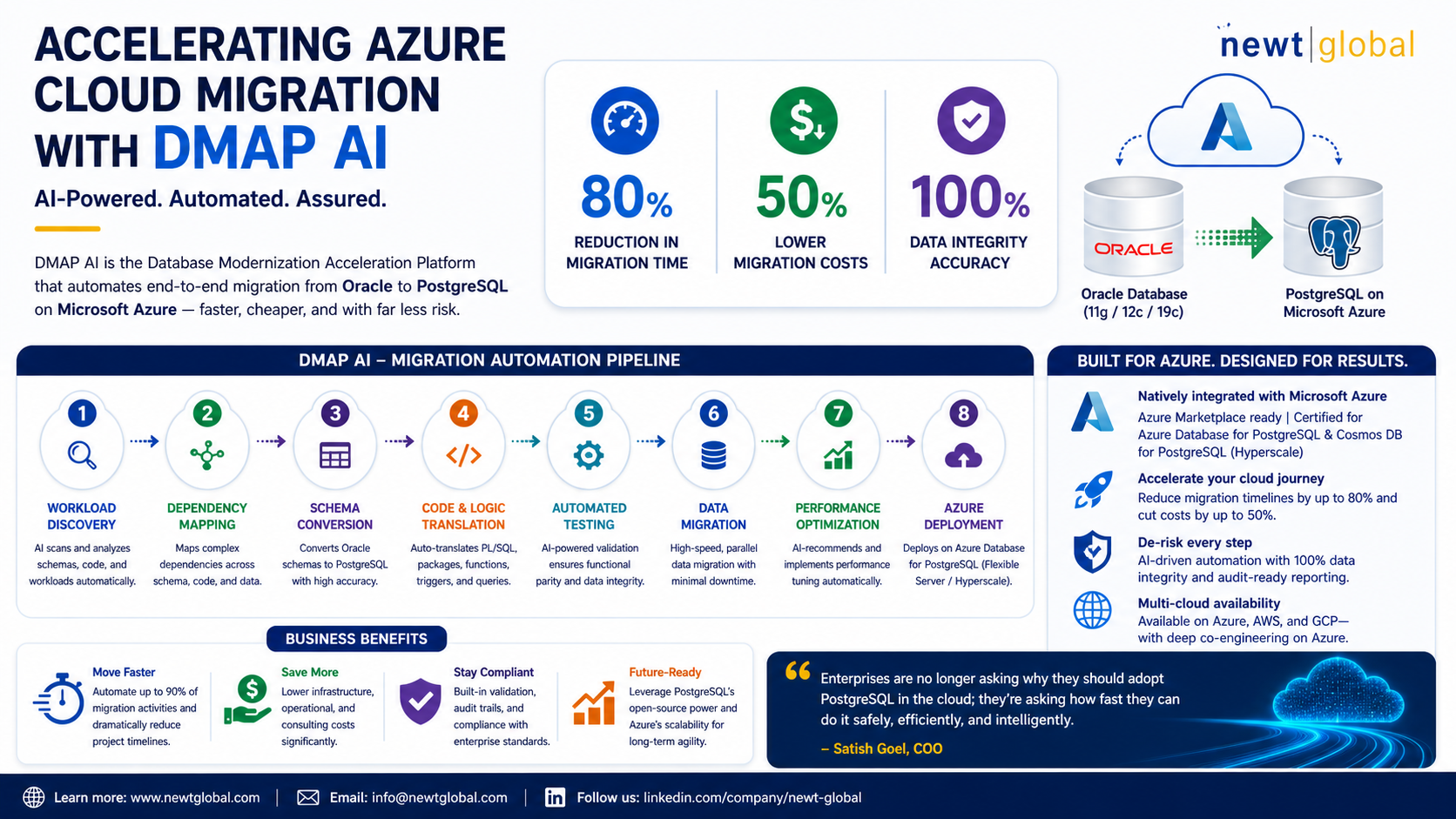
80%
Reduction in migration time
50%
Lower migration costs
100%
Data integrity accuracy
The pressure to move — and the pain of moving
Enterprise cloud adoption has crossed from a strategic option to a business imperative. Yet for organisations running mission-critical workloads on Oracle databases, the path to Microsoft Azure remains strewn with real obstacles: schema complexity, embedded PL/SQL business logic, compliance obligations, and the ever-present fear of downtime.
Traditional migration approaches — armies of consultants rewriting code by hand, multi-year programmes that bleed budget — are no longer viable. The market demands something smarter. That something is DMAP AI from Newt Global.
“Enterprises are no longer asking why they should adopt PostgreSQL in the cloud; they’re asking how fast they can do it safely, efficiently, and intelligently.”
— Satish Goel, COO, Newt Global
What is DMAP AI?
DMAP — the Database Modernization Acceleration Platform — is Newt Global’s flagship AI-powered migration engine. It automates the end-to-end journey from Oracle (11g, 12c, 19c) to PostgreSQL on Microsoft Azure, covering every layer of the stack: schemas, stored procedures, PL/SQL packages, triggers, SQL queries, custom constructs, and the application code that wraps them.
DMAP is available as Docker images, listed on the Azure Marketplace, and certified to run on Azure Database for PostgreSQL Flexible Server and Cosmos DB for PostgreSQL (Hyperscale). It is also available on AWS and GCP — but its deep co-engineering with Microsoft Azure makes it particularly compelling for Azure-first organisations.
DMAP AI — Migration Automation Pipeline
Workload
Discovery
Dependency
Mapping
Schema
Conversion
PL/SQL
Transform
Data
Migration
Validation
& Tuning
Core capabilities that set DMAP apart
Automated workload discovery
AI scans the entire Oracle environment — tables, indexes, sequences, packages, dependencies — and generates a comprehensive migration roadmap with risk scores, without manual inventory work.
AI-driven schema & PL/SQL conversion
DMAP’s AI converts Oracle DDL, stored procedures, functions, triggers, and custom constructs to PostgreSQL-compatible equivalents, automatically flagging non-compatible constructs for review.
@Scale parallel execution
Parallel processing lets teams trade compute for elapsed time — shrinking multi-month migration windows to weeks, while keeping the migration pipeline fully orchestrated.
Automated validation engine
Row-count and checksum validation run automatically post-migration, certifying data integrity across schema, data, and application layers — with no manual spot-checking required.
Application migration coverage
DMAP migrates both the database and the application layer — converting code that embeds Oracle PL/SQL logic to Azure PostgreSQL-compatible format, closing the gap standard tools leave open.
Post-migration optimisation
Continuous AI-driven tuning post-migration — shared_buffers, work_mem, index recommendations — ensures Azure PostgreSQL meets or exceeds Oracle performance benchmarks.
Architecture: Oracle to Azure PostgreSQL
At a high level, the DMAP AI orchestration layer sits between the source Oracle environment and the target Azure managed PostgreSQL service, handling every transformation stage without manual intervention:
SOURCE (Oracle 11g / 12c / 19c)
  ├── Tables, indexes, sequences
  ├── PL/SQL packages, procedures, triggers
  └── On-prem / VM / Exadata
          │
          ▼  Schema extract · Code conversion · Data migration
┌─────────────────────────────────────────────┐
│         DMAP AI ORCHESTRATION LAYER         │
│  · Automated schema conversion              │
│  · Oracle PL/SQL → PL/pgSQL                 │
│  · Dependency mapping & risk scoring        │
│  · Data validation (checksum + row count)   │
│  · @Scale parallel workflow automation      │
└─────────────────────────────────────────────┘
          │
          ▼
TARGET (Microsoft Azure)
  ├── Azure Database for PostgreSQL
  │     Flexible Server / Cosmos DB (Hyperscale)
  ├── Azure Marketplace deployment
  └── Azure-certified Newt Global team
The key difference from generic migration tooling is the AI layer’s ability to handle Oracle-specific constructs that have no direct PostgreSQL equivalent — ROWNUM, CONNECT BY, Oracle sequences, outer-join syntax, and package-level state — automatically transforming them rather than flagging them as unresolvable manual tasks.
PL/SQL to PL/pgSQL: where most migrations stall
Business logic embedded in Oracle PL/SQL is the hardest part of any Oracle-to-PostgreSQL migration. DMAP AI accelerates large-scale PL/SQL transformation by automatically handling syntax translation, logic restructuring, and package refactoring. Consider a basic exception-handling block:
-- Oracle PL/SQL (source)          -- PostgreSQL PL/pgSQL (target, auto-converted)
BEGIN                               BEGIN
  SELECT * INTO v_name                SELECT name INTO v_name
    FROM customers                      FROM customers
    WHERE id = 1;                       WHERE id = 1;
  EXCEPTION                          EXCEPTION
    WHEN NO_DATA_FOUND THEN              WHEN NO_DATA_FOUND THEN
      NULL;                                NULL;
END;                                END;
For complex enterprise codebases with thousands of packages and nested dependencies, this automation is the difference between a 6-month migration and a 3-year one.
Why Azure + DMAP is a particularly strong combination
Microsoft Azure’s managed PostgreSQL services — Flexible Server and Cosmos DB for PostgreSQL — offer enterprise-grade reliability, auto-scaling, built-in high availability, and global reach. DMAP AI is engineered to exploit these capabilities from day one: migrations land on a fully Azure-native topology rather than a lifted-and-shifted approximation.
Newt Global’s team of Azure-certified professionals accompanies every engagement, ensuring migrations are handled by engineers who understand both the DMAP toolchain and the Azure platform at depth. DMAP’s listing on the Azure Marketplace further simplifies deployment — organisations already operating within Azure can provision and integrate DMAP without leaving their existing cloud environment.
“We’re pleased to welcome DMAP from Newt Global to the Microsoft Azure Marketplace, which gives our partners great exposure to cloud customers around the globe.”
— Jake Zborowski, General Manager, Microsoft Azure Platform
Real-world impact: a financial services case study
A large financial services company with a complex on-premises Oracle infrastructure needed to migrate to Azure. Concerns centred on time, cost, and the risk of disrupting business-critical systems. Using DMAP, the organisation was able to:
- Assess their entire environment in a fraction of the time traditional manual discovery would require, using DMAP’s @Scale parallel assessment features.
- Generate precise migration estimates that significantly reduced projected costs compared to conventional SI-led approaches.
- Complete the migration with 100% data integrity validated automatically — no manual spot-checks required.
- Achieve post-migration performance on Azure PostgreSQL that matched or exceeded Oracle benchmarks, while eliminating ongoing Oracle licensing costs.
Newt Global reports that customers who leverage DMAP and Azure together routinely achieve migration time reductions of up to 80%, cost reductions of up to 50%, and 100% data integrity validated automatically.
The AI benefits beyond the migration itself
DMAP AI’s value doesn’t end at go-live. Its post-migration capabilities include continuous workload tuning — analysing query plans, recommending index changes, and right-sizing PostgreSQL memory parameters such as shared_buffers, work_mem, and effective_cache_size. For organisations moving large, data-intensive workloads, this ongoing optimisation closes the performance gap with Oracle and, in many cases, surpasses it.
DMAP also plays a broader role in AI-driven cloud migration strategy:
- Predictive analytics for cost forecasting across migration scenarios
- Workload prioritisation using machine learning models
- Real-time compliance monitoring during data transfer (GDPR, HIPAA)
- Self-healing capabilities that address migration errors automatically
- Continuous post-migration performance monitoring and TCO optimisation
Getting started with DMAP AI on Azure
DMAP is available via the Azure Marketplace for direct deployment into existing Azure environments, and can also be installed as Docker images on Azure VMs, AWS, or on-premises Linux and Windows servers. Newt Global’s team can be engaged for end-to-end migration delivery, assessment-only engagements, or proof-of-concept projects.
Ready to accelerate your Azure cloud migration?
Learn more about DMAP AI and Newt Global’s end-to-end cloud migration and database modernisation services.