
Cloud Database Migration Guide · 2026
Cloud Database Migration: AWS vs Azure vs GCP
A comprehensive comparison to help enterprises choose the right cloud platform for their database modernization journey.
The global cloud database market is projected to surpass $174 billion by 2027. For enterprises still running legacy databases on-premises — or burdened by Oracle’s licensing costs — the question is no longer whether to migrate, but where.
AWS, Azure, and GCP each offer powerful, battle-tested database services. But choosing the wrong platform can mean years of technical debt, unexpected costs, and missed performance targets. This guide breaks down the real differences between all three — across pricing, native services, migration tooling, and ecosystem fit — so your team can make a confident, informed decision.
At Newt Global, we have guided hundreds of enterprises through exactly this choice using our Database Modernization Acceleration Platform (DMAP). Here is what we have learned.
Why Cloud Database Migration Matters Now
The era of on-premises databases is ending. Rising Oracle licensing fees, hardware refresh cycles, and the operational burden of maintaining aging infrastructure are pushing CFOs and CTOs toward cloud-native databases at an unprecedented pace.
Cloud databases offer elastic scalability, managed patching and backups, pay-as-you-go pricing, and built-in high availability — benefits no on-premises deployment can match at equivalent cost. Yet the migration carries real risk: schema incompatibilities, stored procedure rewrites, and data integrity concerns can extend timelines and inflate budgets without automation.
Key InsightEnterprises using automated migration platforms like DMAP cut migration timelines by up to 70% compared to fully manual approaches — and see dramatically fewer post-migration defects.
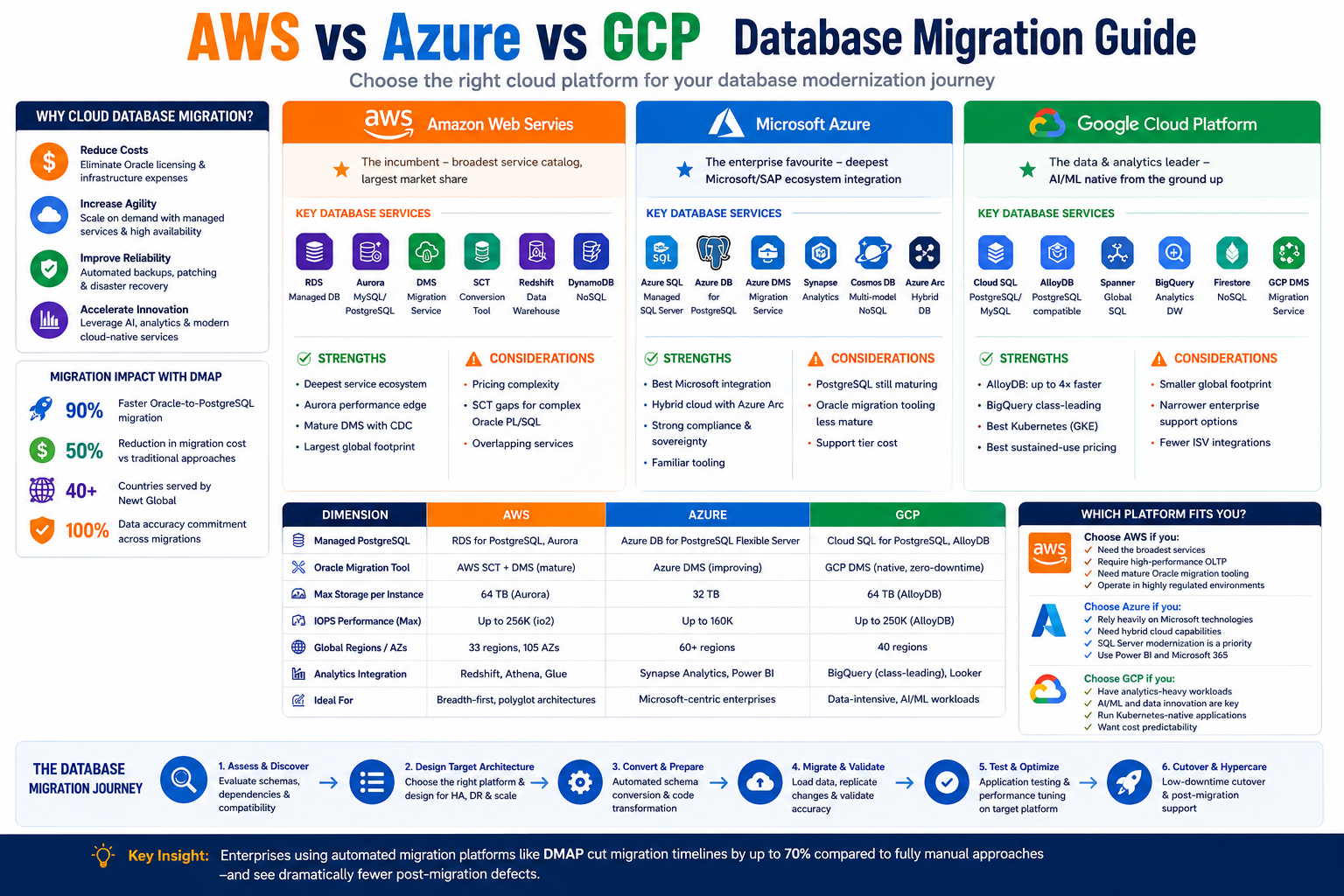
The Big Three: A Snapshot
Here is a high-level orientation of each platform’s identity and primary database strengths.
Amazon Web Services
The incumbent — broadest service catalog, largest market share
AWS commands roughly 32% of the global cloud market and offers the most mature database portfolio. Amazon RDS supports PostgreSQL, MySQL, SQL Server, Oracle, and MariaDB. For Oracle migrations, RDS for PostgreSQL combined with the Schema Conversion Tool (SCT) and Database Migration Service (DMS) provides a well-trodden path.
Aurora MySQL/PostgreSQL-compatible
DMS Database Migration Service
SCT Schema Conversion Tool
Redshift Data Warehousing
DynamoDB NoSQL
✅ Strengths
- Deepest service ecosystem
- Aurora’s performance edge over standard PostgreSQL
- Mature DMS with change-data-capture
- Largest global availability zone footprint
⚠️ Considerations
- Pricing complexity — egress costs add up
- SCT has gaps for complex Oracle PL/SQL
- Multiple overlapping services can cause decision fatigue
Microsoft Azure
The enterprise favourite — deepest Microsoft/SAP ecosystem integration
Azure holds approximately 23% of the cloud market and is the natural destination for enterprises deeply invested in the Microsoft stack — SQL Server, Active Directory, Power BI, Teams, and Office 365. Azure Database for PostgreSQL Flexible Server is its fastest-growing managed database offering.
Azure DB for PostgreSQL
Azure DMS Migration Service
Synapse Analytics
Cosmos DB Multi-model NoSQL
Azure Arc Hybrid DB
✅ Strengths
- Best-in-class Microsoft ecosystem integration
- Hybrid cloud with Azure Arc
- Strong compliance and sovereignty features
- Familiar tooling for Windows-centric shops
⚠️ Considerations
- PostgreSQL Flexible Server still maturing
- Oracle migration tooling less mature than AWS
- Support tier pricing can be substantial
Google Cloud Platform
The data & analytics leader — AI/ML native from the ground up
GCP commands roughly 12% of cloud market share but punches above its weight in data analytics, AI/ML, and Kubernetes-native architectures. AlloyDB — Google’s PostgreSQL-compatible database — offers exceptional OLTP throughput, and GCP DMS provides a native near-zero-downtime migration path from Oracle.
AlloyDB PostgreSQL-compatible
Spanner Global distributed SQL
BigQuery Serverless DW
Firestore NoSQL
GCP DMS
✅ Strengths
- AlloyDB: up to 4× faster than standard PostgreSQL
- BigQuery for analytics is class-leading
- Best Kubernetes (GKE) and containerization story
- Best sustained-use pricing model
⚠️ Considerations
- Smaller global region footprint than AWS/Azure
- Enterprise support and SLA options narrower
- Fewer ISV integrations vs AWS/Azure
Side-by-Side Comparison Matrix
Use this matrix to compare the three platforms across the dimensions that matter most for a database migration decision.
| Dimension | AWS | Azure | GCP |
|---|---|---|---|
| Managed PostgreSQL | RDS for PostgreSQL, Aurora | Azure DB for PostgreSQL Flexible Server | Cloud SQL for PostgreSQL, AlloyDB |
| Oracle migration tool | AWS SCT + DMS (mature) | Azure DMS (improving) | GCP DMS (native, zero-downtime) |
| Max storage per instance | 64 TB (Aurora) | 32 TB | 64 TB (AlloyDB) |
| IOPS performance | Up to 256K (io2) | Up to 160K | Up to 250K (AlloyDB) |
| Global regions / AZs | 33 regions, 105 AZs | 60+ regions | 40 regions |
| Pricing model | On-demand, Reserved 1/3yr, Savings Plans | Pay-as-you-go, Reserved, Hybrid Benefit | On-demand, Sustained-use, Committed use |
| Analytics integration | Redshift, Athena, Glue | Synapse Analytics, Power BI | BigQuery (class-leading), Looker |
| Ideal for | Breadth-first, polyglot architectures | Microsoft-centric enterprises | Data-intensive, AI/ML-heavy workloads |
Which Platform Fits Which Use Case?
Choose AWS if…
- You need the broadest range of managed database engines under one roof
- Your team is already running workloads on EC2 or Lambda and wants to avoid egress complexity
- Aurora’s performance and auto-scaling are important for high-concurrency OLTP
- You require the widest compliance certifications (HIPAA, PCI-DSS, FedRAMP, SOC 2)
Choose Azure if…
- Your enterprise is already on Microsoft 365, Active Directory, or SQL Server
- You need Azure Arc for hybrid database deployments (on-prem + cloud)
- SAP on Azure is part of your roadmap
- Power BI integration with your database reporting layer matters
Choose GCP if…
- Analytics and ML workloads will consume migrated data — BigQuery is unmatched
- AlloyDB’s HTAP (mixed OLTP + analytics) capabilities align with your architecture
- Your workloads are containerised on Kubernetes (GKE is the most mature managed Kubernetes)
- You want predictable pricing with sustained-use discounts requiring no upfront commitment
A Practical Migration Approach That Works Across All Three
Regardless of which cloud you choose, the migration methodology matters as much as the destination. At Newt Global’s Cloud Migration practice, we follow a proven, automation-first six-stage approach.
1.Assessment & Discovery
Inventory your existing Oracle schemas, stored procedures, triggers, and application-layer SQL. Our DMAP platform automates this in days, producing a compatibility report and migration complexity score for each object.
2.Target Architecture Design
Select your target managed PostgreSQL service (RDS Aurora, Azure Flexible Server, or AlloyDB) based on performance, compliance, and ecosystem requirements. Define your HA topology, read-replica configuration, and backup retention policy.
3.Automated Schema & Code Conversion
DMAP automatically converts Oracle DDL, PL/SQL packages, procedures, and functions to PostgreSQL equivalents. Conversion rates of 80–95% are typical; remaining objects are flagged for human review with detailed guidance.
4.Data Migration & Validation
Full-load followed by change-data-capture (CDC) replication keeps source and target in sync during testing. Row counts, checksums, and business-rule validations run automatically via Newt Global’s QA Automation layer.
5.Application Layer Testing
Regression test your application against the migrated PostgreSQL database. DMAP identifies query-plan differences and recommends index changes to maintain or improve performance after migration.
6.Cutover & Hypercare
Near-zero-downtime cutover switches production traffic in a maintenance window as short as 15 minutes. Newt Global provides 30-day hypercare support post-cutover to handle any edge cases that surface in production.
Migrate Oracle to PostgreSQL 90% Faster
DMAP — Newt Global’s Database Modernization Acceleration Platform — automates schema conversion, data migration, and validation across AWS, Azure, and GCP. Cut costs by 50%. Achieve 100% accuracy. Get your free 30-day migration assessment.
Understanding Migration Cost Drivers
Cloud database pricing is notoriously opaque. Budget for these cost categories beyond compute and storage:
- Data egress fees: all three providers charge for data leaving their network. GCP’s sustained-use discount model tends to produce lower total egress costs for continuous workloads.
- Backup storage: automated backups typically include free storage up to the database size; additional retention costs vary by provider and region.
- Read replicas: cross-region read replicas carry replication transfer fees in addition to the replica instance cost.
- Support tiers: enterprise-grade support costs $15K–$50K+/year on AWS and Azure; GCP’s Enhanced and Premium tiers are comparably priced.
- Migration tooling: AWS DMS and GCP DMS are consumption-priced by replication instance hours. Azure DMS Standard tier is free for offline migrations; Premium tier is charged.
Cost Optimisation TipEnterprises migrating from Oracle can typically eliminate Oracle licensing costs entirely — which average $47,500 per processor — by moving to cloud-managed PostgreSQL. For a 4-socket server, that is nearly $200K in annual savings, before counting support and maintenance.
Security & Compliance Considerations
All three platforms provide encryption at rest and in transit, role-based access control, VPC isolation, and audit logging. The differences lie in depth and breadth of compliance certifications and data residency options for regulated industries.
AWS leads in total compliance programmes (over 140), making it the default choice for US federal government (FedRAMP High), defence, and healthcare. Azure is particularly strong for European data sovereignty (GDPR, BSI C5, ENS). GCP excels for financial services (PCI-DSS, SOC 1/2/3) and healthcare (HIPAA BAA).
Newt Global’s database migration services include security-focused assessments that map your compliance obligations to the optimal target platform configuration.
DevOps & Application Modernisation Alignment
A database migration is rarely a standalone project — it happens alongside broader application modernisation or DevOps transformation initiatives. All three clouds support Terraform, Ansible, and GitHub Actions for infrastructure-as-code, so your pipeline strategy need not be constrained by your database choice.
If your migration also involves containerising your application tier, Newt Global’s Kubernetes and containerisation practice can design your entire cloud-native target architecture alongside the database migration.
Making the Final Decision
There is no universally “best” cloud for database migration. The right answer depends on your existing technology landscape, your team’s skills, your compliance obligations, and your cost model.
- Start with your existing investments: Microsoft shop → Azure; AWS-native infrastructure → AWS; data/analytics-first → GCP.
- Run a 30-day assessment against each shortlisted platform using DMAP’s compatibility reports before committing.
- Model your total cost of ownership over 3 years including instance, storage, egress, support, and Oracle licence savings.
- Consider your future workload trajectory: will AI/ML, real-time analytics, or global distribution become requirements in the next 2–3 years?
- Validate with a proof-of-concept migration of one representative schema before full commitment.