
White Paper: Agentic AI in Database Migration with DMAP
How AI-Powered Automation Transforms Enterprise Database Migrations
White Paper • Database Migration • AI & Automation
Executive Summary
Database migration from legacy systems such as Oracle and SQL Server to PostgreSQL has long been a complex and error-prone undertaking. Traditional methods, which rely heavily on Abstract Syntax Tree (AST) parsing and static transformation rules, struggle to address nuanced or nonstandard constructs. This often results in manual remediation cycles that are costly and time-intensive.
The Database Migration Acceleration Platform (DMAP) introduces a new paradigm by embedding an agentic AI process that leverages recursive agents, compiler feedback, and structured diagnostics. By combining deterministic rule-based transformations with iterative AI-driven correction, DMAP achieves higher accuracy, reduces manual workload, and enables scalable enterprise-grade migrations.
Introduction
As enterprises seek to modernize their infrastructure, the shift from commercial databases such as Oracle and SQL Server to PostgreSQL has accelerated. While PostgreSQL offers cost efficiency, scalability, and flexibility, the path to migration is riddled with challenges. Stored procedures, triggers, complex queries, and proprietary vendor-specific functions create incompatibilities that cannot be fully addressed by static mapping or simple syntactic rewrites.
Conventional migration solutions follow a straightforward pipeline: extract source code, parse into AST, apply transformation rules, and validate. However, when the rules engine encounters unsupported constructs, the process breaks down, requiring developers to step in manually. This bottleneck has historically limited automation potential. DMAP redefines this process by introducing an agentic AI feedback loop that allows the system to learn, reason, and correct itself iteratively until the target code is valid.
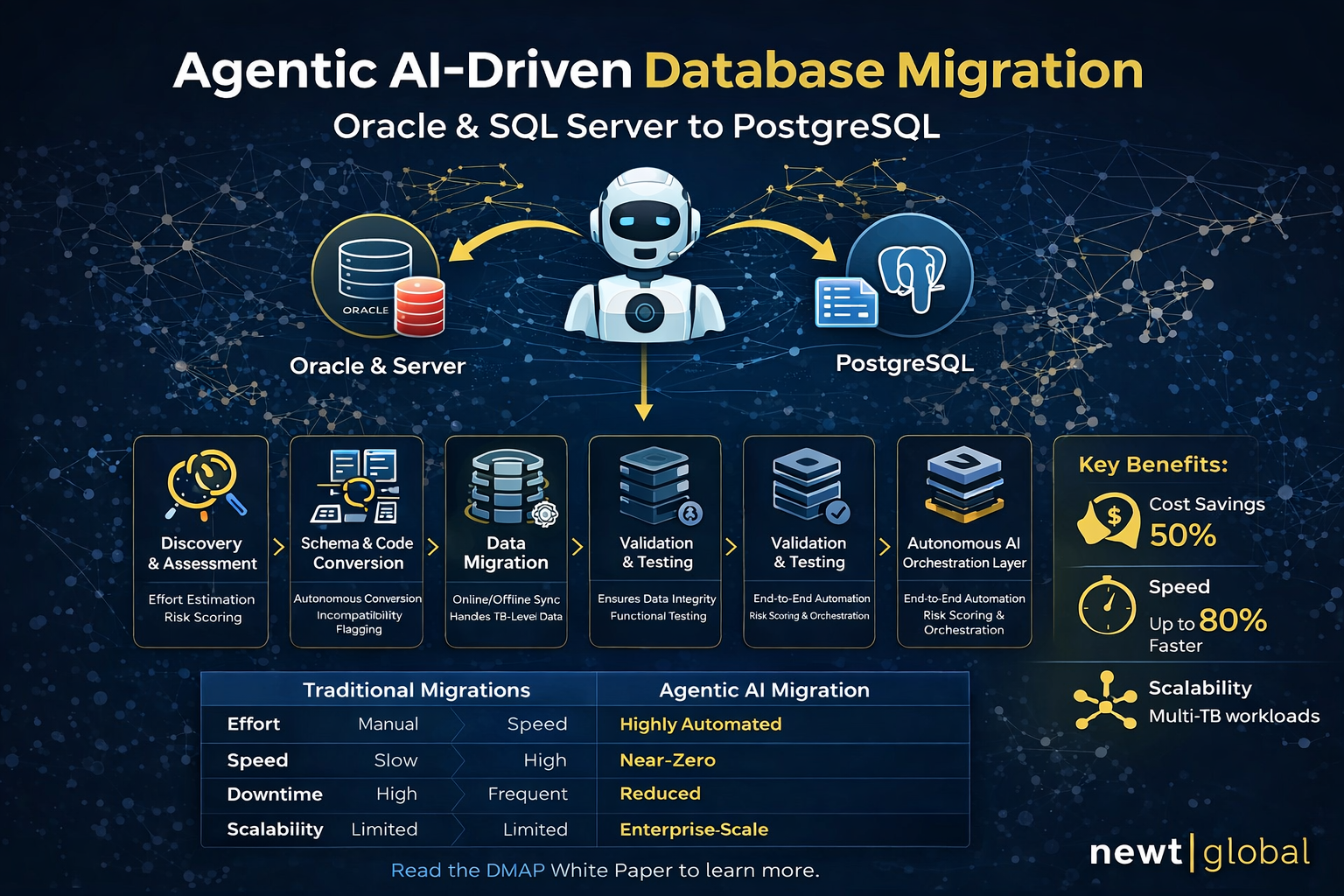
DMAP’s Agentic AI Architecture
At the core of DMAP is its agentic AI process, which integrates recursive agents with a custom Model Context Protocol (MCP) server. This architecture creates a dynamic ecosystem where rules-based processing and AI reasoning co-exist.
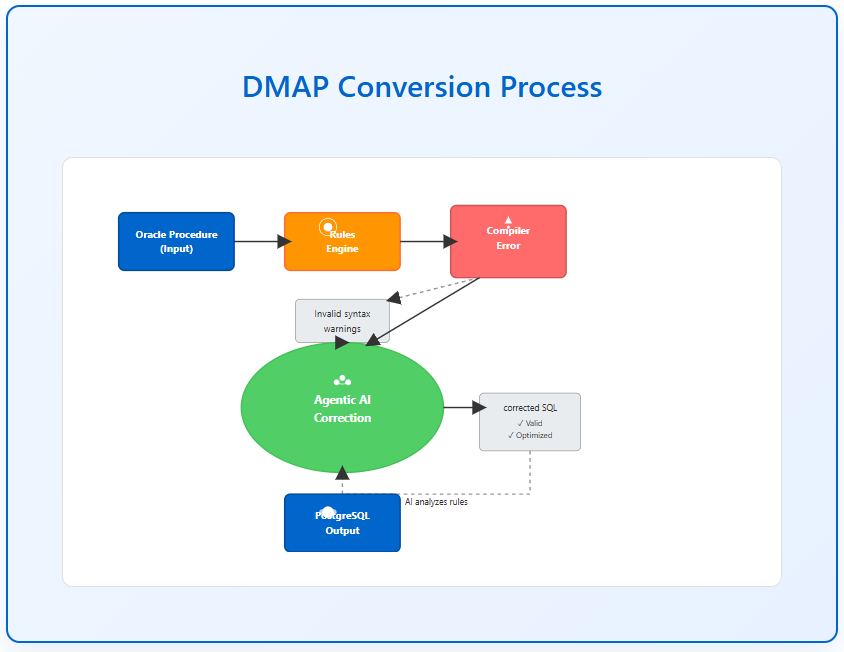
The process begins with AST parsing and deterministic rules to handle straightforward transformations, such as type conversions and syntax adjustments. Once this phase is complete, DMAP compiles the generated PostgreSQL code, runs it through linters, and applies Python-based object checks. Any errors encountered in this phase—whether compiler messages, linter warnings, or schema mismatches—are captured and transformed into structured diagnostics. These diagnostics are then passed back to the recursive AI agents.
Unlike static systems, DMAP’s agents do not stop when they encounter errors. Instead, they ingest the diagnostic feedback and propose corrections using large language model (LLM) reasoning. If errors persist, the cycle repeats, with each iteration refining the code further. The loop continues until either all errors are resolved or a configurable recursion threshold is reached. This recursive process ensures that even edge cases, which traditionally required human intervention, are systematically addressed.
Workflow in Action
Consider the migration of a complex Oracle stored procedure to PostgreSQL. The deterministic engine within DMAP handles the standard constructs, such as table definitions and control flow. However, when encountering Oracle-specific functions like DBMS_OUTPUT or hierarchical queries, compilation errors are generated. These errors are captured by the MCP server and relayed to the recursive agents. The agents interpret the diagnostics and rewrite the constructs into PostgreSQL equivalents, such as replacing DBMS_OUTPUT with logging functions or refactoring hierarchical queries into Common Table Expressions (CTEs). This iterative cycle continues until the procedure compiles successfully and conforms to PostgreSQL best practices.
Example Conversion Workflow
See DMAP in Action
Watch how our AI-powered platform handles complex database migrations with 90% automation.
Advantages of the Agentic AI Approach
The agentic AI design in DMAP delivers several tangible benefits:
- Automation Depth: Recursive correction significantly reduces the volume of manual intervention required.
- Robustness: Error-driven correction ensures resilience against non-standard constructs and edge cases.
- Adaptability: AI reasoning adapts dynamically rather than being limited by predefined rules.
- Efficiency: Human experts are only required for truly novel or ambiguous cases, allowing migrations to scale across large codebases.
- Configurable Safety: A maximum recursion depth ensures predictable execution times and prevents infinite correction loops.
Future Directions
DMAP‘s current implementation already demonstrates high levels of automation and resiliency. Looking forward, the platform will evolve toward persistent learning, where successful corrections are added back into the deterministic ruleset. This will enable a continuously improving system that becomes more efficient with every migration. Additional advancements include parallelized agent loops for large-scale workloads, adaptive rule generation informed by AI insights, and expansion into migrations targeting other platforms such as MySQL, Snowflake, and cloud-native databases.
Conclusion
DMAP represents a major step forward in database migration technology. By embedding agentic AI into the core of its process, it bridges the gap between deterministic rules and dynamic reasoning. This hybrid model allows DMAP to deliver scalable, accurate, and automated migrations from Oracle and SQL Server to PostgreSQL. In doing so, it reduces human effort, minimizes risk, and accelerates enterprise modernization initiatives. The recursive AI-driven feedback loop marks the beginning of a new generation of intelligent migration platforms—where rules provide structure, and AI provides adaptability.
Ready to Accelerate Your Database Migration?
Join hundreds of enterprises that have successfully migrated to PostgreSQL with DMAP.