
Newt Global at PGConf India 2026: A Three-Day Focus on Confident Oracle-to-PostgreSQL Modernization
PGConf India 2026, held in Bengaluru from March 11–13, brought together the PostgreSQL community to discuss innovation, performance, and enterprise adoption. For Newt Global, participating as a Platinum Sponsor, the focus was clear and consistent across all three days—enabling enterprises to modernize from Oracle to PostgreSQL with confidence using DMAP-AI.
This article captures Newt Global’s presence at the conference, structured across Day 1, Day 2, and Day 3—centered entirely on the theme of deterministic database modernization.
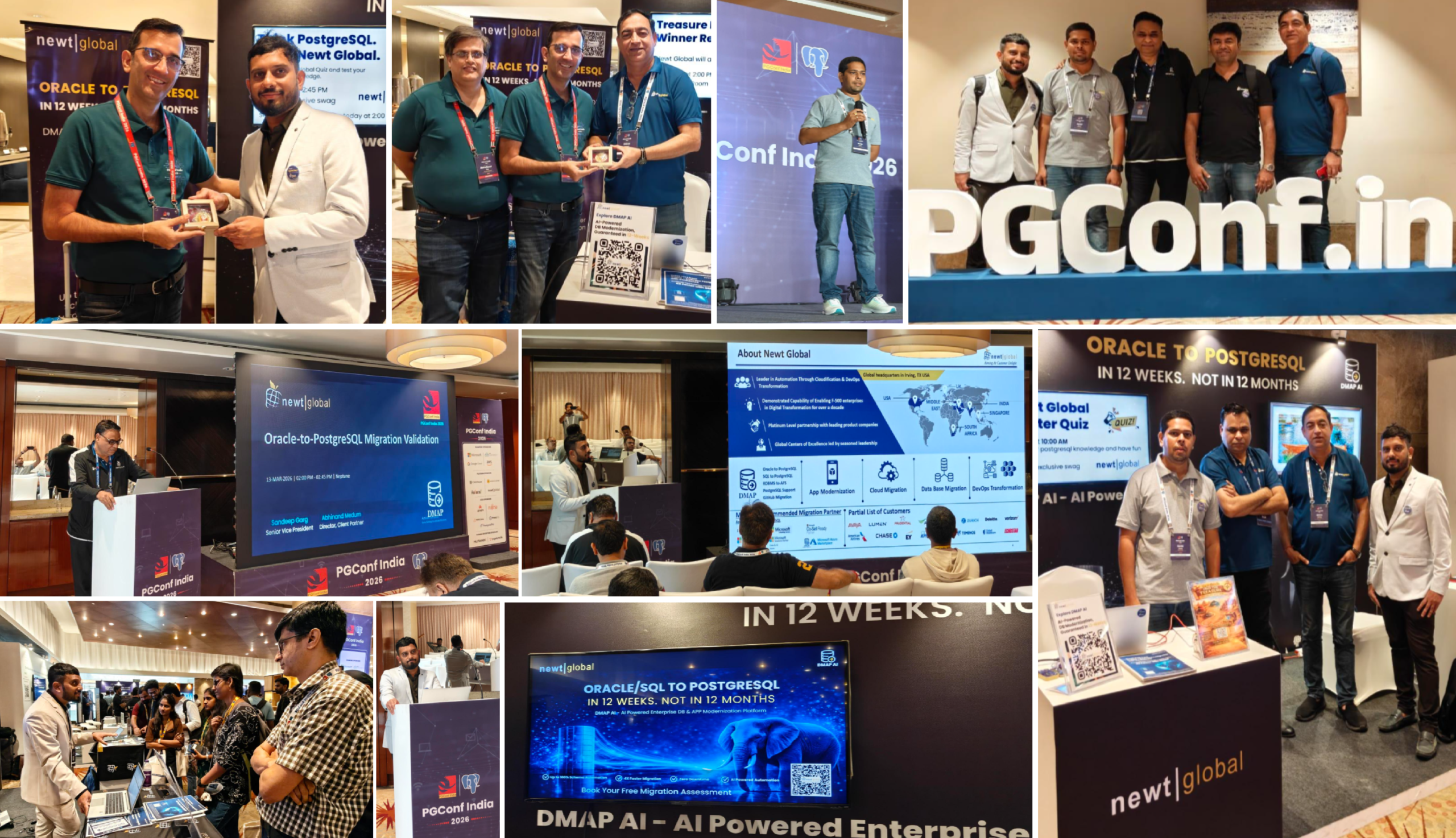
Day 1: Framing the Enterprise Modernization Challenge
Day 1 was largely about conversations—understanding where enterprises stand in their PostgreSQL journey.
Across discussions with architects and engineering teams, a consistent pattern emerged:
organizations are ready to move away from Oracle, but migration complexity continues to slow them down.
Enterprises today are dealing with:
- Large, deeply embedded Oracle databases
- PL/SQL-heavy business logic
- Interconnected application dependencies
- Lack of complete system visibility
Traditional migration approaches—manual or semi-automated—often introduce uncertainty. This is because Oracle-to-PostgreSQL migration is not a simple lift-and-shift exercise; it requires schema transformation, procedural logic conversion, and dependency alignment while maintaining functional and performance equivalence. Learn more about Oracle to PostgreSQL conversion with DMAP
Newt Global used these discussions to highlight a key idea:
Migration is no longer the challenge—confidence in migration is.
This set the stage for the main theme Newt Global would present on Day 2.
Day 2: The Core Presentation — Deterministic Modernization with DMAP-AI
The highlight of Newt Global’s participation came on Day 2 with the session:
“Deterministic Oracle-to-PostgreSQL Modernization: Verified Schema, SQL, and App Migration with DMAP-AI”
The session focused on addressing a fundamental gap in traditional migration approaches—lack of verifiability.
Why Traditional Approaches Fall Short
Most migration tools focus on converting database objects, but:
- They rely on approximations rather than deep analysis
- Validation is treated as a separate, manual phase
- Outputs may “look correct” but behave differently
This results in extended testing cycles, delays, and hesitation in production rollout.
DMAP-AI: A Structured and Verified Approach
Newt Global introduced DMAP (Database Modernization Acceleration Platform) as a solution designed to bring automation, intelligence, and validation together.
As described on Newt Global’s platform page, DMAP is an AI-powered system that automates the entire migration lifecycle—from discovery and assessment to final validation. Explore DMAP platform overview
Key capabilities highlighted include:
- End-to-end automation of schema conversion, data migration, and application transformation See how DMAP accelerates migration lifecycle
- Deep object-level analysis to eliminate guesswork and provide accurate migration insights Understand DMAP discovery and analysis capabilities
- Embedded validation frameworks to ensure correctness throughout the process Learn about DMAP validation approach
- AI-driven code transformation, including PL/SQL to PostgreSQL conversion Read about AI-powered code conversion in DMAP
Unlike traditional tools, DMAP does not treat migration as a one-time activity. Instead, it structures it into phases:
- Discovery and dependency mapping
- Automated transformation
- Continuous validation and testing
This approach ensures that the migrated PostgreSQL system is not just syntactically correct—but functionally reliable.
Business and Engineering Impact
The deterministic approach resonated strongly with conference attendees because it directly addresses enterprise concerns:
- Reduces manual effort and migration timelines significantly (up to ~80%) See how DMAP reduces migration effort
- Minimizes risk through validation and repeatability Explore enterprise-grade migration reliability
- Enables faster decision-making for production deployment
The key takeaway from the session was clear:
Enterprises don’t just need migration tools—they need trust in the outcome.
Day 3: Extending the Discussion — From Strategy to Execution
On Day 3, the focus shifted from presentation to deeper, practical conversations with attendees.
Newt Global engaged with organizations at different stages of their modernization journey—some exploring PostgreSQL, others already in migration phases.
The discussions revolved around real-world concerns:
- How to handle undocumented Oracle environments
- How to ensure application behavior remains unchanged
- How to reduce long validation cycles without increasing risk
These conversations reinforced the importance of combining automation with validation.
Reinforcing the Role of DMAP in Enterprise Transformation
Newt Global highlighted how DMAP addresses these challenges through:
- Complete visibility into Oracle environments via deep discovery and analysis Understand DMAP assessment capabilities
- Synchronized database and application migration, eliminating fragmented approaches Learn how DMAP unifies DB and app migration
- Automated validation and performance checks, ensuring production readiness Explore DMAP validation and testing
Additionally, DMAP’s AI-driven capabilities enable:
- Faster, context-aware code conversion
- Continuous improvement through learning from previous migrations
- Alignment with cloud-native PostgreSQL architectures Read how DMAP enables faster cloud-ready migration
The outcome is a migration process that is not only faster—but also predictable and repeatable.
Conclusion: From Migration to Confidence
Newt Global’s participation in PGConf India 2026 highlighted a critical shift in enterprise database modernization.
Across all three days, one message remained consistent:
- Migration is no longer just about automation
- Speed alone is not enough
- Enterprises need certainty, validation, and trust
With DMAP-AI, Newt Global is enabling organizations to move from Oracle to PostgreSQL with:
- structured transformation processes
- embedded validation
- measurable and reliable outcomes
As PostgreSQL adoption continues to grow, approaches like deterministic modernization will define how successfully enterprises transition to open-source data platforms.
Newt Global is proud to be part of this journey—helping organizations modernize not just faster, but with confidence.
Oracle to PostgreSQL Migration Validation: FAQs That Matter
1. What makes Oracle to PostgreSQL migration validation complex?
Oracle to PostgreSQL migration validation is complex due to differences in PL/SQL vs PL/pgSQL, data types, transaction behavior, and query execution. Even after schema conversion, ensuring business logic, stored procedures, and application outputs remain consistent requires multi-layered validation across data, logic, and performance.
2. What types of validation are required during Oracle to PostgreSQL migration?
Migration validation includes:
-
Schema validation (tables, indexes, constraints)
-
Data validation (row counts, checksums, consistency)
-
Functional validation (procedures, triggers, queries)
-
Performance validation (query plans, response times)
-
Transactional validation (ACID behavior, concurrency)
These layers ensure the migrated system is accurate, stable, and production-ready.
3. How does Agentic AI improve Oracle to PostgreSQL migration validation?
Agentic AI uses autonomous agents to automate validation tasks such as schema comparison, query testing, and anomaly detection. These agents work collaboratively to execute validation workflows, identify inconsistencies, and adapt to complex scenarios—reducing manual effort while improving accuracy and speed.
4. How does validation impact overall migration timelines?
Validation can account for up to 40–50% of the total migration effort. Inefficient validation slows down go-live timelines, while automated and AI-driven validation significantly accelerates migration by identifying issues early and reducing rework.
5. What are the risks of inadequate migration validation?
Inadequate validation can result in:
-
Data inconsistencies
-
Application failures
-
Performance degradation
-
Business logic errors
-
Production downtime
These risks can disrupt operations, impact user experience, and increase post-migration costs.