
Case Study: Hughes Oracle to AlloyDB Migration Using Striim Reverse CDC
Modern enterprises increasingly face the challenge of modernizing legacy database infrastructure without disrupting mission-critical applications. For organizations operating at a global scale, database migrations can be extremely risky, especially when the systems involved power revenue-generating digital platforms.
Hughes Network Systems, an EchoStar company, encountered this exact challenge when they decided to migrate their global e-commerce platform from Oracle Database to Google AlloyDB. The migration involved 1.8 TB of production data across nine countries, supporting a platform critical to the company’s global operations.
To execute this transformation safely and efficiently, Hughes partnered with Newt Global Consulting, implementing an advanced forward and reverse Continuous Data Capture (CDC) architecture using Striim. The solution ensured seamless data synchronization, near-zero downtime, and a reliable fallback mechanism throughout the migration process.
The outcome was not only a successful modernization effort but also the establishment of a new benchmark for large-scale enterprise database migrations.
About Hughes Network Systems
Hughes Network Systems, a subsidiary of EchoStar, is a global leader in broadband networking technologies. The company provides satellite networking equipment, managed services, and end-to-end network operations for millions of consumers, businesses, governments, airlines, and remote communities worldwide.
Hughes plays a critical role in the global connectivity ecosystem and supplies more than half of the global satellite terminal market to leading operators.
Because of the scale and importance of its services, the company relies heavily on highly reliable and high-performance IT infrastructure to support its digital platforms and operational systems.
Industry: Telecommunications
Primary Project Location: United States
Cloud Platform: Google Cloud Platform
The Business Challenge
Hughes operates a complex global e-commerce platform responsible for processing orders and managing customer transactions across multiple international markets. This platform is tightly integrated with various backend systems and is central to the company’s revenue generation and customer engagement strategy.
As Hughes began modernizing its data infrastructure, migrating from Oracle to Google AlloyDB presented several technical and operational challenges.
Mission-Critical System Requirements
The e-commerce application directly impacts revenue streams, operational workflows, and customer experience across several countries. Any downtime during the migration could disrupt business operations and negatively affect customers.
Large-Scale Data Migration
The migration involved approximately 1.8 terabytes of transactional data distributed across multiple regional deployments. Ensuring the accuracy and integrity of this data during the migration process was essential.
Risk of Downtime and Data Loss
Even minor inconsistencies or outages could lead to SLA violations, operational disruptions, and reputational damage. Hughes required a migration approach that guaranteed data consistency and operational continuity.
Need for a Reliable Rollback Strategy
One of the most critical requirements was the ability to quickly revert to the original Oracle environment if any issues emerged after the migration. This meant Oracle had to remain continuously synchronized with AlloyDB during the transition.
Limited Global Experience with Reverse CDC
While many organizations use CDC for forward replication during migrations, continuous reverse CDC implementations running for multiple days are rare globally, making this project technically complex and demanding.
The Migration Strategy
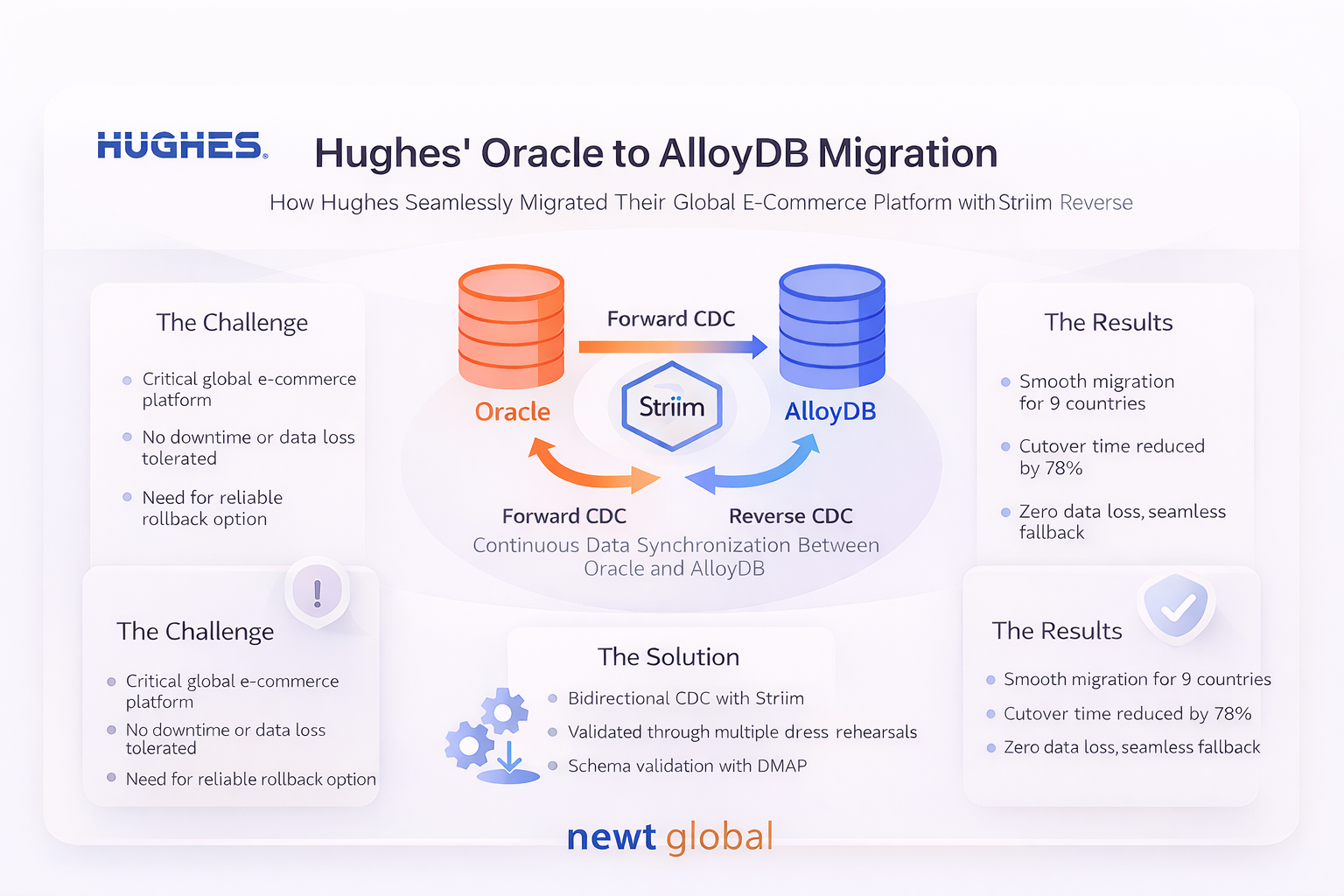
To address these challenges, Newt Global designed a robust migration strategy built around bidirectional Continuous Data Capture (CDC) using the Striim platform.
The architecture ensured that both the legacy Oracle database and the new AlloyDB system remained synchronized throughout the migration process.
This approach significantly reduced operational risk and provided Hughes with the ability to switch environments without losing data.
Learn more about Newt’s database migration services:
➡ https://newtglobal.com/database-migration-services/
The Solution: Forward and Reverse CDC with Striim
The migration architecture consisted of two key components: forward CDC and reverse CDC.
Forward CDC: Oracle → AlloyDB
The first phase involved continuously replicating transactional data from Oracle to AlloyDB using Striim’s CDC capabilities.
Forward CDC allowed the team to migrate data incrementally rather than relying on a traditional “big bang” migration approach.
This provided several benefits:
-
Continuous synchronization between databases
-
Reduced migration downtime
-
Real-time validation of the new AlloyDB environment
-
Minimal disruption to production systems
With forward CDC in place, AlloyDB received live updates while Oracle continued to run production workloads.
Reverse CDC: AlloyDB → Oracle
To ensure a reliable fallback mechanism, Newt implemented reverse CDC to replicate changes from AlloyDB back to Oracle.
This kept the Oracle database continuously updated with the latest transactions, effectively maintaining it as a warm standby environment.
Reverse CDC provided several advantages:
-
Immediate rollback capability if issues occurred
-
Continuous data synchronization between both systems
-
Reduced risk during migration cutover
-
Increased confidence for stakeholders and operations teams
By maintaining bidirectional synchronization, Hughes ensured either system could serve as the active database if necessary.
Implementation and Execution
Executing a migration of this scale required meticulous planning and rigorous testing.
Newt Global followed a structured approach that included multiple stages of validation before the final cutover.
Detailed Migration Planning
The team began by developing a comprehensive migration plan outlining:
-
Data replication workflows
-
Application dependencies
-
Failure scenarios and mitigation strategies
-
Rollback procedures
A RACI framework was also implemented to clearly define responsibilities across engineering, operations, and project stakeholders.
Multiple Migration Dress Rehearsals
Before executing the final migration, the team conducted several migration rehearsal cycles.
These rehearsals allowed the team to simulate real production scenarios and test the entire CDC pipeline.
The rehearsals helped validate:
-
Data synchronization accuracy
-
Application compatibility with AlloyDB
-
Cutover processes and timelines
-
Failover scenarios
One critical validation involved processing orders generated in AlloyDB through the Oracle application, confirming operational continuity between the two systems.
Schema and Data Validation with DMAP
To ensure complete data integrity, Newt used DMAP, its proprietary validation framework, to validate both schema structures and transactional data between the Oracle and AlloyDB environments.
Learn more about DMAP validation platform:
➡ https://newtglobal.com/dmap/
This ensured that:
-
Database schemas were consistent across both systems
-
No records were lost or corrupted during replication
-
Data quality remained intact throughout the migration
Final Cutover Execution
After multiple rounds of testing and optimization, the final migration cutover was executed using a carefully orchestrated process.
Because both databases were continuously synchronized through CDC, the cutover required minimal downtime, allowing Hughes to transition operations smoothly to AlloyDB.
The Results
The migration was completed successfully across all participating countries with minimal operational disruption.
Seamless Global Migration
All nine countries successfully transitioned their e-commerce platform databases from Oracle to AlloyDB while maintaining system availability and performance.
Dramatic Reduction in Cutover Time
Initial projections estimated the migration would require approximately 14 hours of downtime.
However, through repeated rehearsals and optimization, the team reduced the cutover time to just three hours, a remarkable achievement for a migration of this scale.
Risk-Free Migration
Because Oracle remained continuously synchronized through reverse CDC, Hughes maintained a fully operational fallback environment throughout the migration.
Establishing a New Migration Benchmark
The success of this project established a new gold standard for enterprise database migrations, particularly for organizations managing mission-critical workloads across multiple regions.
Customer Testimonial
The Hughes leadership team recognized the impact and technical expertise demonstrated during the project.
“The Newt team’s reverse CDC expertise has evolved to be on par with Striim’s own. Their end-to-end understanding is crucial for minimizing database migration risks for enterprise clients.”
— Mridul Malayanil, Vice President, Hughes Network Company
He also highlighted the significance of the 10-day reverse CDC implementation across multiple countries, noting that such complex implementations remain rare globally.
Why This Migration Matters
This project reflects several major trends shaping enterprise data infrastructure.
Cloud Database Modernization
Organizations are increasingly moving legacy systems to high-performance cloud databases such as AlloyDB to improve scalability, reliability, and operational efficiency.
Zero-Downtime Migration Expectations
Modern enterprises require migrations that avoid downtime and ensure continuous service availability.
Advanced CDC Architectures
Bidirectional CDC is becoming a key strategy for risk-free enterprise database migrations, particularly for mission-critical systems.
About Newt Global Consulting
Newt Global Consulting specializes in helping enterprises modernize applications and databases through cloud migration strategies.
Explore related services:
-
Database Migration Services
https://newtglobal.com/database-migration-services/ -
Cloud Migration Services
https://newtglobal.com/cloud-migration-services/ -
DMAP Platform
https://newtglobal.com/dmap/
The company focuses on delivering database and application migrations in half the time and cost compared to traditional approaches, supporting both homogeneous and heterogeneous migration scenarios.
Through deep expertise in cloud platforms, data replication technologies, and enterprise transformation, Newt Global helps organizations modernize their IT infrastructure with minimal operational disruption.
Conclusion
The Hughes Oracle-to-AlloyDB migration demonstrates how advanced migration architectures and meticulous planning can transform even the most complex enterprise database modernization initiatives into successful outcomes.
By implementing forward and reverse CDC using Striim, Newt Global enabled Hughes to:
-
Migrate 1.8 TB of mission-critical data
-
Maintain business continuity across nine countries
-
Reduce cutover time from 14 hours to just 3 hours
-
Ensure zero data loss and immediate rollback capability
The project stands as a compelling example of how the right combination of technology, strategy, and expertise can enable organizations to modernize their infrastructure without compromising operational stability.