
Case Study: Accelerating Legacy Modernization: Migrating Hughes Network Systems’ ECOM Platform from Oracle to AlloyDB in 12 Weeks
Enterprise modernization initiatives often face a common challenge: mission-critical legacy systems that are too complex and deeply integrated to migrate easily. For organizations operating large-scale enterprise applications, database migration is not just a technical upgrade—it is a strategic transformation that impacts operations, performance, and long-term scalability.
Hughes Network Systems, a global leader in networking technologies and managed network services, encountered this challenge when it decided to modernize its large-scale ECOM platform. The system relied on Oracle databases and consisted of millions of lines of legacy code, making migration to the cloud a complex undertaking.
By partnering with Newt Global and leveraging its DMAP platform along with the Cloud Migration Cockpit framework, Hughes successfully migrated its application and database environment from Oracle to AlloyDB on Google Cloud in less than 12 weeks—an achievement that accelerated its cloud modernization strategy.
About Hughes Network Systems
Hughes Network Systems is a Fortune 500 company recognized globally for delivering advanced networking technologies and managed network services. The company enables essential connectivity for businesses, governments, and communities around the world.
Hughes was recognized as a Leader in the 2023 Gartner® Magic Quadrant™ for Managed Network Services, reinforcing its leadership in network infrastructure and digital connectivity.
Industry: Telecommunications
Project Location: United States
Cloud Platform: Google Cloud Platform
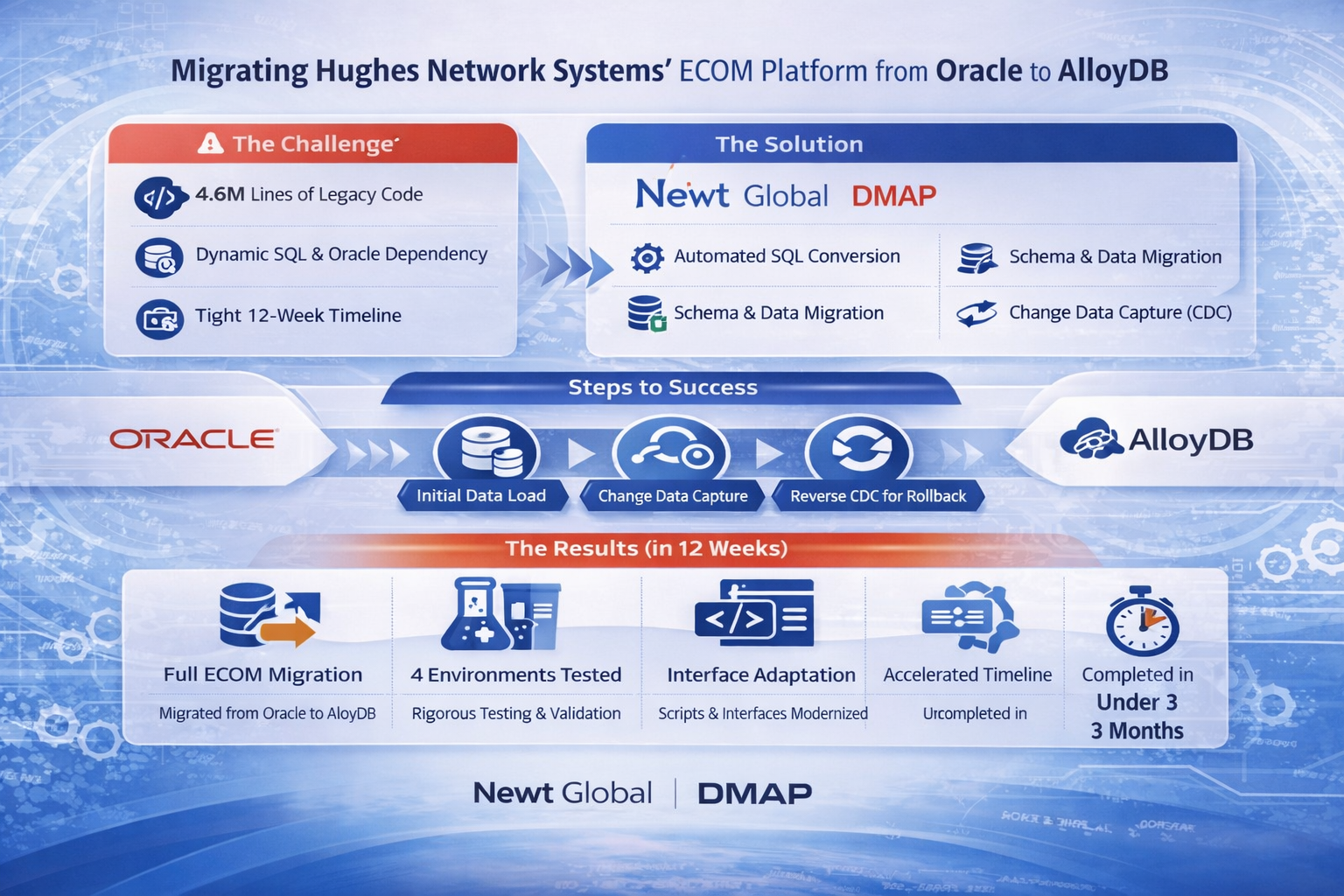
The Modernization Challenge
At the center of this initiative was Hughes’ ECOM platform, a large enterprise application responsible for critical operational processes.
The system architecture included:
-
4.6 million lines of legacy application code
-
Core services developed in Java and NodeJS
-
Deep integration with Oracle databases
-
Multiple supporting interfaces, shell scripts, and backend integrations
Migrating such a complex ecosystem to AlloyDB, Google Cloud’s PostgreSQL-compatible database, required careful planning and technical expertise.
Oracle-to-PostgreSQL Compatibility Differences
Although AlloyDB is PostgreSQL compatible, there are significant differences between Oracle and PostgreSQL SQL syntax, functions, and database behavior. These differences can introduce issues such as:
-
SQL syntax incompatibilities
-
Query failures during runtime
-
Performance inefficiencies
-
Data integrity risks
Even after initial manual code conversion, several SQL statements continued to produce runtime errors due to these differences.
Echostar Success Story final (3)
Dynamic SQL in Application Code
Another major obstacle was dynamic SQL embedded within the application codebase.
Unlike static SQL stored in database procedures, dynamic SQL is generated during runtime, which makes detection and conversion extremely challenging. Traditional migration tools often fail to identify or transform these queries effectively.
Massive Codebase Complexity
With 4.6 million lines of code, the application required extensive validation to ensure all database interactions, integrations, and services functioned correctly after migration.
This level of complexity required a highly automated migration strategy.
Tight Timeline
The project began in late June 2024, and the goal was to complete the entire migration—including remediation, testing, and production cutover—within approximately 12 weeks.
Distributed Teams
The migration required coordination across 40+ engineers and stakeholders operating across five global time zones, increasing the need for structured project governance and strong program management.
The Solution: Cloud Migration Cockpit Powered by DMAP
To address these challenges, Newt Global implemented its Cloud Migration Cockpit, a structured migration framework powered by the DMAP (Database Migration Acceleration Platform).
This approach provided a systematic, end-to-end migration path covering:
-
Database schema conversion
-
Data migration
-
Application remediation
-
Environment setup
-
Testing and validation
-
Production cutover management
Automated SQL Remediation
DMAP was used to identify and convert unresolved SQL statements embedded within the application code.
The platform helped:
-
Resolve Oracle-specific SQL syntax
-
Adapt queries to PostgreSQL-compatible structures
-
Correct dynamic SQL issues
-
Reduce manual remediation effort
This automation significantly accelerated the application remediation process.
Schema Conversion and Data Validation
The database migration involved transforming the Oracle schema into structures compatible with AlloyDB.
DMAP enabled:
-
Automated schema conversion
-
Validation of converted database objects
-
Data integrity verification during migration
This ensured that the AlloyDB environment replicated the original Oracle environment accurately.
Structured Data Migration and Cutover
The migration team designed a carefully controlled cutover strategy to ensure minimal disruption.
The process included three stages:
Initial Data Load
A full database migration transferred the existing Oracle data into AlloyDB.
Change Data Capture (CDC)
CDC mechanisms captured and synchronized ongoing changes from the Oracle database to the new AlloyDB environment.
Reverse CDC for Rollback
A rollback mechanism was implemented to ensure the ability to revert if required during the migration process.
This approach reduced operational risk during the transition.
Program Governance and Global Collaboration
Given the distributed nature of the team, program governance played a key role in ensuring successful delivery.
The project execution included:
-
Coordination across five global time zones
-
Continuous integration and testing cycles
-
Milestone-based project tracking
-
Dedicated focus on Go-Live readiness and Day-2 operational stability
This structured delivery model helped maintain momentum throughout the 12-week timeline.
The Results
Despite the scale and complexity of the migration, the project delivered exceptional outcomes.
The ECOM platform and its associated Oracle databases were successfully migrated to AlloyDB within 12 weeks, enabling Hughes to accelerate its cloud modernization journey.
Key Outcomes
Complete Application and Database Migration
The legacy ECOM system was successfully transitioned to AlloyDB with minimal disruption.
Rigorous Testing and Validation
The application was tested across four separate environments before production deployment.
Interface and Script Adaptation
Multiple supporting interfaces and shell scripts were modified to ensure compatibility with AlloyDB.
Accelerated Cloud Transformation
The migration timeline—from project kickoff to production cutover—was completed in less than three months.
Customer Testimonial
Mridul Malayanil, Senior Director of Cloud Solutions at Hughes Network Systems, described the collaboration as both challenging and rewarding:
“The team demonstrated their competence and commitment by working through weekends alongside our teams, helping us conquer what felt like Mount Midoriyama (as in American Ninja Warrior). Each stage was like a Ninja challenge, as we were all navigating it for the first time.”
He also emphasized the impact of the migration platform:
“DMAP achieved something no other tool in the market was doing.”
Driving Faster Cloud Modernization
Large-scale legacy migrations often take months or even years due to technical complexity and operational risk.
This project demonstrates how organizations can accelerate their modernization journeys through a combination of automation, structured frameworks, and expert collaboration.
With its DMAP platform and Cloud Migration Cockpit, Newt Global enabled Hughes Network Systems to modernize a mission-critical application in record time while ensuring operational stability.