
Application & Legacy System Modernization Services: A Complete Enterprise Guide to Modernizing Applications with Microservices Architecture
Enterprise technology landscapes are undergoing a profound transformation. Organizations across industries are rapidly adopting cloud-native platforms, automation frameworks, and AI-driven engineering practices to accelerate innovation. Despite these advancements, a large portion of enterprise workloads still operate on legacy systems built decades ago using monolithic architectures.
These legacy applications often remain critical to business operations. They power financial systems, supply chain platforms, healthcare applications, and many other enterprise workflows. However, as digital expectations evolve, legacy architectures increasingly become barriers to innovation. They are difficult to scale, costly to maintain, and challenging to integrate with modern digital ecosystems.
As a result, Application & Legacy System Modernization Services have become a strategic priority for enterprises pursuing digital transformation. Modernization initiatives allow organizations to evolve legacy systems into scalable, cloud-native architectures capable of supporting modern business demands.
Today, enterprises are not just migrating infrastructure—they are fundamentally transforming application architectures. Through approaches such as microservices architecture, DevOps automation, and cloud-native engineering, organizations are creating resilient platforms that enable continuous innovation.
Organizations exploring modernization strategies can learn more about enterprise application modernization frameworks and transformation approaches here:
https://newtglobal.com/app-modernization/
Platforms such as DMAP AI from Newt Global are helping accelerate this transformation by automating application discovery, modernization analysis, and migration orchestration. These capabilities allow enterprises to modernize large application portfolios while minimizing risk and operational disruption.
Understanding Application Modernization Services
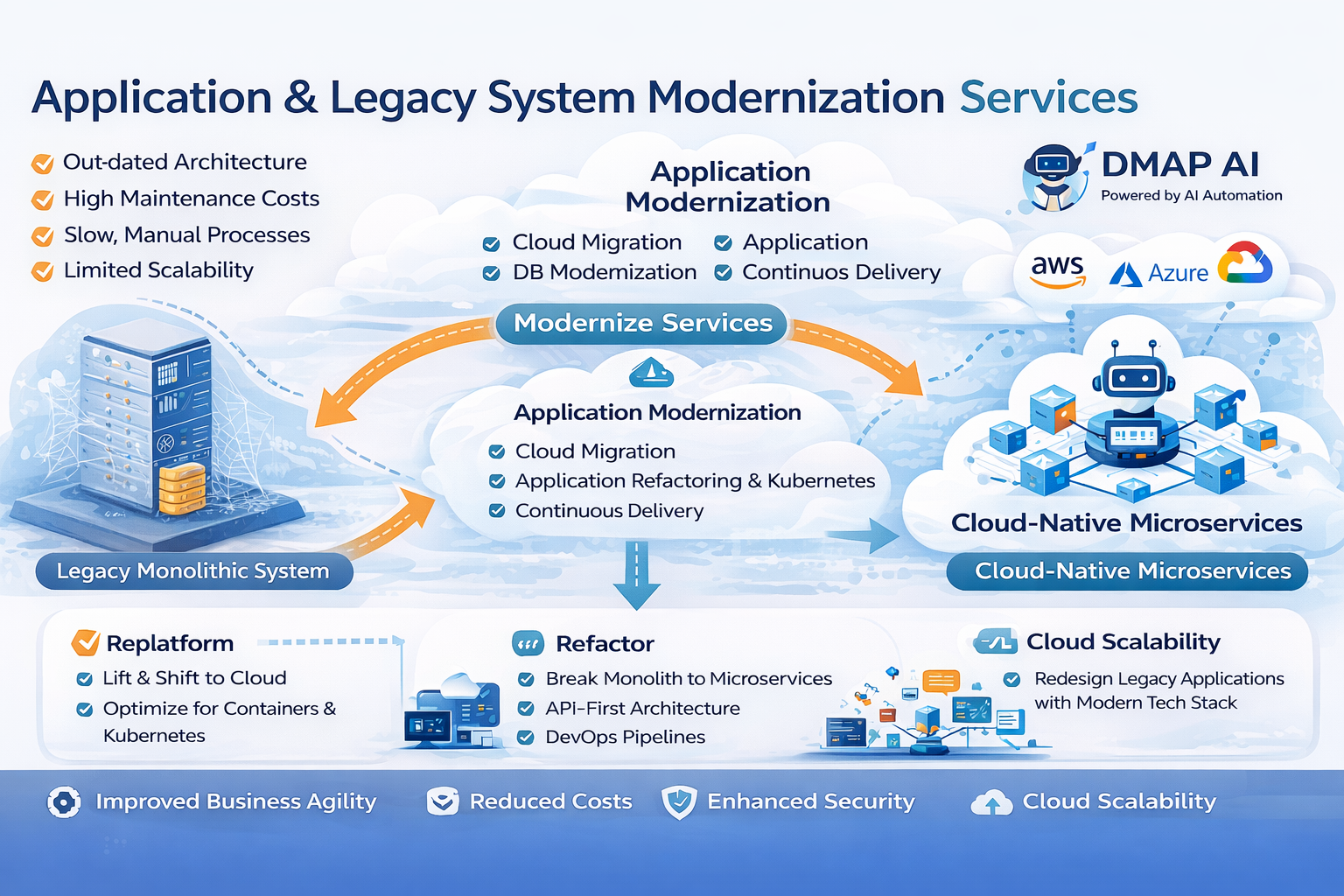
Application modernization refers to the process of transforming legacy enterprise applications into modern, scalable systems designed for cloud environments and distributed architectures. Rather than replacing entire systems, modernization focuses on evolving existing applications while preserving their core business logic.
This transformation often involves multiple technical strategies. Organizations may migrate applications from traditional on-premise infrastructure to cloud platforms, refactor legacy monolithic architectures into microservices, modernize underlying databases, and integrate DevOps automation pipelines to improve deployment efficiency.
Many enterprises pursuing modernization also evaluate cloud migration strategies and modernization roadmaps as part of broader digital transformation programs. More details on cloud migration services can be explored here:
https://newtglobal.com/cloud-migration-services/
The objective of modernization is not simply to upgrade technology stacks. Instead, it aims to create application ecosystems that support continuous innovation, high scalability, and seamless integration with modern digital platforms.
Through modernization, enterprises can reduce technical debt while enabling faster product development and improved operational resilience.
The Challenge of Legacy Systems in Modern Enterprises
Legacy systems are typically applications built using outdated technologies, frameworks, or infrastructure environments that are difficult to maintain and scale. Many of these systems were originally designed for static enterprise environments where business requirements changed slowly and infrastructure remained stable for years.
In today’s rapidly evolving digital economy, however, enterprises must continuously adapt to new market demands. Legacy architectures struggle to support these changes due to several inherent limitations.
Most legacy systems rely on monolithic architecture, where all application components are tightly coupled within a single codebase. This design makes it difficult to update or scale individual components without affecting the entire system. As applications grow more complex, development cycles become slower and operational risks increase.
Legacy platforms also frequently depend on proprietary technologies, creating vendor lock-in and increasing licensing costs. Integration with modern systems is often limited because many legacy applications were not built with APIs or distributed communication models in mind.
For organizations seeking to modernize legacy workloads, database modernization and platform transformation often play a critical role in enabling scalable architectures. Learn more about these modernization capabilities here:
https://newtglobal.com/database-modernization/
Why Legacy Application Modernization Has Become a Strategic Priority
Across industries, enterprise leaders recognize that legacy technology environments can significantly limit innovation. Research from Gartner suggests that a majority of enterprise applications will require modernization within the coming years as organizations pursue cloud transformation and digital innovation.
One of the primary drivers behind modernization initiatives is the need for business agility. Modern digital services require real-time data processing, API-based integrations, and scalable infrastructure capable of supporting unpredictable demand. Legacy architectures often lack the flexibility needed to support these capabilities.
Cost optimization is another major factor. Many legacy systems depend on expensive proprietary infrastructure and software licenses. By transitioning to cloud-native platforms and open-source technologies, organizations can significantly reduce operational costs while improving performance.
Security and compliance considerations also play an important role. Modern application frameworks include built-in security mechanisms such as encryption, identity management, and automated compliance monitoring. These capabilities help enterprises maintain stronger security postures while meeting regulatory requirements.
Finally, modernization enables faster software development. Traditional legacy systems often rely on manual deployment processes and infrequent release cycles. By adopting modern DevOps practices, organizations can automate testing, integration, and deployment, allowing teams to deliver new features much more rapidly.
Modernization Strategies for Enterprise Applications
Application modernization initiatives typically involve several architectural strategies depending on the complexity and business importance of each system.
One common approach is rehosting, often referred to as lift-and-shift migration. In this strategy, applications are moved from on-premise infrastructure to cloud platforms with minimal modifications. While this approach provides immediate benefits such as improved scalability and infrastructure availability, it does not fully leverage cloud-native capabilities.
A more advanced strategy is replatforming, which involves optimizing applications for cloud environments without significantly altering their architecture. This may include migrating databases to managed cloud services, containerizing applications using technologies such as Docker, or deploying workloads through Kubernetes orchestration platforms.
For deeper transformation, organizations often pursue application refactoring. This approach restructures legacy codebases to support distributed architectures and modern development practices. Monolithic systems are decomposed into smaller services that communicate through APIs, enabling independent scaling and deployment.
In some cases, legacy applications may be too outdated to modernize incrementally. Organizations may choose to rebuild these systems entirely using modern development frameworks. Enterprises evaluating modernization initiatives often combine application modernization with cloud-native migration strategies supported by specialized transformation platforms.
Microservices Architecture as the Foundation of Modern Applications
A key outcome of application modernization is the adoption of microservices architecture. Unlike monolithic systems, where all application components exist within a single codebase, microservices divide applications into smaller services that operate independently.
Each service performs a specific function and communicates with other services through APIs. This architecture allows development teams to build, deploy, and scale services independently, dramatically improving development agility and system resilience.
Microservices architectures are typically deployed using container technologies such as Docker and orchestrated through platforms like Kubernetes. These environments allow applications to scale dynamically while maintaining high availability across distributed cloud infrastructure.
Service mesh technologies and API gateways further enhance communication and observability within microservices environments, enabling enterprises to manage complex application ecosystems more effectively.
How DMAP AI Accelerates Application Modernization
Modernizing large enterprise application portfolios can be extremely complex. Many organizations operate hundreds or even thousands of legacy applications, each with unique dependencies and architectural challenges.
Manual modernization efforts often require extensive analysis, planning, and testing, which can significantly extend transformation timelines.
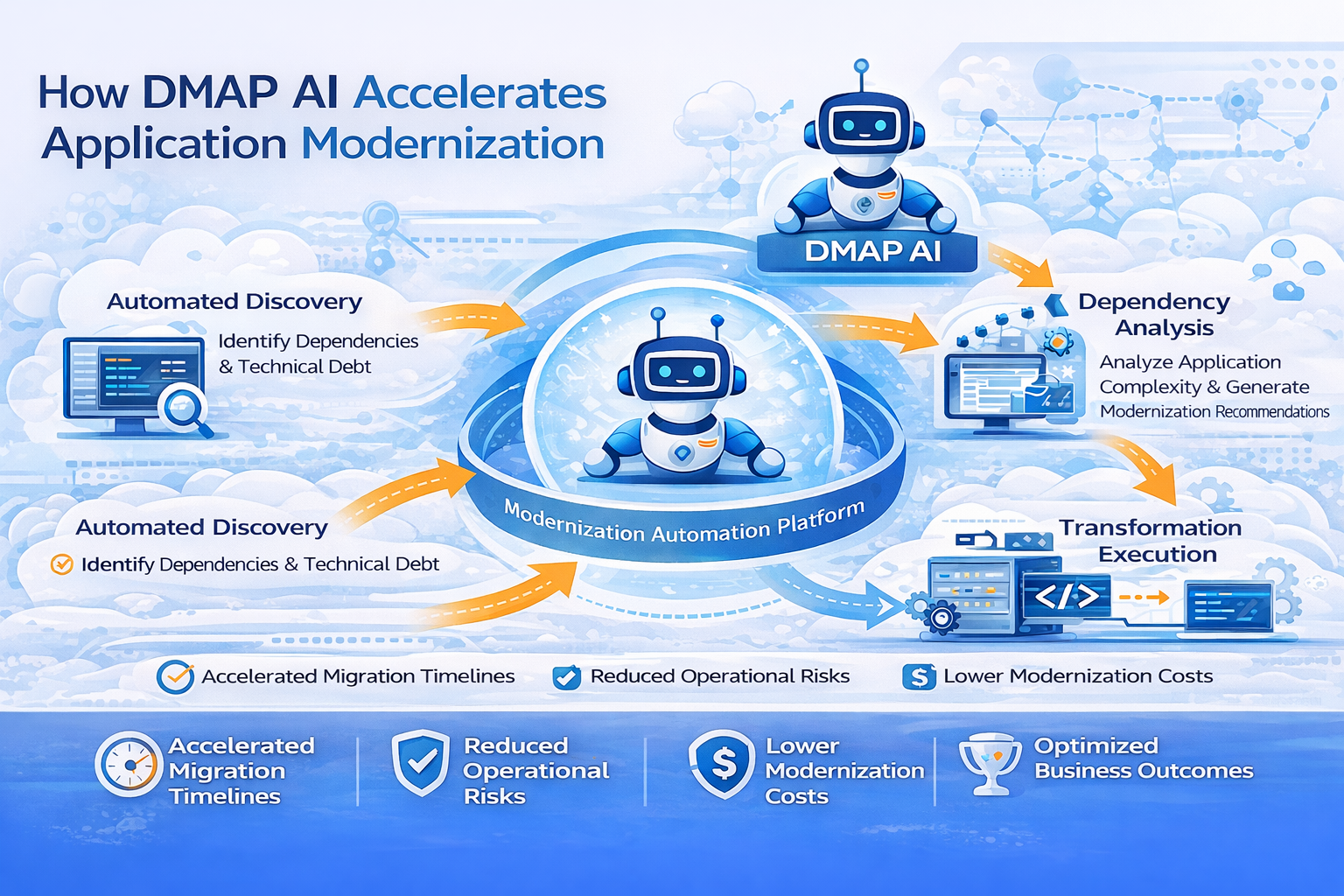
Automation platforms such as DMAP AI, developed by Newt Global, help address these challenges by introducing intelligent automation into the modernization process.
DMAP AI provides:
-
automated discovery of application environments
-
deep dependency analysis across code and infrastructure
-
transformation recommendations for modernization
-
automated migration planning and orchestration
-
continuous validation and testing capabilities
By leveraging AI-driven insights, organizations can quickly identify modernization opportunities, prioritize application transformations, and execute migrations more efficiently.
Explore the DMAP platform here:
https://newtglobal.com/dmap/
Enterprises adopting DMAP AI often combine the platform with cloud modernization and application transformation services to accelerate enterprise-scale modernization programs.
A Structured Framework for Enterprise Application Modernization
Successful modernization initiatives typically follow a structured transformation framework. The process begins with a comprehensive application portfolio assessment, where organizations evaluate technical dependencies, modernization readiness, and business importance across their application landscape.
Once assessment is complete, enterprises define a target architecture that supports modern development and operational models. This architecture often includes microservices, API-driven communication layers, and event-driven integration models.
Applications are then migrated to cloud platforms such as AWS, Microsoft Azure, or Google Cloud. Cloud infrastructure enables organizations to scale workloads dynamically while improving system resilience and availability.
Finally, organizations integrate DevOps automation frameworks to support continuous integration, continuous delivery, and automated testing. These capabilities ensure that modernized applications can evolve rapidly without compromising stability.
The Business Impact of Application Modernization
Enterprises that successfully modernize their application ecosystems experience significant improvements in both operational efficiency and business agility.
Modern architectures enable faster product development and deployment, allowing organizations to respond quickly to changing market demands. Improved scalability ensures that applications can handle sudden spikes in demand without performance degradation.
Operational resilience also improves because microservices architectures isolate failures within individual services rather than affecting the entire application. At the same time, modernization reduces technical debt and simplifies long-term maintenance.
Perhaps most importantly, modern applications enable organizations to deliver superior digital experiences to customers through real-time services, personalized interactions, and seamless integrations across digital channels.
Conclusion
Application and legacy system modernization has become a strategic imperative for enterprises seeking long-term competitiveness in a rapidly evolving digital landscape. Organizations that continue to rely on outdated architectures risk falling behind competitors who adopt cloud-native technologies and scalable digital platforms.
By embracing Application Modernization Services, implementing microservices architecture, and leveraging intelligent automation platforms such as DMAP AI, enterprises can transform legacy systems into resilient, future-ready application ecosystems.
Modernization is not simply a technology upgrade—it is a foundational step toward enabling enterprise agility, innovation, and sustainable digital growth
Frequently Asked Questions
What are Application Modernization Services?
Application Modernization Services help organizations transform legacy applications into modern, scalable systems using cloud-native technologies, microservices architecture, DevOps automation, and AI-driven platforms. These services enable enterprises to improve performance, reduce operational costs, and accelerate digital transformation.
What is Legacy System Modernization?
Legacy System Modernization refers to upgrading or transforming outdated enterprise applications, infrastructure, and databases into modern architectures that support cloud platforms, APIs, and distributed systems. The goal is to preserve core business functionality while improving scalability, security, and integration capabilities.
Why is Application Modernization important for enterprises?
Application modernization is essential for enterprises because legacy systems often limit scalability, innovation, and operational efficiency. By modernizing applications, organizations can adopt microservices architectures, cloud-native infrastructure, and automation tools that improve system performance, reduce technical debt, and enable faster product development.
What are the key approaches to Application Modernization?
There are several common approaches to application modernization, including:
-
Rehosting (Lift and Shift) – Moving applications to cloud infrastructure without major code changes.
-
Replatforming – Optimizing applications for cloud environments with minimal architectural changes.
-
Refactoring – Breaking monolithic systems into microservices to improve scalability.
-
Rebuilding – Rewriting legacy applications using modern frameworks and cloud-native architectures.
Each approach depends on the complexity and modernization goals of the organization.
What is Microservices Architecture in Application Modernization?
Microservices architecture is a modern application design approach where large monolithic applications are divided into smaller, independent services that communicate through APIs. This architecture allows organizations to scale applications more efficiently, deploy updates faster, and improve system reliability.
How does DMAP AI accelerate Application Modernization?
DMAP AI accelerates application modernization by automating critical transformation processes such as application discovery, dependency analysis, modernization planning, and migration execution. By using AI-driven insights, organizations can identify technical debt, analyze application complexity, and modernize legacy systems more efficiently with reduced operational risks.
Learn more about the platform here:
https://newtglobal.com/dmap/
What are the benefits of modernizing legacy applications?
Modernizing legacy applications provides several business and technical benefits, including improved system scalability, reduced infrastructure costs, faster software development cycles, enhanced security, and better integration with modern cloud platforms. These improvements enable organizations to deliver better digital experiences and innovate more rapidly.
What challenges do organizations face in legacy application modernization?
Common challenges in legacy modernization include complex system dependencies, outdated codebases, limited documentation, data migration risks, and potential operational downtime. These challenges can be addressed through structured modernization frameworks and automation platforms like DMAP AI that help reduce transformation risks.
How long does an application modernization project take?
The timeline for an application modernization project depends on factors such as application complexity, system dependencies, modernization strategy, and organizational readiness. Small modernization initiatives may take a few months, while large enterprise transformation programs involving multiple applications may take several phases over one to two years.
How do organizations choose the right Application Modernization partner?
Organizations should evaluate modernization partners based on their expertise in cloud architecture, microservices engineering, DevOps automation, migration frameworks, and AI-driven transformation platforms. A strong modernization partner should provide structured methodologies, automation capabilities, and proven experience in large-scale enterprise modernization projects.