
Zero Downtime Oracle to PostgreSQL Migration
Modern enterprises are under continuous pressure to modernize legacy database platforms. Oracle environments, while robust, often introduce high licensing costs, infrastructure rigidity, and vendor lock-in challenges. PostgreSQL offers flexibility, open-source innovation, and cloud-native compatibility — making it a strategic destination for modernization.
However, the true barrier is not technical capability.
It is operational risk.
For mission-critical systems, downtime is not an inconvenience — it is a business disruption.
Zero Downtime Oracle to PostgreSQL Migration enables enterprises to transition from Oracle to PostgreSQL while maintaining uninterrupted production availability. It transforms migration from a high-risk infrastructure event into a controlled, engineered modernization program.
This approach aligns directly with enterprise-scale Database Modernization initiatives:
👉 https://newtglobal.com/database-modernization/
The Enterprise Imperative for Zero Downtime Oracle to PostgreSQL Migration
Oracle databases frequently power:
-
Real-time financial transaction systems
-
Insurance policy processing engines
-
Telecom billing platforms
-
Manufacturing supply chain systems
-
Retail commerce infrastructures
These systems operate 24/7. Planned downtime windows are shrinking. Customer expectations and compliance requirements are tightening.
Traditional migration methods — export/import, backup-restore, offline schema conversion — introduce downtime proportional to database size. For large enterprise databases, that window may extend into hours or days.
Zero Downtime Oracle to PostgreSQL Migration eliminates extended outage risk by maintaining continuous synchronization between source and target systems until the exact moment of switchover.
This shifts migration strategy from reactive to engineered.
Explore structured Oracle modernization programs:
👉 https://newtglobal.com/oracle-to-postgresql-migration/
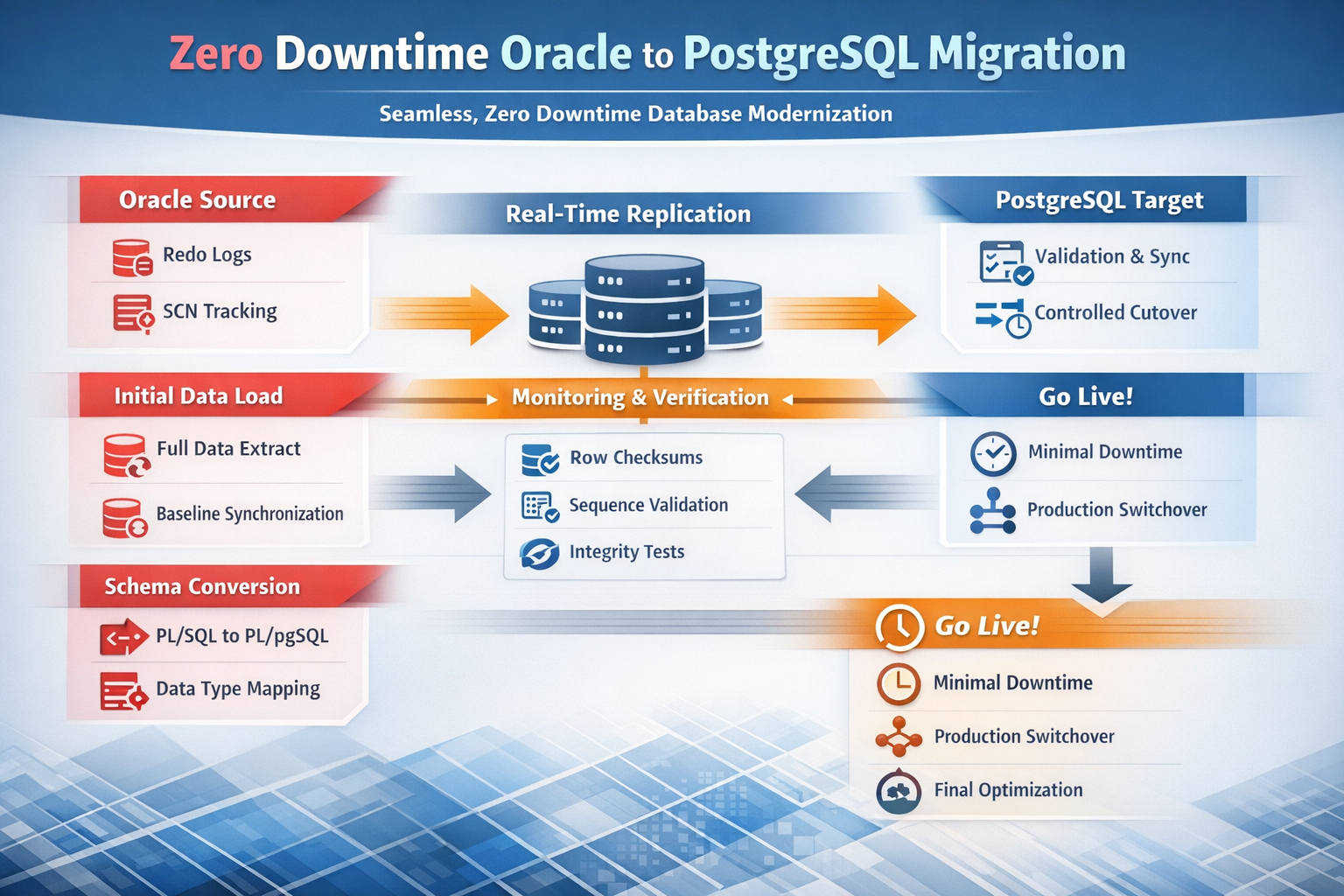
Deep Technical Architecture of Zero Downtime Oracle to PostgreSQL Migration
A successful zero downtime migration is built on four core technical pillars:
-
Log-Based Change Data Capture (CDC)
-
Deterministic Schema Transformation
-
Continuous Validation Framework
-
Controlled Cutover Orchestration
Let’s examine each layer in depth.
1. Oracle Source Engineering
The Oracle environment must be carefully prepared:
-
Enable supplemental logging
-
Ensure archive log retention
-
Monitor SCN (System Change Number) progression
-
Identify and remediate long-running transactions
Log-based CDC engines read directly from redo logs. This approach:
-
Avoids trigger overhead
-
Captures committed transactions only
-
Preserves commit-order sequencing
-
Minimizes production impact
Unlike application-level replication, redo-log mining guarantees transactional fidelity at the database engine level.
2. Baseline Data Migration Strategy
Before real-time replication begins, a full baseline snapshot must be established.
Technical best practices include:
-
Partition-wise parallel extraction
-
High-throughput ingestion using PostgreSQL COPY
-
Deferred index and constraint rebuild
-
Optimized WAL and checkpoint tuning
-
Isolation of bulk load from OLTP replication threads
At completion, PostgreSQL represents a consistent Oracle snapshot at a defined SCN boundary.
That SCN becomes the starting point for incremental replication.
3. Continuous Change Data Capture (CDC)
Once baseline synchronization is complete, CDC begins streaming incremental transactions in near real time.
Technical Guarantees of CDC-Based Zero Downtime Migration
-
Commit-order transaction replay
-
Atomic transaction reconstruction
-
Referential integrity preservation
-
Automatic rollback handling
-
Deterministic logical equivalence
Replication lag is continuously monitored through:
-
SCN delta tracking
-
Transaction queue depth
-
Apply throughput metrics
-
Network latency monitoring
For high-throughput systems, scaling strategies include:
-
Parallel apply workers
-
Memory buffer optimization
-
Adaptive batching
-
Logical decoding tuning
This ensures PostgreSQL remains within seconds of Oracle at all times.
4. Schema & Procedural Code Modernization
Zero Downtime Oracle to PostgreSQL Migration is not just about moving data — it is about transforming database behavior.
Data Type Mapping Considerations
-
NUMBER → NUMERIC or BIGINT
-
VARCHAR2 → VARCHAR
-
DATE → TIMESTAMP
-
RAW → BYTEA
-
CLOB/BLOB → TEXT/BYTEA
Procedural Refactoring Challenges
Oracle PL/SQL constructs must be carefully converted to PL/pgSQL while addressing:
-
Exception handling differences
-
Autonomous transactions
-
Cursor behavior
-
Package state management
-
Sequence generation logic
Large environments require automated dependency analysis and remediation planning.
This is where industrialized modernization platforms such as DMAP become critical.
Explore DMAP platform:
👉 https://newtglobal.com/dmap/
Validation: The Core of Zero Downtime Assurance
Zero downtime does not mean zero verification.
Enterprise validation frameworks include:
-
Row-level reconciliation
-
Checksum comparisons
-
Referential integrity validation
-
Sequence alignment checks
-
Business-rule validation queries
-
Application regression testing
Validation dashboards continuously measure equivalence between Oracle and PostgreSQL.
Only after deterministic parity is achieved does cutover proceed.
Controlled Cutover Engineering
The final switchover is an orchestrated engineering event:
-
Pause application write traffic
-
Allow CDC replication queue to fully drain
-
Confirm zero replication lag
-
Synchronize sequences
-
Redirect database endpoints
-
Resume production
In mature environments, downtime is reduced to minutes.
Rollback planning typically includes maintaining Oracle in read-only mode during stabilization windows.
Zero downtime is not accidental — it is architected.
Cloud-Aligned Zero Downtime Oracle to PostgreSQL Migration
Modern enterprises increasingly align migrations with cloud adoption strategies.
PostgreSQL targets can be deployed across:
-
AWS
-
Microsoft Azure
-
Google Cloud
Newt Global’s Database Modernization Acceleration Platform (DMAP) is available across cloud marketplaces, enabling streamlined deployment:
AWS Marketplace:
https://aws.amazon.com/marketplace/pp/prodview-dmap
Microsoft Azure Marketplace:
https://marketplace.microsoft.com/en-us/marketplace/apps/newtglobalconsultingllc1581492268566.dmap_vm_marketplace_offer?tab=Overview
Google Cloud Partner Profile:
https://cloud.google.com/find-a-partner/partner/newt-global-consulting-llc
This cloud ecosystem alignment ensures Zero Downtime Oracle to PostgreSQL Migration integrates seamlessly into broader transformation initiatives.
Post-Migration Performance Engineering
After cutover, PostgreSQL must be tuned for sustained performance.
Critical optimization areas include:
-
shared_buffers calibration
-
effective_cache_size tuning
-
work_mem adjustments
-
Autovacuum optimization
-
Index strategy review
-
Execution plan validation
Oracle and PostgreSQL optimizers differ significantly. Post-migration workload validation ensures performance parity or improvement.
Risk Mitigation Framework
| Risk | Mitigation Strategy |
|---|---|
| Long-running transactions | Pre-migration workload profiling |
| DDL changes during replication | Controlled DDL freeze windows |
| Replication lag spikes | Parallel apply scaling |
| Sequence mismatch | Pre-cutover synchronization |
| Performance regression | Production-scale benchmarking |
Zero downtime is achieved through disciplined engineering governance.
Strategic Outcomes
Enterprises implementing Zero Downtime Oracle to PostgreSQL Migration achieve:
-
40–70% Oracle licensing cost reduction
-
Elimination of vendor lock-in
-
Improved cloud portability
-
Enhanced HA/DR architecture
-
Lower long-term total cost of ownership
-
Accelerated modernization timelines
More importantly, modernization programs gain executive confidence once operational disruption risk is removed.
Conclusion
Zero Downtime Oracle to PostgreSQL Migration is not simply a replication technique — it is a structured modernization discipline built on log-based CDC, deterministic validation, engineered cutover planning, and automation-driven governance.
When executed correctly, it allows enterprises to modernize mission-critical Oracle estates without interrupting daily business operations.
Database transformation no longer requires operational compromise.
With the right architecture, execution model, and modernization platform, zero downtime becomes an engineered certainty — not an aspirational goal.