
Why data modernization stalls
Database modernization is not a simple database move. Schema, applications and interfaces all have to move with it.
Database features, procedural logic, database code and SQL embedded in applications must all be remediated and validated before they work on a cloud-native target such as PostgreSQL. That is where most programs slow down:
- Point solutions are fragmented. Most tools only convert developer code and miss the full lifecycle, including applications.
- Validation isn’t automated. Converted schemas and migrated data are hard to verify.
- Much of the work is still manual. Embedded SQL in applications, batch processes and shell scripts often have no tooling at all.
- Governance is weak. Changes and code merges are tracked by hand.
- There is no enterprise-grade integrated platform tying it all together.
Point tools combined with “AI slop” are slow and error-prone, and the outcomes are unpredictable.
Agentic AI in data modernization takes a different approach. Instead of a single conversion tool, a coordinated set of AI agents plans, converts, repairs and validates the work as one migration factory, with analytics and end-to-end observability. This guide explains how that works, using Newt Global’s DMAP AI platform as the example.
What is agentic AI in data modernization?
In DMAP AI, agentic AI means a team of specialist AI agents orchestrating the migration: a planner agent, a model router, and guidance, conversion, remediation and repair, and validation agents.
Together they deliver hyper-automation for legacy database modernization, working at scale across four stages:
- Discovery and assessment: database schema, database server and performance analysis, right-sizing of CPU, memory and disk, and embedded SQL in applications.
- Schema and application conversion: schema code objects and storage objects, database-native constructs, and embedded SQL in applications.
- Schema and application validation: primary and foreign keys, indexes, sequences, disabled triggers, permissions, and embedded SQL and data types in applications.
- Data migration and validation: test and production data, table row values and counts, arithmetic validation of numeric columns, and BLOB/CLOB validation.
Agentic AI vs generative AI for data migration
AI output on its own is not enough. Point tools combined with AI slop are slow and error-prone. Agentic orchestration adds grounded rules, deterministic validation and evidence.
|
Point tools + AI slop |
Agentic orchestration (DMAP AI) |
|
| Scope | Developer code conversion only | Discovery, assessment, schema conversion, application SQL remediation and validation |
| Accuracy | Error-prone, unpredictable outcomes | RAG-grounded rules, deterministic validators and side-by-side intent checks |
| Validation | Converted schema and data not validated automatically | Automatic validation of schema, data and integrity |
| Manual work | Embedded SQL, batch processes and shell scripts left to people | Application SQL remediation, with a copilot-integrated developer desktop for the rest |
| Governance | Changes and merges tracked by hand | Integrated Git for traceability, plus certification evidence |
| Result | Slow | About 80% less effort and 4x faster PostgreSQL onboarding |
How agentic AI works in database migration
Database and application code is ingested through a DMAP hook, worked on by an AI agent swarm, and returned as converted database and application code, supported by four layers underneath.
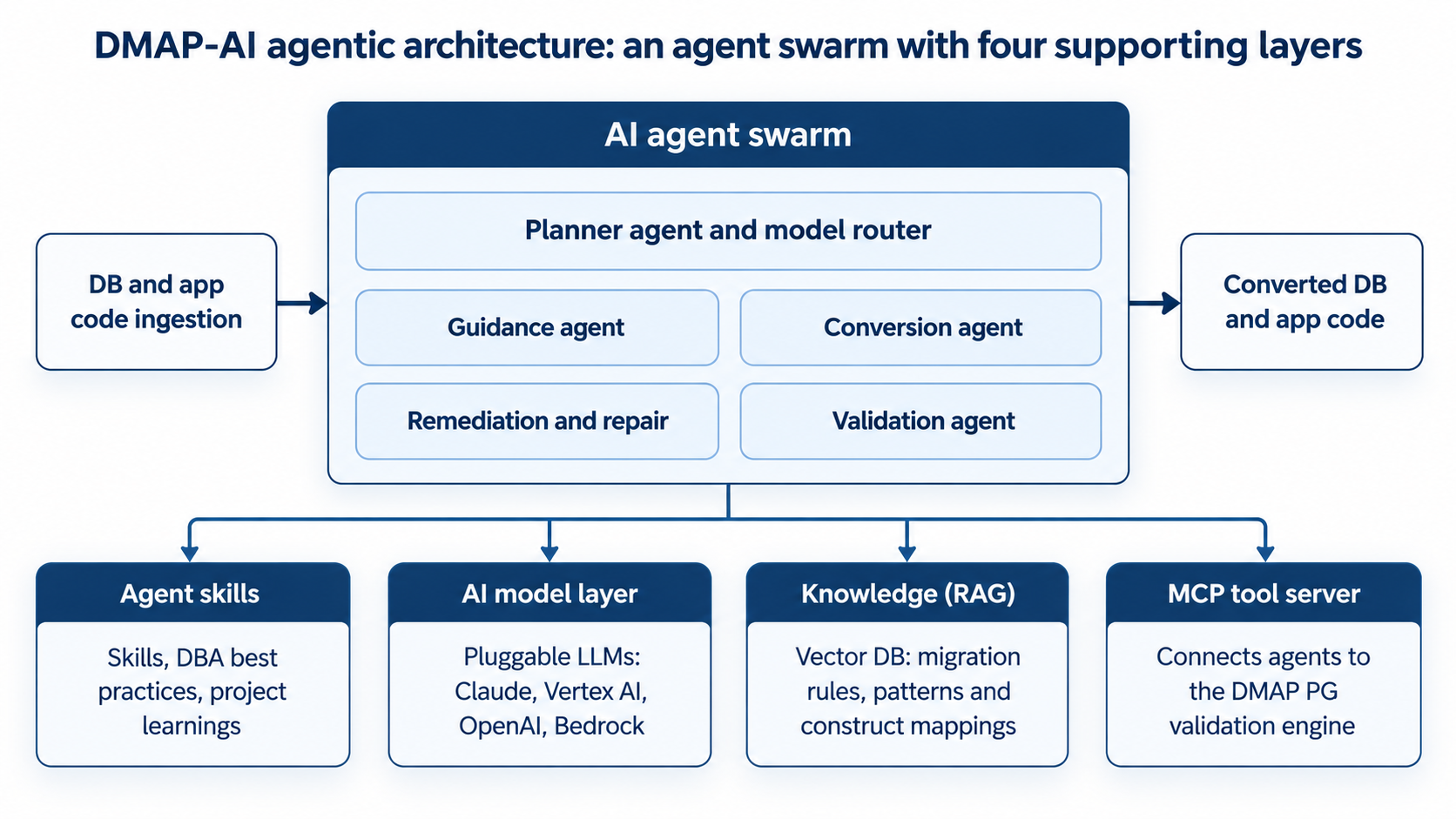
DMAP-AI agentic architecture
A multi-agent architecture for database migration
DMAP AI uses a multi-agent architecture for database migration, with the work orchestrated by an AI agent swarm:
- Planner agent and model router
- Guidance agent
- Conversion agent
- Remediation and repair agent
- Validation agent
The agents run discovery, assessment, conversion and validation at scale, with multi-threaded and parallel execution for faster migrations.
An agent skills layer gives them skills, DBA best practices and project learnings. An AI model layer keeps the LLM provider pluggable: Claude, Vertex AI, OpenAI or Bedrock.
RAG for database migration
The agents are grounded by a knowledge layer built on RAG. A vector database holds migration rules, patterns and construct mappings. The result is RAG-grounded rules, checked by deterministic validators and side-by-side intent checks.
MCP server database migration
An MCP tool server connects the agents to the DMAP PostgreSQL validation engine, so validation runs through DMAP’s own deterministic engine.
Where AI agents for data migration do the work
DMAP AI covers the whole journey, from discovery and assessment through conversion and validation, for applications, schemas, databases and batch processes.
1. Discovery, assessment and automated schema conversion
- Discovery: database infrastructure, database size, database objects and lines of database code.
- Assessment: code and data objects, remediation effort and TCO.
- Automated schema conversion: construct conversion with a conversion report, at about 90% automation.
At-scale assessment covers 1,000+ schemas and their applications at the same time. Teams get schema conversion effort, technical feasibility, migration cost and a business case with TCO and ROI before migration starts.
2. Embedded SQL remediation
Applications have to change along with the database. DMAP AI handles embedded SQL remediation in three steps:
- App discovery: checks source file validity across every tech stack and finds the files likely to contain SQL queries.
- App assessment: assesses embedded SQL in Java, .NET, C++ and other languages, covering static and dynamic queries, plus dead code analysis.
- App conversion: ORM-neutral remediation of static and dynamic queries, with mapping of data type changes and object name changes.
Interfaces get the same treatment: shell scripts, jobs, reports and ETL pipelines.
3. Data migration validation
Every stage is validated automatically, and DMAP produces reports in PDF or Excel:
- Schema validation: tables, columns, default values, nullable columns, primary and foreign keys, indexes, triggers and sequences.
- DB object lineage: maps each object’s name in the source and target and reports any that changed.
- Data migration validation: compares row counts and flags discrepancies. It also compares the minimum, maximum, average and sum of numeric columns, and compares data rows to find mismatches.
The output is certification evidence for schema, data, code intent, testing and cutover readiness.
Keeping humans in the loop
DMAP automation covers 70% to 95% of the work, and Newt Global’s professional services cover 15% to 30%.
For what isn’t automated, DMAP Desktop (developer experience with AI assist) turns the last mile into a governed execution layer:
- Schema exceptions and embedded SQL findings become developer-owned remediation queues.
- Database and application teams work in one controlled delivery model.
- Team leads upload remediation workbooks, map source branches and assign work centrally.
- Each developer works in a synced local Docker container connected to the master backlog.
- Side-by-side review, remediation and validation come with AI assist.
- Git integration provides systematic review and approval of manual remediation.
- Standard lifecycle states, file-level ownership and direct check-in create a clean audit trail.
- Daily progress is captured automatically, for the team and for each person.
The result is visibility, accountability and scale.
Agentic modernization in practice
Two DMAP customer stories show the results.
A leading insurance company wanted to modernize its 20+-year-old, business-critical reinsurance platform to PostgreSQL on Azure, moving from IBM WebSphere to Tomcat on Azure Kubernetes Service (AKS). The system ran 210+ database-heavy batch programs for premium and claim calculations. The new system had to perform as well as or better than the old one and save at least USD 100K a year.
- DMAP migrated the schema to PostgreSQL and converted procedural SQL embedded in Java code and shell scripts to PL/pgSQL.
- DMAP migrated 3.7 TB of data.
- Premium and claim calculations matched the existing system to six decimal places.
- Performance improved by 30%: 19 million records were processed for premium calculation within the 10-hour window.
- The company saves about USD 150K a year in licensing costs.
A large enterprise’s ECOM platform was stuck: a monolith with 700+ tables, 200+ orphaned database objects and over 1 million lines of entangled logic. The team had spent 10,000+ hours on application remediation, manually converting 4.6 million lines of Java, and 90% of test cases were still failing. Old and new platform costs were running in parallel, giving negative ROI.
- Newt Global introduced its CMC framework, with a 12-week program from development through SIT to production cutover.
- DMAP delivered end-to-end automation across assessment, schema conversion and validation, data migration and validation, and application remediation.
- DMAP’s code merge utilities cut merge effort from 49 person-days to under 10.
- IT teams used one integrated tool instead of four or five.
- Results: 50%+ less manual effort, 30% to 50% lower migration cost, and a timeline cut from 32–52 weeks to 12 weeks.
How Newt Global puts this to work: DMAP AI
The Newt Triad brings three things together, with war-room-style program management:
- Cloud Migration Cockpit (CMC™): the most comprehensive migration scoping, end to end, from one-click assessment to production go/no-go and post-production optimization.
- An integrated, deterministic platform with the highest actual automation across database code conversion, data migration, application remediation, and schema and data validation.
- Engineering-led execution.
The result: about 80% less time and effort, 4x faster onboarding, and 12 months to 12 weeks to production for a mid-size database and application.
Frequently asked questions
How does agentic AI work in database migration?
In DMAP AI, database and application code is ingested and handled by an AI agent swarm: a planner agent and model router, plus guidance, conversion, remediation and repair, and validation agents. The agents draw on agent skills, pluggable LLMs and a RAG knowledge layer. Validation runs through the DMAP PostgreSQL validation engine via an MCP tool server.
What is the difference between agentic AI and generative AI in data migration?
Point tools combined with AI slop are slow and error-prone, with unpredictable outcomes. Agentic orchestration in DMAP AI adds RAG-grounded rules, deterministic validators, side-by-side intent checks and certification evidence.
Which stages of a migration do the agents cover?
Discovery and assessment, schema and application conversion, schema and application validation, and data migration and validation, all at scale.
Can AI agents fully automate a database migration?
DMAP automation covers 70% to 95% of the work, and Newt Global’s professional services cover 15% to 30%. The rest goes to developers through DMAP Desktop, with AI assist, Git-based review and approval, and an audit trail.
How does DMAP AI keep AI output accurate?
Through RAG-grounded rules, deterministic validators and side-by-side intent checks. Every stage produces certification evidence for schema, data, code intent, testing and cutover readiness.
What is embedded SQL remediation?
It’s fixing SQL inside application code so it works on the new database. DMAP assesses embedded SQL in Java, .NET, C++ and other languages, including static and dynamic queries and dead code. It then applies ORM-neutral remediation and maps data type and object name changes.
What is RAG in database migration?
In DMAP AI, the knowledge layer is built on RAG: a vector database of migration rules, patterns and construct mappings that grounds the agents’ work.
What role does an MCP server play in database migration?
In DMAP AI, an MCP tool server connects the agents to the DMAP PostgreSQL validation engine.
Which AI models does DMAP AI use?
The LLM provider is pluggable: Claude, Vertex AI, OpenAI or Bedrock.
How is data validated after a migration?
DMAP compares row counts between source and target and flags discrepancies. It also compares the minimum, maximum, average and sum of numeric columns, compares data rows to find mismatches, and validates BLOB/CLOB columns.
What reports does DMAP produce?
Assessment reports (schema discovery, schema conversion assessment, consolidated assessment summary, database performance metrics, application SQL remediation assessment, and one-time migration and cost reports with a TCO/ROI summary). Validation reports (schema validation, DB object lineage and data validation). Reports come in PDF and/or Excel.
How long does an agentic data modernization take?
With DMAP AI and the CMC framework, a mid-size database and application can go from 12 months to 12 weeks to production, with about 80% less time and effort.
The migration that thinks for itself
With DMAP AI, the agent swarm handles assessment, conversion, remediation and validation at scale. RAG grounding and deterministic validation keep the output accurate, and DMAP Desktop keeps engineers in control of the last mile.
The outcome is automation, analytics, assurance and adaptability: about 80% less time and effort, and production in 12 weeks instead of 12 months for a mid-size database and application.
Book a DMAP AI assessment to see your schemas, applications, conversion effort and business case with TCO and ROI.